Google's New Frontier Model Gemini 4 Carbon: A New Revolution in Cybersecurity and Coding
Google DeepMind's most powerful AI model capable of finding and fixing complex software flaws without stopping for long periods has been introduced.

In the world of artificial intelligence, until now models were limited to chatting or writing simple essays, but now Google has pushed the boundaries of AI capabilities to a new level. On October 28, 2026, Google DeepMind announced its most powerful frontier model, Gemini 4 Carbon. According to Google, this new model has been created specifically to achieve unprecedented success in programming coding, autonomous agentic tasks, and cybersecurity defense. This model is based on Gemini 4 Argon, which was released just two weeks ago, and provides a direct example of how quickly the company is developing its capabilities.
The most talked-about topic in the technology world right now is that Gemini 4 Carbon has reached the number one spot worldwide with a score of 59 on the Artificial Analysis Intelligence Index v5.0. According to a report by The Verge, this model has surpassed heavyweight rivals like OpenAI's GPT-6 Astra and Anthropic's Claude Opus 5.5 in several key metrics. While ordinary chatbots stop after a few minutes of processing, this model can keep working on complex engineering problems continuously for days.
Historic Leap in Cybersecurity
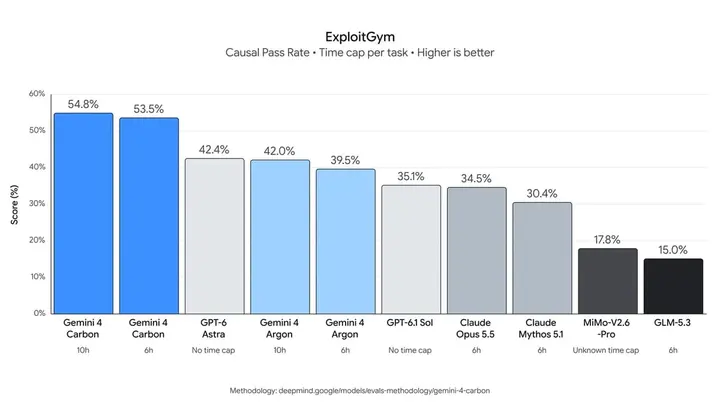
In the digital world, new security vulnerabilities are created every day, and finding them and fixing them on time has remained the biggest challenge for security agencies. Gemini 4 Carbon delivers extremely high accuracy across the entire lifecycle of cyber defense. According to the company's report, in SEC-bench Pro, the international benchmark for finding software flaws, this model has secured a clear lead by achieving a massive score of 88.2%. In addition, it achieved a score of 54.8% in ExploitGym for system security verification and 71.0% on CWE-bench for bug fixing, i.e., patching.
Google's internal Chrome browser team has noted that when it comes to creating high-quality security patches (patch: a piece of code fixing a flaw), Carbon delivers results 10 times better than large frontier models from other competing labs. Furthermore, compared to the previous Argon model, it achieves twice the success in generating secure code. Leading cloud security platform Wiz has also noted that this model has topped benchmarks in web penetration testing (web penetration testing: a method of checking security by attacking a website).
Long-Horizon Engineering: An Agent Working Continuously for Days
Ordinary AI models stop after answering a single question, but Gemini 4 Carbon has been designed for the long horizon (long horizon: complex tasks running over a long period). When there is a very deep and ambiguous bug in software, this model tries different paths like a senior software engineer. If a path appears closed, it finds other solutions without losing heart and rests only after finding the root cause. Google's internal teams have observed that this model can solve flaws present in complex databases and systems by running continuous processing for days.
- 1. Scanning and Finding FlawsThe model analyzes complex codebases of millions of lines and automatically discovers hidden security flaws.
- 2. Validation and ExploitationIt creates a proof-of-concept to verify whether the discovered flaw can actually cause damage to the system.
- 3. Secure Patch CreationIt prepares a secure software patch that permanently closes the flaw without breaking the original system.
- 4. Continuous Automated VerificationIt tests the new patch in a rigorous environment, making it suitable for immediate deployment in the system.
In the field of web development too, the model has delivered an impressive performance. On WebDev Arena, which is considered a competition for building full-stack websites, this model reached the fourth spot globally with a score of 1768, backed by a surge of 89 Elo points. It can easily analyze complex web architectures and code. Most importantly, for developers working in Google's internal environment, it has halved the probability of generating wrong answers or hiding errors, allowing programmers to trust its results much more.
Pricing and Marketing Strategy
Google has also announced the pricing structure for this cutting-edge model. To attract users, an introductory price has been applied initially, which has been kept the same as the price of Gemini 4 Argon. A rate of $2 per million input tokens (token: a small part of a word or letter) and $10 per million output tokens has been set for this model. Moreover, if the data is pre-cached (cached: stored frequently used data), a massive 95% discount will apply to its input tokens. However, after the initial term ends, this price will increase to $4 per million for input and $20 for output.
| Token Type | Initial Price | Regular Price |
|---|---|---|
| Input Token (Per Ten Lakhs) | $2 | $4 |
| Output Token (Per Ten Lakhs) | $10 | $20 |
| Cached Input Token | 95% Discount | - |
| Time Period | Input Token Rate (Per 1 Million) | Output Token Rate (Per 1 Million) |
|---|---|---|
| Initial Introductory Price | $2 | $10 |
| Regular Price (After Offer) | $4 | $20 |
To train this model, Google has used its custom-built Tensor Processing Units (TPUs: processors built specifically for AI). The Gemini family originally started at the Google I/O event in May 2023, and its first version was launched in December 2023. Now this fourth-generation Carbon model possesses multimodal (multimodal: the power to understand text, voice, images, and code together) capabilities along with the facility of continuous monitoring of its thought process.
Security, Controls, and the Fairwind Program
A cyber model possessing such tremendous capability could wreak havoc in the digital world if it falls into the wrong hands. Considering this risk, Google has adopted an extremely cautious approach this time. The company is not handing over this model directly to general consumers or public developers. First, this model is being evaluated under the US government's voluntary pre-release model testing process.
In the initial stage, this model will be provided only to selected cybersecurity experts and trusted partners of Google's Fairwind Program. Started in September 2026, the Fairwind Program connects more than 650 leading organizations, government agencies, and security companies worldwide. The goal of this program is to protect government departments, hospitals, and public services from cyberattacks. More than $100 million in global cybersecurity funding has been allocated so far through Google.org, out of which $36 million has been given to 35 cyber clinics in America, enabling the protection of over 1250 hospitals and schools.
- 1. Autonomous DiscoveryThe model automatically discovers hidden security flaws and bugs present in complex codebases.
- 2. Continuous AnalysisLike a senior engineer, it solves complex problems for days by trying different paths.
- 3. Patch CreationFinding the root cause of the flaw, it prepares a secure and ready-to-use code patch.
What This Means for Ordinary Citizens and India
In a vast digital country like India, where crores of people use UPI, banking, and government portals every day, the arrival of such security models is a huge relief. Most cyberattacks happen due to old software vulnerabilities because it is impossible for humans to manually check millions of lines of code. Autonomous models like Gemini 4 Carbon will keep defenders one step ahead of attackers. Whenever a new virus or security hole surfaces, AI will be able to prepare a solution in minutes and secure servers nationwide.
Google's announcement confirms that future software development will not be driven solely by humans, but by a partnership of humans and constantly vigilant AI agents. When the Carbon model, currently under a strict security shield, becomes available to general businesses and developers in the coming months after gathering feedback, a new era of productivity and security will begin in the software industry.