Revolutionizing the World of Computer Vision: How Do Convolutional Neural Networks (CNNs) Work?
Inspired by the visual processing of the human eye and brain, CNN technology is charting a new course for artificial intelligence by interpreting digital images.

In today's modern era of Artificial Intelligence (AI), when a smartphone unlocks by recognizing your face, or an autonomous car identifies traffic signals and pedestrians on the road, a remarkable technology called Convolutional Neural Network (CNN) is at work behind it. CNN is a specific type of feedforward neural network that uses the optimization of filters or kernels to learn specific features from data. In the field of computer vision, which gives computers the ability to understand images and videos, CNN is considered the gold standard.
Although new technologies like Vision Transformers have replaced CNN in some areas in recent times, the dominance of CNN in digital image processing remains intact. The use of this technology is not limited to just recognizing images. Today, CNN is being widely used in many complex fields such as image and video recognition, image classification, medical image analysis, image segmentation, recommender systems, Natural Language Processing (NLP), brain-computer interfaces, and financial time series analysis.
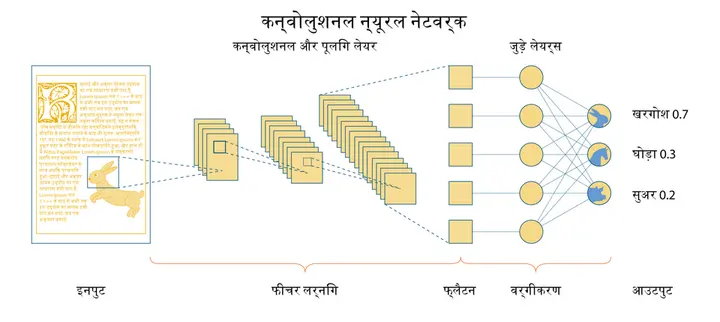
- 1. Image input and tensor creationThe image is entered into the network in the form of a mathematical tensor containing its height, width, and color channels.
- 2. Convolution and ReLU activationSmall filters slide over the input to obtain dot products and create feature maps.
- 3. Data compression via pooling layerDimensions are reduced by retaining important details using max or average pooling.
- 4. Fully connected layer and classificationAll data is flattened to obtain the classification result at the final level.
Limitations of traditional networks and the emergence of CNN
In the early stages of computer vision, traditional artificial neural networks were used. These networks were of the fully connected type, where every neuron in one layer was connected to all the neurons in the next layer. Due to this full connectivity, the volume of calculations in the network would increase exponentially. For example, if a small image of only 100 × 100 pixels were to be processed, 10,000 weights would be required for each neuron in the second layer. When dealing with large and high-quality images, the number of these neurons would reach into the billions, causing a depletion of the computer's memory and processing power.
Furthermore, in traditional networks, serious problems like vanishing gradients and exploding gradients would occur during the backpropagation process during training. Apart from this, there was also the problem of overfitting due to excessive reliance on data. To overcome these limitations, the CNN architecture was developed. In CNN, weight sharing is performed using filters. If a convolution process is performed on a 5 × 5 size tile, only 25 weights are required per layer. This leads to an extraordinary reduction in computation.
Biological inspiration: Human vision and the Hubel-Wiesel discovery
The architecture of a CNN is inspired by the biological processes of the visual cortex in the human and animal brain. In the 1950s and 1960s, scientists David Hubel and Torsten Wiesel conducted research on the visual cortex of cats. They demonstrated that specific neurons in the brain respond only to specific small parts of the eye's visual field. This small, limited part of the visual field is called a receptive field. The receptive fields of different neurons partially overlap with each other to cover the entire visual field.
In their 1968 research paper, Hubel and Wiesel identified two main visual cell types in the brain: simple cells, which recognize straight edges with specific orientations; and complex cells, which have larger receptive fields and can recognize edges without depending on their specific location. Subsequently, in 1969, Kunihiko Fukushima introduced a multilayer visual feature detection network inspired by this, which became the foundation of convolutional networks.
વજનની સંખ્યા
Internal Structure and Main Layers of CNN
Mainly, a CNN architecture consists of three types of layers: input layer, hidden layers, and output layer. Hidden layers include convolutional layers, pooling layers, and fully connected layers. When an image is fed into a CNN, it is taken in the form of a mathematical tensor, the size of which is (number of inputs) × (height) × (width) × (color channels).
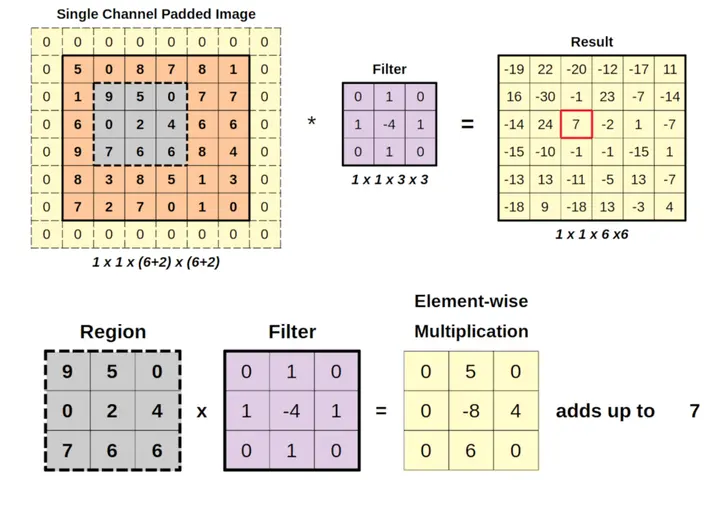
The Convolutional Layer is the heart of a CNN. In this layer, a dot product is calculated between the convolution kernel (filter) and the input matrix. This process is called the Frobenius inner product. The result is then passed through an activation function such as ReLU (Rectified Linear Unit). As the filter slides across the entire image, it creates a feature map or activation map. This layer performs the task of identifying the primary edges, colors, and shapes of the image.
To speed up processing, depthwise separable convolutional layers are also used instead of standard convolutional layers, in which depthwise convolution and pointwise (1 × 1 kernel) convolution are used separately. This technique reduces computation time.
Importance of Pooling and Fully Connected Layers
After the convolutional layer, the data is sent to a pooling layer. The primary purpose of the pooling layer is to reduce the mathematical dimensions of the feature map. This process typically utilizes small 2 × 2 clusters. There are two main types of pooling: Max Pooling and Average Pooling. In Max Pooling, the maximum value is taken from the selected small segment, whereas in Average Pooling, the average of all values is calculated.
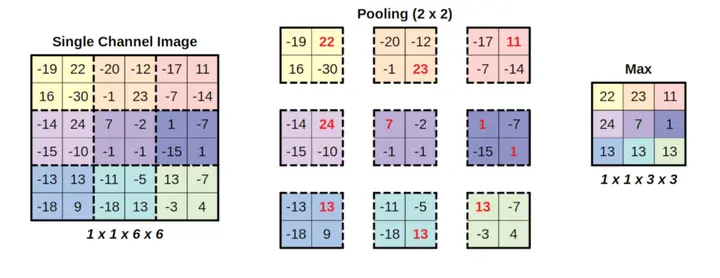
This process simplifies data computation and makes the network robust against minor variations in an image. Following this, there is the Fully Connected Layer. All the feature maps obtained up to this point are flattened into a one-dimensional vector, resembling a straight line. In this layer, all neurons are interconnected, functioning much like a traditional Multi-Layer Perceptron (MLP), which provides the final output or image classification.
| Layer name | Main function | Main benefit |
|---|---|---|
| Convolutional Layer | Creating feature maps by rotating filters over input | Makes calculation very simple through parameter sharing |
| Pooling Layer | Reducing dimensions of feature maps | Prevents overfitting and increases speed |
| Fully Connected Layer | Combining all features to perform final classification | Determines the appropriate category or class of the image |
In image generators, the reverse process of a CNN, known as a Deconvolutional Neural Network, is utilized. It consists of deconvolutional layers and unpooling layers. It works to reconstruct and sharpen the image through the transpose multiplication of matrices.

Future Direction and Significance for India
In traditional image processing algorithms, engineers had to design filters manually, whereas CNNs automatically learn the optimal filters. This is why they are extremely efficient and scalable. In this field, this technology is proving revolutionary for India in identifying crop diseases in the agricultural sector, automating the analysis of X-rays and MRI scans in the medical field, and managing traffic in smart city projects. The ability to reduce mathematical complexity and make visual data accessible to machines is what makes CNN a robust and reliable component of artificial intelligence.