'Spiking Neural Networks' that Think Like the Brain: A New Energy-Saving Revolution in Artificial Intelligence
Traditional AI models consume vast amounts of electricity, but spiking neural networks, mimicking the human brain, can perform complex computations using very little energy.

Today, artificial intelligence (AI) has become an integral part of our lives, but a major crisis is hidden behind it: energy consumption. Most current AI models, which we call artificial neural networks (ANN), continuously use electricity and processing power to perform calculations. As a solution to this problem, scientists are now focusing on 'Spiking Neural Networks' (SNNs). This technology attempts to closely replicate the functioning of neurons in the human brain.
According to a Wikipedia report, spiking neural networks are considered the third generation of AI. In traditional networks, information flows continuously, but in SNNs, information is transmitted only when a specific event or 'spike' occurs. This method is similar to the biological process of the brain, where neurons, instead of remaining active at all times, send electrical flash-like signals only when needed. This leads to massive energy savings and also increases computational capacity.
Biological Neurons and the Spiking Process
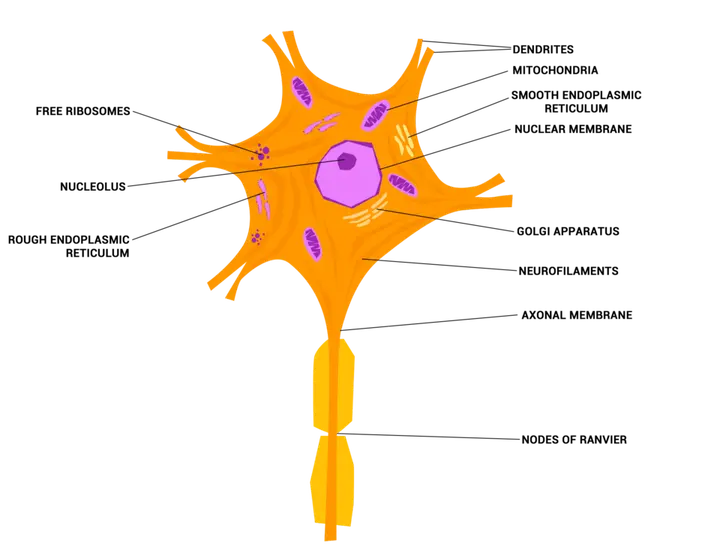
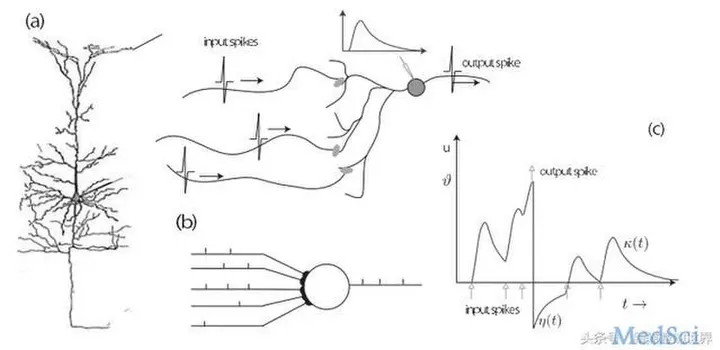
Billions of neurons are present in our brain, which are connected to each other in a complex manner. When a neuron receives signals from its neighboring neurons, a type of electrical charge accumulates inside it, which is called 'membrane potential'. When this potential reaches a certain limit, i.e., the 'threshold', only then does that neuron activate and send a signal forward. This process is called 'firing'.
- Input ReceptionThe neuron receives electrical signals or spikes from its neighboring neurons.
- Potential IntegrationIncoming signals increase the neuron's membrane potential, which accumulates over time.
- Threshold CheckIf the potential exceeds a certain limit (threshold), the further process occurs.
- Spike GenerationAs soon as the threshold is exceeded, the neuron itself generates a spike and sends it to the subsequent neurons.
- ResetAfter firing, the neuron's potential drops back to a lower level and it prepares for new signals.
This same principle is used in spiking neural networks as well. Here, each artificial neuron aggregates inputs arriving over time. If the input is strong enough and exceeds the threshold, only then does the neuron generate a 'spike' or pulse. This spike then reaches other neurons in the network. In this process, 'time' is an important factor, which is not found in traditional AI models.
The Leaky Integrate-and-Fire Model
The most widely used model in SNNs is the 'leaky integrate-and-fire' (leaky integrate-and-fire - LIF). In this model, the neuron 'integrates', i.e., accumulates, the signals coming to it. However, if no new signal arrives for a long time, the accumulated electrical charge gradually begins to dissipate, which is called 'leakage'. This method very closely resembles the behavior of actual biological neurons.
When a neuron fires, its potential immediately returns to zero or a lower level. This is called the 'reset' process. In this way, SNNs work only when it is actually needed. According to Wikipedia sources, high-performance deep spiking neural networks can operate with only 0.3 spikes per neuron, which demonstrates their remarkable efficiency.
| Feature | Artificial Neural Network (ANN) | Spiking Neural Network (SNN) |
|---|---|---|
| Form of Information | Continuous numerical values | Time-based spikes (pulses) |
| Importance of Time | Negligible (sequence only) | Extremely important (temporal) |
| Energy Consumption | Very high | Very low (only during spikes) |
| Biological Similarity | Low | High (brain-like) |
| Training Method | Backpropagation (simple) | STDP or Surrogate Gradients (complex) |
Information Encoding: Rate Coding and Temporal Coding
In traditional AI, information is in the form of precise floating-point numbers, but in SNNs, it has to be converted into spikes. Two main methods are used for this: 'rate coding' and 'temporal coding'. In rate coding, the number of spikes is determined based on the intensity of the information. For example, if a pixel in an image is brighter, more spikes are generated for it.
On the other hand, in temporal coding, the exact time when a spike occurs is important. Here, even a single spike can carry a lot of information if its timing is precise. Research shows that the human brain can perform complex tasks like image recognition in a short duration of just about 10 milliseconds (ms). Such fast processing is not possible with rate coding alone, which proves that the brain also uses temporal coding.
Training Difficulties and New Solutions
Training SNNs is more difficult than traditional AI. Generally, AI models learn through a method called 'backpropagation', which uses mathematical 'gradient descent'. However, the spikes of SNNs are not 'differentiable', meaning that mathematical differentiation cannot be directly applied to them because a spike either exists (1) or does not exist (0).
To solve this problem, scientists are using methods like 'surrogate gradients'. In this, spikes are treated as smooth or continuous functions during training so that gradients can be calculated. In addition, methods like 'Spike Frequency Adaptation' (SFA) have also been developed, which increase the efficiency of neurons and provide capabilities like short-term memory.
સ્પાઇક્સ પ્રતિ ન્યુરોન
Neuromorphic Hardware: IBM TrueNorth and Intel Loihi
The true power of SNNs is seen only when they are run on special types of hardware called 'neuromorphic' chips. General computer processors (CPUs) are not efficient for SNNs because they cannot naturally understand the time factor. Research in this field began from the 1980s.
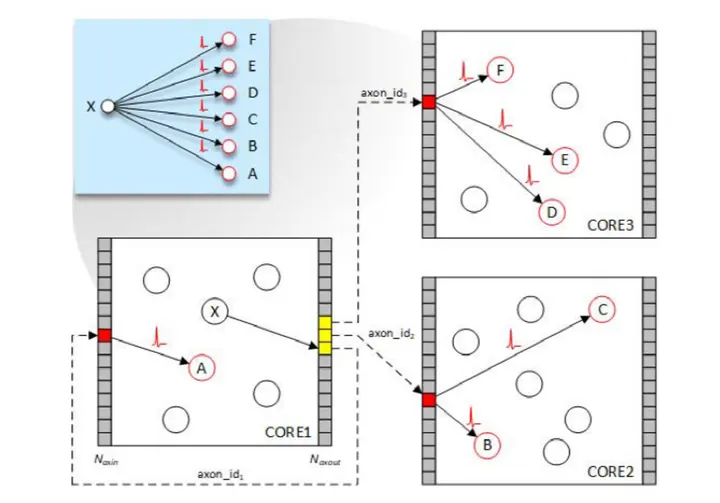
IBM's 'TrueNorth' chip was a major step in this direction. It can simulate millions of neurons and consumes very little power. Similarly, Intel's 'Loihi' chip focuses on online learning and adaptability. Developed in Europe, 'BrainScaleS' and Manchester University's 'SpiNNaker' project are also known for large-scale neuron simulation. These chips could revolutionize robotics and autonomous vehicles in the future.
Importance for India and the Common People
For a country like India, where energy conservation and low-cost technological solutions are needed, SNNs can prove to be extremely useful. This technology is especially a boon for 'edge computing', meaning AI running directly on devices without the internet. The use of SNNs in smartphones, health monitoring devices, and household appliances can increase battery life manifold.
However, SNNs currently lag slightly behind traditional ANNs in terms of accuracy, but according to Wikipedia reports, this gap is closing rapidly. As new training algorithms and more powerful neuromorphic chips emerge, spiking neural networks will give a new direction to the future of AI. This technology will not only make machines smart but also make them think in a more human and natural way.