James Webb Space Telescope: Unveiling the Universe's Early Secrets Through Infrared Vision and Golden Mirrors
A comprehensive technical overview of how the James Webb Space Telescope, positioned 1.5 million kilometers from Earth, observes the formation of the universe's first stars and galaxies using infrared wavelengths.

In the history of astronomy, the most complex and powerful instrument ever devised by humankind to unlock the deepest and most ancient corners of the universe is the James Webb Space Telescope (JWST). This telescope is primarily designed for infrared astronomy. It was launched into space on December 25, 2021, by an Ariane 5 rocket from Kourou, French Guiana. In January 2022, it reached its orbit near the Sun-Earth L2 Lagrange point, located approximately 1.5 million kilometers (930,000 miles) away from Earth. This project has been led by the U.S. National Aeronautics and Space Administration (NASA), with the participation of the European Space Agency (ESA) and the Canadian Space Agency (CSA). NASA's Goddard Space Flight Center in Maryland managed its development, while the prime contractor for the project was Northrop Grumman. The telescope is named after James E. Webb, who was the administrator of NASA during the Mercury, Gemini, and Apollo programs from 1961 to 1968.
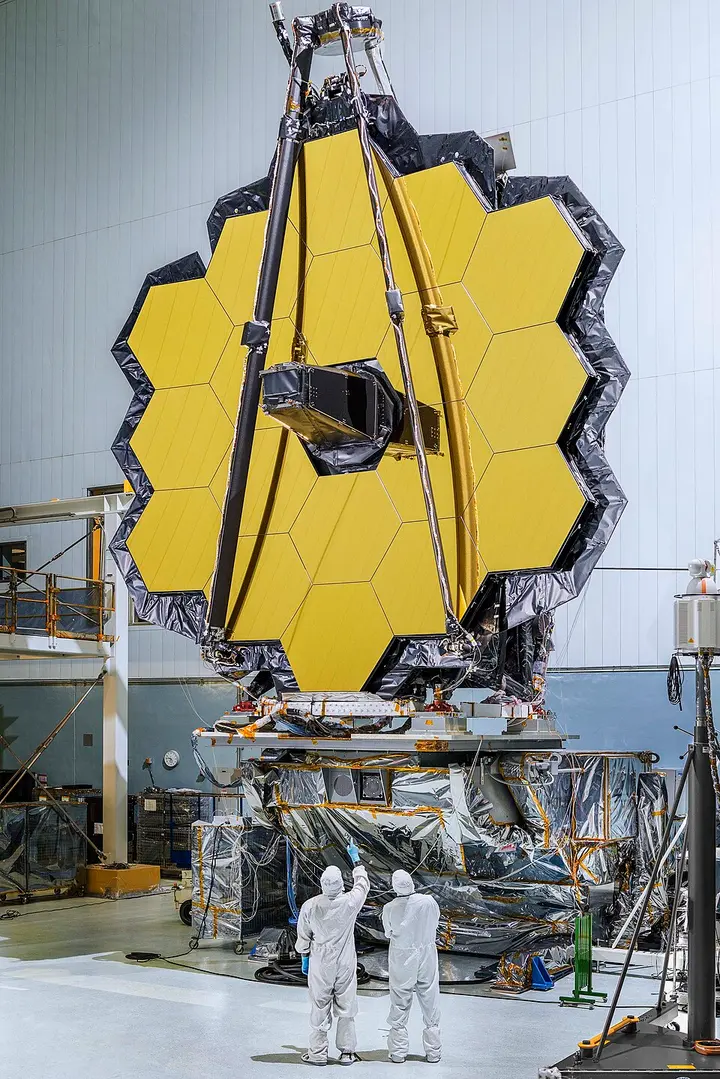
The most striking feature of the James Webb Telescope is its exceptional light-gathering capability and infrared imaging. Webb's primary mirror is 2.7 times larger in diameter than that of the Hubble Space Telescope. Hubble's mirror is 2.4 meters (7.9 feet) in diameter, whereas Webb's primary mirror measures 6.5 meters (21 feet) in diameter. Webb's mirror is composed of 18 separate hexagonal segments made of beryllium metal coated with a thin layer of gold. The total polished area of this mirror is 26.3 square meters, of which 0.9 square meters is obscured by the secondary mirror's support struts. Thus, Webb's total effective light-gathering area is 25.4 square meters (273 square feet), which is more than 6 times that of Hubble's 4.0 square meter area.
| Feature | Hubble Telescope | James Webb Telescope |
|---|---|---|
| Main mirror diameter | 2.4 meters | 6.5 meters |
| Light collecting area | 4.0 square meters | 25.4 square meters |
| Wavelength range (Spectrum) | 0.1 to 2.5 micrometers | 0.6 to 28.5 micrometers |
| Operating temperature | Approx. 15 °C (288 K) | Below 50 K (−223 °C) |
| Distance from Earth | 550 kilometers | 1.5 million kilometers (L2) |
ચોરસ મીટર
The working principle and optical design of the telescope are based on a three-mirror anastigmat. This design uses curved secondary and tertiary mirrors, which provide clear images without optical aberrations over a wide field. The diameter of the secondary mirror is 0.74 meters. In addition, there is a fine steering mirror that makes minute adjustments to its position several times per second to keep the image stable. A total of 132 small actuation motors are used to properly position the telescope's 18 mirror segments after launching them into space. These motors can move the mirrors with an incredible precision of 10 nanometers. Due to the hexagonal shape of the mirrors, images of point light sources (such as stars) taken by Webb show 6 main and 2 faint diffraction spikes.
- 1. Collection by primary mirror18 gold hexagonal mirrors collect distant infrared light rays and reflect them towards the secondary mirror.
- 2. Fine actuation132 actuator motors adjust the mirror segments with an accuracy of 10 nanometers to keep it focused.
- 3. Optical stabilizationThree-mirror anastigmat design and fine steering mirror change position multiple times per second to stabilize the image.
- 4. Analysis by ISIM instrumentsInstruments like NIRCam and NIRSpec analyze infrared light to prepare spectroscopy and images.
For infrared astronomy, keeping the telescope extremely cold is essential. If the temperature of the telescope is high, it begins to emit infrared radiation itself, which obscures the faint light coming from distant celestial bodies. Hubble's mirror is maintained at a temperature of about 15 °C (288 K), so it cannot observe these infrared bands. The Webb Telescope needs to be kept at an ultra-cold temperature below 50 Kelvin (−223 °C or −370 °F). For this, Webb is equipped with a 5-layer sunshield. Each layer is approximately 0.1 millimeters thick and is made of Kapton E film, coated with aluminum on both sides. The outer two layers facing the sun have an additional layer of doped silicon to reflect solar heat back into space. This sunshield has a Sun Protection Factor (SPF) of 1,000,000 (1 million).
To fit inside the payload fairing of the Ariane 5 rocket in space (which had a diameter of 4.57 meters and a length of 16.19 meters), the sunshield was folded and packed 12 times. Once deployed, the size of the sunshield becomes 14.162 meters × 21.197 meters. Because it is located at the Sun-Earth L2 point, the Sun, Earth, and Moon always remain on the same side of the telescope. This allows the sunshield to block the heat and light from all three bodies. While revolving in a halo orbit around L2, its position varies between 250,000 and 832,000 kilometers from the L2 point, so that it does not fall into the shadow of the Earth or the Moon and continues to receive a constant supply of solar energy.
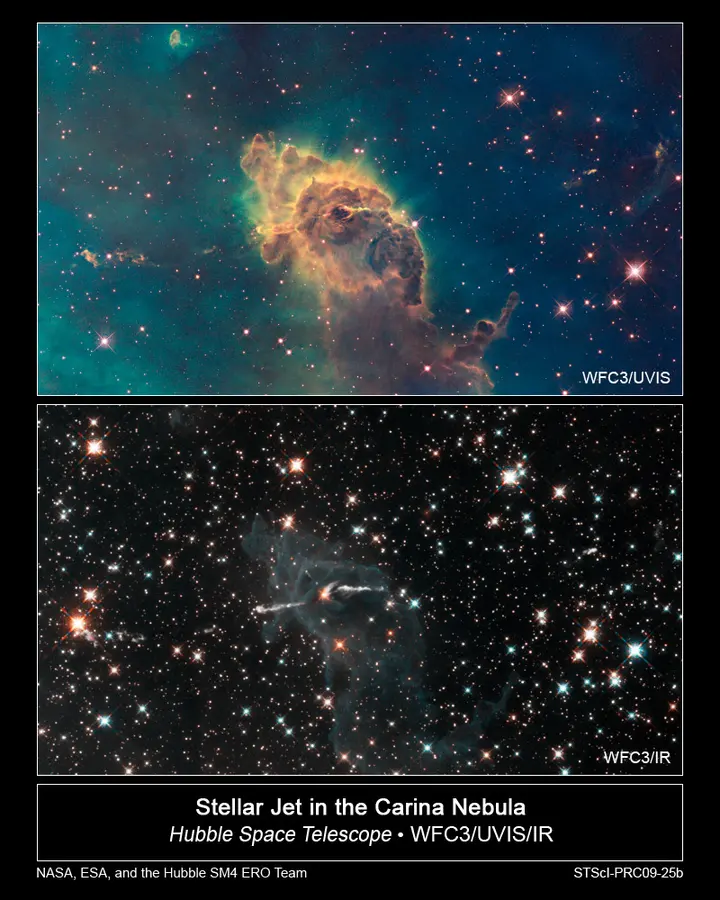

The Webb Telescope primarily observes light with wavelengths ranging from 0.6 to 28.5 micrometers (μm), spanning from red visible light to the mid-infrared region. The Hubble Telescope operates in the 0.1 to 2.5 micrometer (ultraviolet, visible, and near-infrared) region. Due to the expansion of the universe, the wavelength of light coming from extremely distant objects is stretched and shifts toward the red and infrared, a phenomenon known as redshift. The Webb Telescope can view high-redshift objects up to z ≈ 20, a period representing only 180 million (18 crore) years after the Big Bang. In comparison, Hubble could only see up to z ≈ 11.1 (the GN-z11 galaxy, 400 million years after the Big Bang). The first stars are believed to have formed between z ≈ 30 and z ≈ 20, and the first galaxies around z ≈ 15 (270 million years). Infrared light can easily penetrate dust clouds in space, allowing the birthplaces of stars and the formation of planets to be clearly seen.
To support the scientific instruments, there is a structure called the Integrated Science Instrument Module (ISIM), which is made of graphite-epoxy composite. This module contains 4 main instruments and a guide camera. Among them, NIRCam (Near Infrared Camera) takes pictures in the 0.6 to 5 micrometer region. Built by a team from the University of Arizona (principal investigator Marcia J. Rieke), this camera features 10 sensors of 4 megapixels each. NIRCam also functions as a wavefront sensor for setting the primary mirror. In addition, NIRSpec (Near Infrared Spectrograph), built by ESA, performs spectroscopy in the same wavelength range.
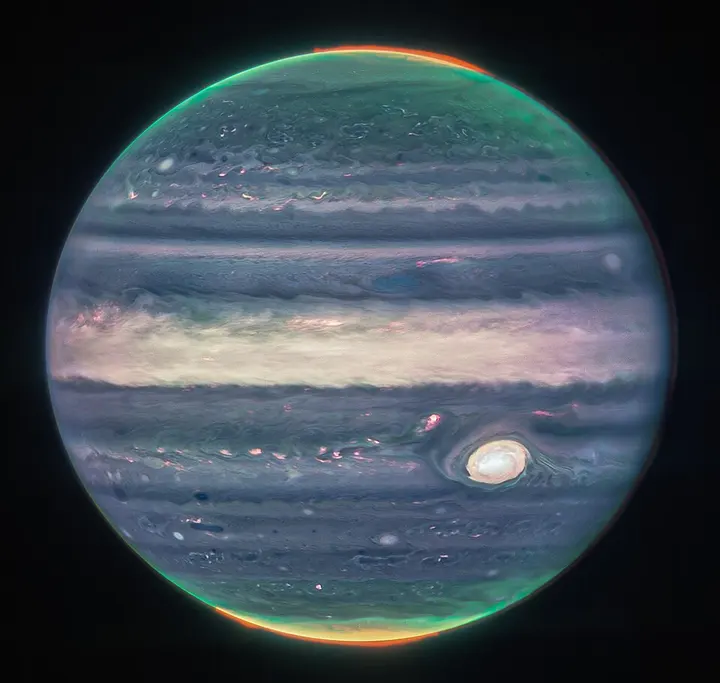
The James Webb Telescope can also observe objects in our solar system. It observes objects located at angles greater than 85° from the Sun and moving at speeds less than 0.03 arcseconds per second, such as Mars, Jupiter, Saturn, Uranus, Neptune, Pluto, Kuiper Belt Objects, and comets. Furthermore, it can initiate observations within 48 hours of deciding on unpredictable events like supernovae or gamma-ray bursts. Initiated in 1996 as the Next Generation Space Telescope, this project originally planned for a 2007 launch with a 1 billion dollar budget in 1999. However, due to technical complexities, it was redesigned in 2005 and manufacturing was completed in 2016. Further delays occurred due to the sunshield tearing during testing in 2018, and this epoch-making telescope was finally realized at a total cost of 10 billion dollars.