The Search for Extraterrestrials in the Universe Now Relies on 'Agentic AI': When Machines Hunt for Machines
Autonomous AI agents have joined the search for intelligent life beyond Earth, capable of processing terabytes of data in seconds to detect extraterrestrial signals.
In science fiction, we have always heard that whenever we meet extraterrestrials, they will look like 'little green men.' However, reality may be completely different from this. There is now a major turning point in the Search for Extraterrestrial Intelligence (SETI). Scientists are now creating artificial intelligence (AI) agents that will listen for signals sent by AI agents from other advanced civilizations in the universe. This is a revolution where human-made machines will attempt to detect the machines of extraterrestrials.
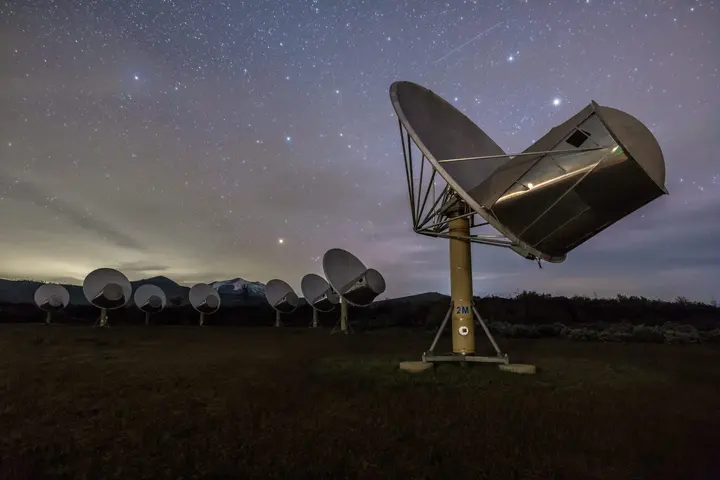
Breakthrough Listen and the SETI Institute are now using 'Agentic AI' in their daily searches. At the Allen Telescope Array in California, these AI agents are no longer just examining data; they can direct the telescope themselves, refine incoming data, and apply complex models based on a simple natural language request. According to NVIDIA's announcement, this technology increases the capacity to process the vast stream of data coming from the universe by many times.
What is Agentic AI and how is it different from general AI?
Generally, the AI we use, such as chatbots, only answers our questions. This can be called 'tool-like AI.' But agentic AI is a program that can make decisions independently without human intervention, set goals, and take steps to complete them. According to Wikipedia reports, agentic AI possesses goal-oriented behavior, the ability to use external tools, and the power to complete complex tasks autonomously.
Large Language Models (LLMs) work behind these agents, giving them the power to reason. A software layer called an 'agent harness' or scaffold surrounds this model, connecting it to computer hardware, data files, and tools like telescopes. Because of this, the AI does not just talk, but can also perform work in the real world.
- Command receptionScientists instruct the telescope in common language.
- Autonomous operationAI agent turns the telescope's antenna towards a specific star.
- Data processingFilters and corrects data in real-time with the help of GPU.
- Result displayAI agent prepares a spectrogram and shows the result to scientists.
- Command in natural languageScientist gives command in plain English, such as 'focus on a certain star'.
- Planning by the agentNexus orchestrator understands this command and turns the telescope's antenna.
- Antenna system like the radio dish used in the Allen Telescope Array.
- Real-time data processingWith the help of NVIDIA Holoscan and DAQIRI, data goes directly into GPU memory.
- Error correction and analysisAI agent corrects defects in the data and immediately prepares a spectrogram.
An ocean of data and the challenge of processing
When radio telescopes look toward space, they generate an incredible amount of data. Instruments like the Allen Telescope Array produce terabits of data per second. Saving such vast amounts of data to hard drives and then examining them for months was the old method. With the help of the NVIDIA Holoscan platform, this data is now processed 'in flight,' meaning at the very moment the data is arriving.
This system uses a library called DAQIRI, which pulls telescope sensor data directly into GPU (Graphics Processing Unit) memory. A GPU is a graphics processing unit known for performing extremely fast calculations. In this process, a framework called CyberEther performs mathematical computations. Using NVIDIA RTX 6000 Ada Generation Blackwell GPUs, this system can handle 2.4 terabits of data per second. Due to this speed, scientists can now monitor celestial events in real time.
Tbps (ટેરાબિટ્સ પ્રતિ સેકન્ડ)
Nexus: The New Charioteer of the Telescope
The entire system is managed by a web-based orchestrator called 'Nexus.' It acts as a platform for the agent from which it can determine the telescope's status and issue commands. Researchers can now simply type and say, "Point the telescope toward a certain star and show me the spectrogram of the signals coming from there." A spectrogram is a visual representation of waves.
The AI agent understands this command, turns the telescope's antenna, calibrates the instruments to clean the signal, and corrects errors in the data. Work that used to take humans weeks or years is now done by these agents in just hours. The first proof of this system's success came when it detected pulsar signals coming from the Crab Nebula in real time. A pulsar is a rapidly rotating dead star that emits pulses of light into the universe like a lighthouse.

| Component Name | Function |
|---|---|
| NVIDIA RTX 6000 | Powerful GPUs for fast computation |
| Nexus | Agent orchestrator and control panel |
| DAQIRI | Library that brings sensor data directly into memory |
| CyberEther | Mathematical framework for signal processing |
History and the Journey of SETI
The history of the search for extraterrestrial life is quite old. In 1896, Nikola Tesla suggested that wireless electrical transmission could be used to contact the planet Mars. In 1960, Frank Drake initiated the modern SETI experiment through 'Project Ozma.' In 1977, the 'Wow!' signal was discovered, which is considered the strongest potential extraterrestrial signal to date, although it has never been detected again.
According to Wikipedia, in 2015, Stephen Hawking and Yuri Milner launched the 'Breakthrough Listen' project at a cost of 100 million dollars. The purpose of this project is to capture signals coming from nearby stars. No concrete evidence has been found in the search so far, which is known as the 'Fermi paradox'—that is, if the universe is so vast, why haven't we encountered anyone yet? Agentic AI might help in finding the answer to this question.
The importance of this for India and the common man
Although these experiments are currently being conducted on telescopes in America, their impact is global. India is also making great strides in space science, and such AI technology could also be used in Indian radio telescopes in the future. For the common people, this means that we are making a revolutionary change in our ability to understand the universe. Agentic AI has started to be used not only in space but also on Earth in government services, software development, and data analysis.
According to Andrew Siemion of the SETI Institute, when our new agentic observatories search the universe, what they find might be more like their own (AI) than humans. This is not a cause for fear, but a 'breakthrough in translation'. Perhaps other civilizations are also sending messages through their AI agents.
Future direction: AI on the moon?
Researchers are now evaluating open models like NVIDIA Nemotron. There is a plan for the future to establish autonomous observatories on the far side of the moon, where there is no interference from Earth's radio waves. These observatories will be able to work independently with the help of agentic AI, even while remaining offline without the internet.
Many questions still remain unanswered. Will we actually be able to capture a signal? If that signal has been sent by an AI agent, will we be able to understand it? For now, we only know that we now have a companion that never tires and whose vision is millions of times sharper than ours. To solve the mysteries of the universe, man and machine are now working shoulder to shoulder.