AI Revolution in Construction: 'World Models' to Automatically Generate Robust Building Designs
A US-based startup, 'Dream', founded by former Palantir executives, is leveraging cutting-edge AI models to address the construction industry's decades-long productivity crisis.
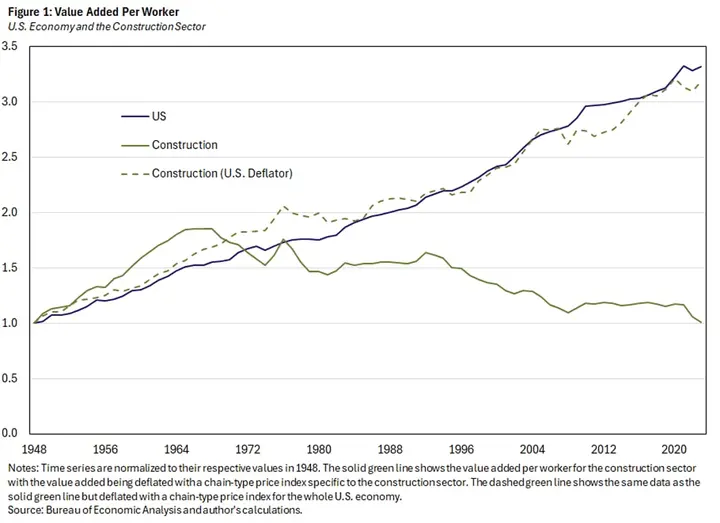
Over the past seven decades, humanity has made unprecedented progress in the field of technology. We have traveled the journey from dial-up internet to superintelligent artificial intelligence (AI). But surprisingly, when it comes to building the physical world around us, our capacity seems to be declining rather than increasing. Looking at the data of the American economy, a shocking fact emerges: labor productivity in the construction sector, that is, the actual output per worker, remains the same today as it was in 1948. According to a report by Chen Yeh, a senior economist at the Federal Reserve Bank of Richmond, productivity has tripled in all other sectors, but the construction sector has remained an exception in this regard.
This decline in productivity is not just a statistical illusion, but a serious economic problem. Data from the Bureau of Economic Analysis shows that productivity in the construction sector has been steadily declining since the 1970s. In 2020, the output per worker was 30 percent lower compared to 1970. This is a paradox that is puzzling economists. While sectors like manufacturing and mining have made significant progress by adopting new technology, the construction sector has lagged behind. The impact of this decline falls on ordinary people in the form of affordable housing prices and overall economic growth. The construction sector accounts for approximately 4.5 percent of America's GDP and is an important supplier providing capital to other sectors.
According to the Federal Reserve report, if construction productivity had increased by a modest 1 percent each year since 1970, total economic productivity and per capita income today would be 10 percent higher than current levels. This loss is as large as approximately $1 trillion every five years. Researchers have examined several aspects to get to the root of this problem. Initially, it was believed that there might be an error in the calculation of the figures, but even after considering subcontractors and other factors, this trend does not change. The journal Nature and other studies also confirm that even physically, there has been a decline, such as in the number of houses built per worker.
AI has now entered the field as a solution to this global problem. A new startup named 'Dream' is developing 'world models' for the construction industry. Founded by former Palantir executives Andy Elder and Arjun Mathur, the company recently secured $17 million in seed funding. Their goal is to revolutionize the Architecture, Engineering, and Construction (AEC) industry. Currently, architects and engineers still use legacy software like AutoCAD and Revit, in which every part must be drawn manually. There is no role for AI in this process, which acts as a barrier to productivity.
A 'world model' is an internal representation of external reality. In psychology, this term is used for 'mental models,' which help us imagine future events. In the context of AI, the Dream company's model does not just create beautiful images; it is based on physics and construction standards. While Large Language Models (LLMs) like ChatGPT learn from words, Dream's model is trained on over 100 million square feet of building data obtained from American permit archives. This model understands what is inside walls, what materials are used, what beams are made of, and how much weight they can support.
| Feature | AutoCAD / Revit | Dream AI World Model |
|---|---|---|
| Design method | Drawing every part manually | Entire building is generated automatically |
| Understanding of physics | Negligible (drawing only) | Complete (calculation of weight and strength) |
| Data base | User input | 100 million square feet of building data |
| Time and cost estimation | Must be calculated separately | Instantly available with design |
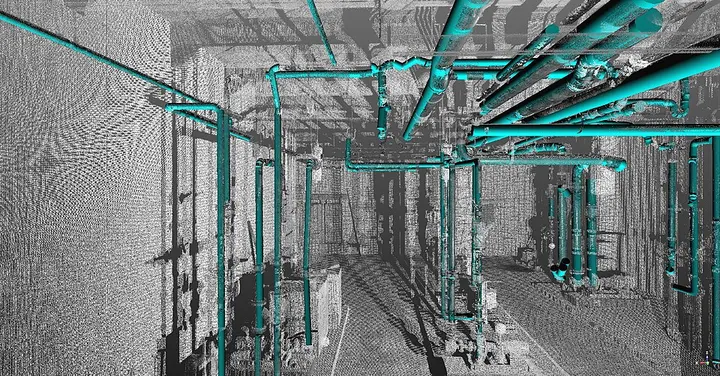
The company calls this approach 'structural cognition.' This model generates designs that are structurally accurate and include internal systems such as plumbing and HVAC (Heating, Ventilation, and Air Conditioning). Using this technology, developers can prepare building designs and get an instant estimate of their total cost. Currently, the platform is being used in 10 active projects in Texas and California. This method is much faster than traditional methods because it can design an entire building at once.
- Data learningAI gets trained from millions of square feet of building plans and permit archives.
- Structural cognitionThe model understands the arrangement of beams, pipelines, and electrical systems inside the walls.
- Automatic designAccurate design is prepared according to the user's requirement subject to the laws of physics.
- Cost analysisInstant estimate of required materials and total cost is generated based on the design.
A major reason for declining productivity in the construction sector is also strict land-use regulations. According to a 2024 working paper, the approval process for building construction in America has become more complex and lengthy since 1970. Because of this, developers prefer small projects over large ones. Small companies have less capacity to invest in new technology or research, which creates a vicious cycle. If construction companies were the size of manufacturing companies, productivity would be 60 percent higher. AI world models can help remove this obstacle by simplifying these complex regulations and the design process.
The construction industry is massive on a global scale. In 2022, spending on construction activities exceeded $11 trillion, accounting for approximately 13 percent of global GDP. This figure is projected to reach $14.8 trillion by 2030. For countries like India, where the need for infrastructure and housing is constantly increasing, such technology could prove to be extremely important. If we can build faster, cheaper, and stronger buildings with the help of AI, it could provide new momentum to economic growth.
However, many challenges still remain. Construction is a hazardous industry where safety standards are extremely stringent. In 2019, 20 percent of all workplace fatalities in the United States occurred in the construction sector. Therefore, it is imperative that AI-generated designs pass all real-world safety tests. Companies like Dream claim that their models are more reliable because they are based on actual engineering data. In the future, these world models may not be limited to design alone, but could also be used to guide robots and machines at construction sites.
In conclusion, the five-decade-old inertia of the construction sector now seems to be breaking under the influence of technology. AI world models are not just software updates; they have the potential to change the way we build the physical world. As these models gain more data and experience, they will become more accurate and efficient. This revolution is not just for engineers or architects, but for everyone who hopes to obtain a good and affordable home.