Managing Airports Without High Glass Cabins: America Launches Digital Air Traffic Control Tower
Replacing traditional tall towers, a new system for aircraft management through high-definition cameras and digital displays has become operational in the United States.

When we hear the word airport, a magnificent tall tower with glass windows standing beside the runway comes to our mind. For years, sitting atop this control tower, air traffic controllers have kept an eye on the runway with binoculars and the naked eye, granting permission for airplanes to land or take off. However, a major technological turning point has arrived in American aviation history. The Federal Aviation Administration (FAA), operating under the United States Department of Transportation, has officially announced the commissioning of the country's first 'digital air traffic control tower'.
This new system has been introduced at Florida's Bartow Executive Airport and Alaska's Kenai Municipal Airport. In this setup, controllers are not required to sit atop a tall tower; instead, seated on the ground or in a remote operations room, they can control the entire airport based on advanced cameras and sensors. The purpose of the digital tower is not to eliminate human controllers, but to strengthen the safety of aircraft both in the sky and on the ground by providing them with more accurate information and advanced tools.
What is a Digital Control Tower and how does it work?
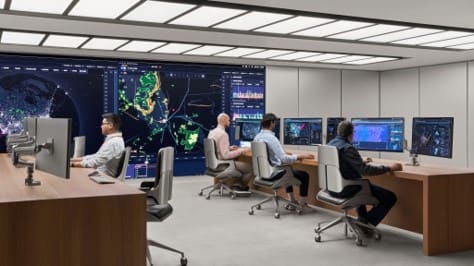
A digital air traffic control tower, also known as a remote tower, is essentially an integrated infrastructure of cameras, sensors, and digital screens. Powerful high-resolution panoramic cameras are installed across various airport premises, runways, taxiways, and the surrounding airspace. These cameras capture live footage of all four directions around the clock.
This visual data is transmitted to the control room via an ultra-fast communication line, where the controller gets a continuous 360-degree view on a massive semi-circular digital monitor. This digital display becomes even more useful than what is visible through the glass window, because details such as the aircraft's identification, its speed, altitude, and atmospheric conditions automatically appear superimposed right on the screen.
- 1. Visual capture through advanced camerasHigh-definition panoramic cameras continuously record 360-degree footage around the airport's runway, taxiways, and airspace.
- 2. Sensors and data integrationRadar, flight tracking data, and weather details are combined with camera footage using digital systems.
- 3. Transmission via secure linesAll audio, video, and flight data are sent to the ground control room via an ultra-fast network.
- 4. 360-degree display on panoramic screensControllers in the control room see a realistic view of the airport on large monitors along with aircraft tags and information.
- 5. Safe decision-making by the controllerHuman controllers give safe instructions to pilots for take-off and landing based on this detailed digital information.
This technology was not deployed directly at airports. The system underwent rigorous testing for years by the FAA at the William J. Hughes Technical Center in Atlantic City, New Jersey. It was approved only after passing the agency's strict standards for safety, accuracy, and reliability. For this project, the system of the Austrian aviation technology company Frequentis was chosen.
| Airport Name | State | Current Status |
|---|---|---|
| Bartow Executive Airport (KBOW) | Florida | Operational |
| Kenai Municipal Airport (PAEN) | Alaska | Operational |
| Winter Haven Regional Airport | Florida | Planned in next phase |
| Venice Municipal Airport | Florida | Planned in next phase |
| Montgomery County Airpark | Maryland | Planned in next phase |
| Johnston Regional Airport | North Carolina | Planned in next phase |
| Durango-La Plata County Airport | Colorado | Planned in next phase |
A major transition from legacy systems to digital
America's air traffic system is among the largest and busiest systems in the world, yet it has remained dependent on decades-old infrastructure. Many control towers still used copper telecommunications lines, floppy disks, and paper strips to track aircraft. In the old method, controllers had only a radar scope and the option of looking out the window. In fog, heavy rain, or the darkness of night, it was difficult to see what was happening at the far end of the runway.
Digital towers overcome all these limitations. If an aircraft is not visible through the naked eye in fog, advanced cameras and digital processing allow controllers to view the exact position of the aircraft on a screen. According to FAA Administrator Bryan Bedford, controllers will continue their vital work of maintaining safe distances between aircraft, and the new system will empower them to make better decisions.

Scope of the project and upcoming airports
Under funding from the American administration's 'Working Families Tax Cut Act', these digital towers are currently being installed first at regional and smaller airports that previously did not have permanent control towers (non-towered airports). Following Bartow in Florida and Kenai in Alaska, preparations are now underway to install this technology at five other airports.
These five airports include Winter Haven Regional Airport in Florida, Venice Municipal Airport in Florida, Montgomery County Airpark in Maryland, Johnston Regional Airport in North Carolina, and Durango-La Plata County Airport in Colorado. Building a traditional concrete tower at smaller airports is economically extremely expensive, whereas a digital tower provides modern security systems at a lower cost.
અબજ ડોલર ($)
SMART system: Integration of Artificial Intelligence
In addition to digital towers, the US Department of Transportation also introduced a state-of-the-art Artificial Intelligence (AI)-based tool called 'SMART' (Strategic Management of Airspace, Routes and Trajectories - SMART) for air traffic management in September 2026. Unveiled by Transportation Secretary Sean P. Duffy and Administrator Bryan Bedford, this system integrates more than 200 data streams—including weather, flight paths, traffic flow, and controller staffing—onto a single platform.
Generally, thousands of flights face delays every day due to scheduling and weather, as demand exceeds airspace capacity. The SMART system forecasts airspace congestion before it occurs and suggests alternative routes. Currently, this tool has been launched on a limited basis in the airspace around Washington, D.C. The heads of United Airlines, Delta Air Lines, American Airlines, and Southwest Airlines have also welcomed this modernization, as it is expected to significantly reduce flight cancellation and delay problems.
Budget, Security Concerns, and Controversies
In June 2025, the US Congress approved $12.5 billion for five years for the modernization of the entire aviation sector. Under this amount, 13 workstreams including replacing telecom lines, installing new radars, and implementing electronic flight strips are targeted to be completed by the end of 2028. However, the Trump administration has requested an additional $30 billion from Congress to push these reforms forward rapidly.

However, concerns are intertwined with this rapid implementation of technology. Experts are raising questions about the increasing reliance on artificial intelligence and digital screens in air traffic control. In 2025, a mid-air collision between a passenger jet and a military helicopter near Washington, D.C. resulted in 67 deaths, which was America's deadliest aviation accident in the last twenty years and authorities described it as entirely preventable.
Due to this tragedy and a nationwide shortage of controllers, the security of the system is under constant scrutiny. Some critics also fear that digital towers might not become a means to reduce human controllers' jobs in the future, or that airport operations might not be disrupted during a cyber attack or camera system malfunction. However, the FAA clarifies that there is no intention to replace staff and human judgment will remain final in the system.
Future Direction
Digital air traffic control towers open a new direction for the aviation sector worldwide. Even in countries like India, where dozens of small and regional airports are becoming operational under the 'UDAN' scheme, centralized digital digital towers can become a very cost-effective and safe option instead of spending crores of rupees behind traditional towers. Following the successful launch in Florida and Alaska in America, these digital eyes are becoming the foundation of the safe skies of the future.