Oxygen Factory on Mars: Technological Revolution and Mechanism of NASA's MOXIE Instrument
NASA's Perseverance rover has created history by producing pure oxygen from Mars' carbon dioxide-rich atmosphere. A complete engineering analysis of this breakthrough in solid oxide electrolysis.
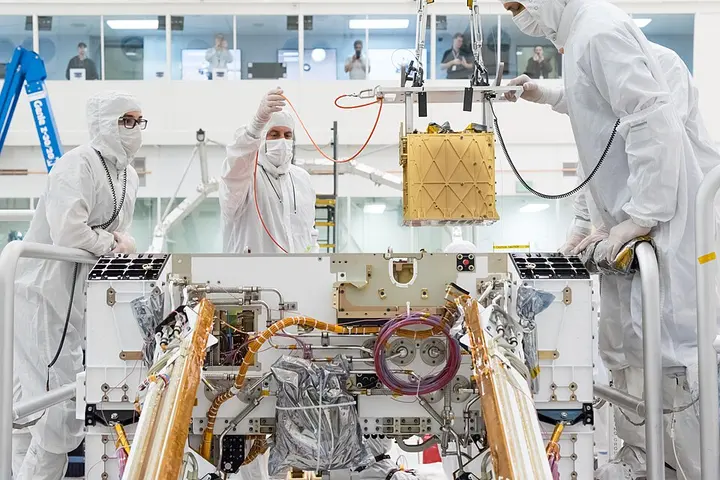
The historic achievement of producing oxygen for human use by utilizing natural resources located on a celestial body other than Earth has been accomplished by NASA's 'Perseverance' rover. On April 20, 2021, an instrument named 'MOXIE' (Mars Oxygen In-Situ Resource Utilization Experiment) fitted in the Perseverance rover successfully demonstrated for the first time the production of oxygen from carbon dioxide at the Jezero Crater on Mars. In this initial experiment, MOXIE produced 5.37 grams of oxygen, which was enough for an astronaut to breathe for about 10 minutes.
The main objective behind this technology demonstration mission was to verify whether oxygen could be successfully extracted from the extremely thin atmosphere of Mars. On August 7, 2023, in its 16th and final experiment, MOXIE produced 9.8 grams of oxygen. Over the course of the experiments spanning two Earth years or one Martian year, MOXIE produced a total of 122 grams of oxygen, which is enough for a small dog to breathe for 10 hours.
- 1. Collecting atmospheric airCarbon dioxide gas is drawn from the Martian atmosphere through a HEPA filter and the pressure is increased to approximately 1 bar using a scroll compressor.
- 2. Heating to high temperatureThe gas is heated up to approximately 800 degrees Celsius using a heater, which enables thermal decomposition and electrochemical processes.
- 3. Electrolysis processIn the YSZ ceramic solid oxide cell, oxygen atoms are released from CO2 molecules, acquire electrons at the cathode, and become oxide ions (O2-).
- 4. Collecting pure oxygenOxide ions release their charge at the anode to form pure O2 gas, while carbon monoxide and other gases are vented out.
The MOXIE instrument is the result of a joint collaboration between the Massachusetts Institute of Technology (MIT), Haystack Observatory, NASA's Jet Propulsion Laboratory (JPL), and OxEon Energy. The Principal Investigator of this project was Michael Hecht of MIT, while former NASA astronaut Jeffrey Hoffman served as the Deputy PI. Jeff Mellstrom of JPL was the project manager. In addition to these, institutions such as Air Squared, Imperial College London, the Technical University of Denmark, and Arizona State University were also participants.
The core idea of MOXIE was based on its predecessor experiment MIP (Mars In-situ propellant production Precursor), which was designed for the 'Mars Surveyor 2001 Lander' mission. However, after the Mars Polar Lander mission failed, the 2001 lander mission was canceled. Later, under the Perseverance rover mission, this technology was revived and integrated into the interior of the rover.
The MOXIE instrument operates on the principle of solid oxide electrolysis (a process of separating gases at high temperatures using an electric current). The atmosphere of Mars is predominantly composed of carbon dioxide (CO2) gas. In the operation of MOXIE, Martian air is first drawn in through a HEPA filter (a filtration process that removes ultra-fine particles from the air). Thereafter, using a scroll compressor (a pump that compresses gas to increase pressure), the pressure of the gas is increased to approximately 1 bar.
After compressing the air, it is heated to an extremely high temperature of approximately 800 degrees Celsius (800 °C) using a heater. It takes about 90 minutes to reach this temperature. The foundation of a Solid Oxide Electrolysis Cell (SOEC) is that at high temperatures, ceramic oxides such as Yttria-Stabilized Zirconia (YSZ) or Scandia-Stabilized Zirconia (ScSZ) become conductors of oxygen ions (O2–).
| Parameter / Property | Value and Detail |
|---|---|
| Total Mass | 17.1 kg |
| Weight on Earth / Mars | 37.7 lbf (168 N) / 14.14 lbf (62.9 N) |
| Dimensions | 24 cm × 24 cm × 31 cm |
| Power Consumption | 300 Watts |
| Operating Temperature | 800 °C |
| Oxygen Purity | 98% to 99.6% |
| Oxygen Production Capacity | 6 to 12 grams per hour |
A thin, non-porous disk of YSZ is placed between two porous electrodes. Upon reaching the cathode (negative electrode), the thermal decomposition and electrocatalysis of the CO2 molecule occur. In this process, an oxygen atom is released from the CO2 and, by gaining two electrons from the cathode, becomes an oxide ion (O2–). Due to the applied DC potential, these ions flow through the vacancies in the crystal lattice toward the anode (positive electrode).
Upon reaching the anode surface, the oxide ion releases its charge and combines with another oxygen atom to form pure oxygen gas (O2). The chemical equation for this entire process is 2 CO2 ⟶ 2 CO + O2. The carbon monoxide (CO) produced as a byproduct during this process, as well as the nitrogen (N2) and argon (Ar) gases from the atmosphere, remain separated from the oxygen and are released back into the Martian atmosphere.
મીટ્રિક ટન
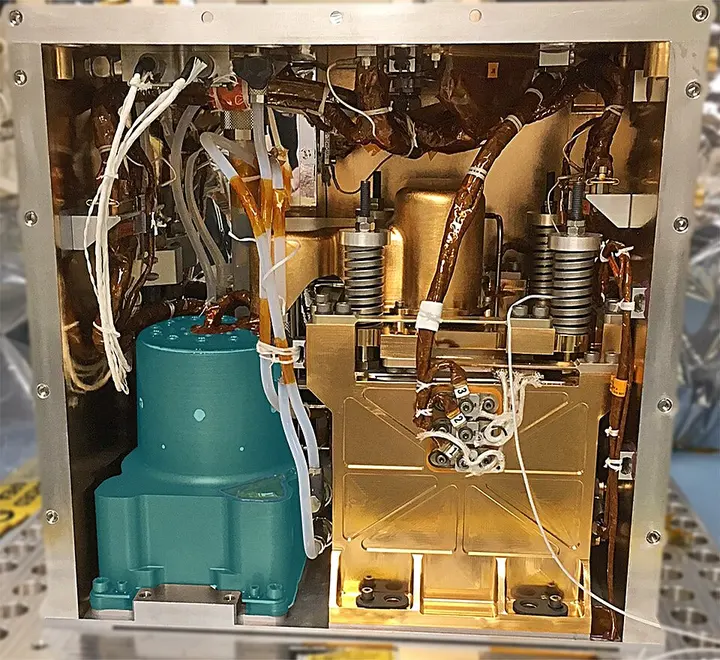
The physical structure of MOXIE is extremely complex and possesses micro-scale capabilities. The overall size of this device is 24 cm × 24 cm × 31 cm, and its total weight is 17.1 kilograms. On Earth, its weight is 37.7 pounds (168 Newtons), while in the low gravity of Mars, its weight remains 14.14 pounds (62.9 Newtons). This entire instrument operates on 300 watts of power, which is provided by the rover's power supply.
The scroll pump used to intake gas rotates at a low rate of 2000 to 4000 RPM. It draws in Martian gas, which is at a pressure of 7 Torr and a temperature of 20 °C, at a rate of 83 grams per hour and compresses it with a power consumption of 120 watts. In the electrolysis section, a total of 10 cells are arranged in two stacks of 5 cells each. The interconnects between these cells are made using powder metallurgy (CFY Plansee). Glass seals are used for proper sealing between the ceramic and metal. Perovskite is used as the anode and modified cermet is used as the cathode for the electrodes.

According to NASA's original goal, the MOXIE instrument was designed to produce 6 to 10 grams of oxygen per hour with a purity of at least 98%. However, during experiments, MOXIE set a record by producing double the expected amount, reaching up to 12 grams of oxygen per hour with 99.6% purity. Due to the rover's power supply capacity of 4 amperes, its theoretical production rate was limited to 12 grams.
The future plan of NASA and MIT is to utilize this technology extensively for sending human missions to Mars. If 4 astronauts are sent to Mars for one year in the 2030s, they would require only 1 metric ton of oxygen for breathing and life support for the entire year. However, approximately 25 metric tons of oxygen are needed as rocket fuel and oxidizer for the Mars Ascent Vehicle to fly back to Earth from Mars.

Transporting 25 tons of oxygen from Earth to Mars is extremely expensive and difficult. Therefore, instead of carrying oxygen from Earth, there is a proposal to establish a MOXIE-based plant on Mars that is 200 times larger. A plant of this size would be able to produce more than 2 kilograms of oxygen per hour by using 25 to 30 kilowatts of energy. In 1 Earth year, this plant would prepare the 25 tons of oxygen required for the rocket on Mars itself. Additionally, the carbon monoxide obtained as a byproduct can also be used to produce methane.