A Talking 'Monster House' Powered by OpenAI Models Unveiled for Halloween
Using NVIDIA's Nemotron open models and a local workstation, a garage door has been transformed into a living, talkative, and amusing monster.

In the field of artificial intelligence (AI), models are no longer limited to chatbots, but have become capable of interacting with the physical world. According to a report published on Hugging Face on October 30, 2026, NVIDIA engineers Rick Grandy and Maryam Motamedi have built a unique 'MonsterHouse' under the 'nemotron-halloween' project. This is an interactive house that listens to the voices of children arriving for Halloween, replies in a grumpy pirate voice, and softens up to give out chocolate when visitors politely say 'please'.
The most remarkable aspect of this entire project is that such a complex AI architecture runs entirely on a single local workstation rather than relying on the cloud. Giving the garage door a mouth and teaching it to complain is a marvelous synthesis of artificial intelligence and 3D animation. This system is based on NVIDIA's family of open models, where different AI models for conversation, hearing, vision, and facial expressions work together.

Inspiration and Background Behind the MonsterHouse
According to the project's creator Rick Grandy, he wanted to give a unique experience to the children visiting his home during Halloween. The idea was for the house itself to become a grumpy yet less frightening character that distributes chocolate. To achieve this, he designed the wooden slats of the garage door in the shape of chapped lips and ignited a digital fire behind them.
An interesting backstory was created for this character of the house. The house is built from the wood of a sunken pirate ship and remains constantly dissatisfied and angry due to its stormy past. Whenever a visitor arrives, it initially turns them away by saying, "I am busy being angry, go bother the neighbors!". However, if visitors converse continuously or use polite words, its mood changes. Once a visitor wins it over, the system remembers that visitor so that re-negotiation is not required every time.
- 1. Speech Recognition (Nemotron ASR)The visitor's voice is recorded and converted to text in real-time by the `nemotron-speech` model.
- 2. Dialogue Generation (Bolt E4B)The `Nemotron 3.5 Bolt E4B` model writes a response in the appropriate pirate mood using a LoRA adapter.
- 3. Speech Synthesis (Magpie TTS)The `Magpie TTS Zeroshot` model gives a vivid voice to the response using a short voice sample.
- 4. 3D Animation (Audio2Face-3D)The `Audio2Face-3D` technology visually animates the mouth in Unreal Engine 5 based on sound waves.
How the System Works: Step-by-Step Explanation
The conversational process of the MonsterHouse is divided into five main stages, which are executed extremely rapidly in real-time:
In the first stage, hearing or speech recognition takes place. Whatever the visitor speaks is converted into text by 'NVIDIA Nemotron Speech ASR' (Automatic Speech Recognition). For this, the `nemotron-speech-streaming-en-0.6b.q8_0.gguf` model is used, which recognizes that the speech has ended after 300 milliseconds (ms) of silence.
In the second stage, reasoning, or dialogue generation, takes place. The 'NVIDIA Nemotron 3.5 Bolt E4B 4GB' model formulates the next conversational response. This is a small language model that has been molded into a pirate's temperament with the help of a LoRA adapter (Low-Rank Adaptation).
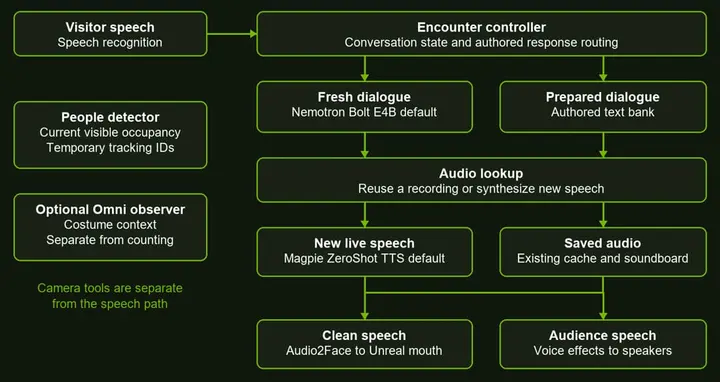
The third stage is speech, which is text-to-speech. The 'NVIDIA Magpie TTS Zeroshot' model converts the written response into a living voice. Using a short reference sample, this system generates a voice with the appropriate emotion in a matter of seconds.
The fourth stage is animation. Based on the clear audio, 'NVIDIA Audio2Face-3D' technology live-animates the expressions of a wooden mouth created in Unreal Engine 5. And in the fifth stage, vision, or visual processing, comes into play, where a VLM (Vision Language Model) named 'NVIDIA Nemotron 3 Nano Omni' recognizes children's costumes or attires presented before the camera.
| Component | Model / Technology | Task / Detail |
|---|---|---|
| Speech Recognition (ASR) | nemotron-speech-streaming-en-0.6b.q8_0.gguf | Convert visitor's voice to text |
| Language Model (LLM) | Nemotron 3.5 Bolt E4B 4GB (LoRA fine-tuned) | Prepare conversational response |
| Text-to-Speech (TTS) | NVIDIA Magpie TTS Zeroshot | Speech synthesis according to 7 moods |
| 3D Animation | NVIDIA Audio2Face-3D + Unreal Engine 5 | Real-time lip-sync of the door's mouth |
| Visual Processing | Nemotron 3 Nano Omni, YOLO, ByteTrack | Identify visitors' costumes and count |
| First GPU | NVIDIA RTX PRO 6000 Blackwell Max-Q | Run ASR, LLM and Voice pipeline |
| Second GPU | NVIDIA RTX PRO 4000 Blackwell | Unreal Engine and Audio2Face processing |
Technical Statistics, Customization, and Benchmarks
To bring Monster House to life, Rick Grandy prepared a dataset of over 5,000 multi-turn conversations. LoRA adapters for different LLMs were trained on this dataset, taking 1 to 4 hours to train. Compared to larger models like Qwen3 30B-A3B and Qwen 3.6 35B-A3B for the conversational agent, the 4-bit quantized version of Bolt E4B proved to be faster and consumed less memory.
Response latency is critically important in this system. If the house takes too much time to respond, its scariness and effectiveness diminish. With the Bolt Q4 and TTS pipeline, the median latency from speech completion to audio initiation stood at 1.70 seconds. However, for responses that were pre-cached, or saved, this time dropped to just 0.72 seconds.
સેકન્ડ
Seven distinct moods have been defined for the house, ranging from angry to joyful modes. Based on the emotion tags in the prompt template, Magpie TTS utilizes appropriate 3 to 10-second voice samples. In the animation system, a 100-millisecond adjustment was set for Audio2Face-3D buffering to maintain a consistent frame rate.
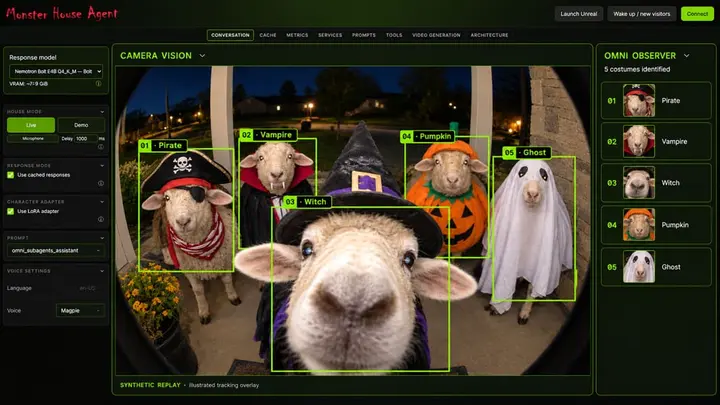
To test the home vision system, a video of sheep wearing five different Halloween costumes (a pirate, a vampire, a witch, a pumpkin, and a ghost) was fed to the Nemotron 3 Nano Omni model. This model accurately identified each costume. To ensure this recognition remained precise, the YOLO and ByteTrack models were used separately for people counting and tracking.
Hardware and Computing Budget
To run this entire pipeline on-premise without any cloud server, a powerful hardware setup was deployed. The computational workload was divided into two parts:
1. First processor: The language model (Bolt E4B), speech-to-text (ASR), and vision model were run on an NVIDIA RTX PRO 6000 Blackwell Max-Q GPU. 2. Second processor: Unreal Engine 5 graphics and Audio2Face-3D real-time motion animation were run on an NVIDIA RTX PRO 4000 Blackwell GPU.
Dividing the computing power in this manner ensures that even while the language model is processing, there is no drop in the animation frame rate, keeping the experience completely smooth.
The Alliance of Hugging Face and NVIDIA
This project has been released on the Hugging Face platform. Hugging Face was founded in 2016 in New York City by Clément Delangue, Julien Chaumond, and Thomas Wolf. Originally a company that built chatbots for teenagers, it has today become the world's largest open-source platform for machine learning models and datasets.
It is noteworthy that in September 2026, NVIDIA announced the acquisition of Hugging Face for $12.93 billion. Founded in January 1993 by Jensen Huang, Chris Malachowsky, and Curtis Priem, NVIDIA is today the world's leading AI chip maker with a market cap exceeding $5 trillion. NVIDIA has clarified that even after this acquisition, Hugging Face will continue to operate as an open platform.
Implications for India and Future AI Agents
The nemotron-halloween project proves that open AI models running locally (edge computing) are now becoming just as capable as cloud servers. In India, where internet connectivity and data privacy are major issues, this type of agent running on local workstations or on-device can be extremely useful.
This has also paved the way for creating real-time avatars and 3D animated agents capable of communicating in local languages across fields such as education, entertainment, robotics, and customer service. Monster House is not merely a playful Halloween experiment, but a robust preview of AI interaction between the physical and digital worlds.