Meta Muse AI 'Spaces': A New Revolution in Building Custom Apps Without Coding
Meta has introduced the 'Spaces' feature to its Muse AI agent, enabling users to create personalized tools or dashboards by providing instructions in natural language.

When we need a specific app for a particular task on a computer or smartphone, we go to an app store to find it or have a programmer write the code from scratch. But what if we could just write a single sentence and have the computer create a new tool or dashboard tailored to our needs in the blink of an eye? On November 6, 2026, Meta Platforms took a major step in this direction by announcing a new feature called 'Spaces' on its Muse platform. This feature allows users to create temporary or permanent digital spaces according to their daily habits, goals, and projects without learning any kind of coding.
According to the company, this new system available within the Muse app will redefine the use of personal software. Everything for which we previously created separate spreadsheets or pages in notes apps will now be transformed into a live experience by a single AI agent (an agent is software that automatically makes decisions and performs complex tasks on behalf of the user). Meta co-founder and CEO Mark Zuckerberg stated that he personally used this feature to create a dashboard for controlling his home appliances, a barbecue game, and an event tracker, all by simply providing instructions.
What is Spaces and how is it useful in daily life?
'Spaces' is essentially a specialized workspace that has evolved beyond the standard conversational chatbox. Until now, whenever a new topic began in a conversation with AI, old information would scroll out of view. This difficulty has been resolved in Spaces. A user can create a separate tab or sidebar space for any specific project. For example, if a family is planning a wedding in the coming months, they can create a space named 'Wedding Planner,' where the expense list, guest list, and shopping items remain fixed in one place.
This space is not limited to static text but is fully interactive (meaning the user can click, change details, or check off items). According to a report by The Verge, these Spaces can connect directly with third-party services such as Gmail, Google Calendar, OpenTable, and Notion. Because of this integration, if a flight ticket arrives in your email, concert dates change, or a new interest rate is added to your savings plan, the space automatically updates itself in the background. The user does not have to ask it to do so every time.
In addition, users can organize the schedules of these Spaces according to their needs. During the working days of the week, from Monday to Friday, the office weekly planner can be kept on the main screen, while as soon as Saturday arrives, it automatically hides and the dashboard for weekend planning or Sunday outings appears. Projects that are completed can be archived or hidden in the sidebar.
ટકા (%)
Technology behind the scenes: Muse Wonder and the new model architecture
It is impossible to run a complex system like Spaces using only a simple large language model (a large AI model learned from the relationships between billions of words of language). For this, the help of the 'Muse Wonder' model series, introduced a few weeks ago by Meta Superintelligence Labs, has been taken. According to the official report of the research laboratory, specialized models have been prepared based on the experiences gained from Muse Wonder, and they have now been integrated into the Muse app as well as Meta AI.
Research results show that the new generation of models has recorded a score of 47% on the Personal Superintelligence Index (a score measuring AI efficiency in personal tasks), while the previous Muse model was stuck at 38% in this test. This direct jump of 9 percentage points shows that these models are not limited to just answering questions, but have the ability to properly advance complex and long-term projects.
To understand the mathematics behind the entire process, it is necessary to look at Meta's internal model history. Meta introduced the first model of this series, Muse Spark, in April 2026. Subsequently, on August 10, 2026, Muse Glimmer was launched for local coding. On October 15, 2026, the company released 'Muse Spark Open', an open-weight model with 816 billion total parameters (arithmetic values representing the model's memory and learning capacity) and 42 billion active parameters, which was based on Mixture of Experts (a system containing special sub-models for different subjects). The cumulative essence of all these researches has now reached the general user through Muse Wonder.
- Description of the ideaThe user states their need in simple language, such as planning a trip, a wedding shopping list, or a daily sports board.
- Interface creationMuse AI instantly creates a temporary app with interactive buttons, checklists, and trackers based on this instruction.
- App integration and data syncInformation is automatically updated in the background by connecting with external apps like Gmail, Google Calendar, or Notion.
- Continuous improvements and placementThe user can organize this space in the sidebar or main tab and make changes at any time during the conversation.
Active Memory and Active Focus: A brain that never forgets
When any AI tool handles long projects, two major problems arise: first, it forgets old conversations or holds onto unnecessary details; second, if an unexpected obstacle occurs while working, it gets stuck. The Meta AI team has added two extremely important features called 'Active Memory' and 'Active Focus' as a permanent solution to these problems.
The hallmark of Active Memory is its ability to distinguish between permanent and temporary information. For instance, the fact that a user has a seafood allergy is permanent, but the information regarding which restaurant they are visiting tonight is temporary. The model draws a logical distinction between information that has become outdated over time and information that is useful in the present. According to Meta's statistics, there has been a 2.4-fold reduction in errors related to forgetting necessary context in the new model. In Active Memory evaluation tests, the current model achieved 90% accuracy in the criterion of correctly utilizing critical contexts, up from 76% previously.
On the other hand, the Active Focus model trains the system to remain fixed on its primary objective. In everyday life, unexpected obstacles arise while performing any task, such as a website failing to load or details being incomplete. In such circumstances, the new model seeks alternative paths without giving up. The model has shown a 67% improvement in successfully completing daily tasks that involve unexpected difficulties. Furthermore, when a user intervenes mid-task to provide new clarifications or change direction, the model accepts the new instructions without getting confused.
ટકા (%)
Market Competition and Broader Perspective
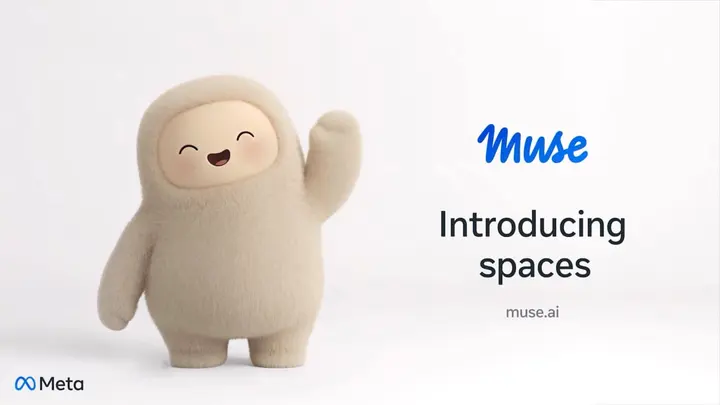
According to a TechCrunch report, Meta is not alone in this field. In recent months, a race has intensified among various AI companies to create agentic helpers. OpenAI has introduced 'dots,' and Elon Musk's organization-affiliated SpaceXAI has released cute, cartoon-styled agents like 'Grokbot' into the market. Meta has also given its agents a specific cute mascot avatar in this competition. In the October 2026 earnings call, Mark Zuckerberg announced that in less than two months since launch, the number of Muse agent users in the US and Canada had surpassed 10 million (one crore).
Not just spaces, but the company also introduced a feature called 'Muse Voice' this very week, which allows users to conduct direct video calls with their AI agent and issue commands via speech. All these developments indicate that Meta is no longer limited to just a chat application but is creating an experience akin to an entire operating system, where all of a user's digital tasks can be handled by a single agent.
| Model Name | Type / Size | Main Role / Capability | Release Date |
|---|---|---|---|
| Muse Spark | Base model | First foundation model of the Muse series | April 2026 |
| Muse Glimmer | Small open-weight model | For local agentic and coding operations | 10 August 2026 |
| Muse Spark Open | 816B total, 42B active (MoE) | Open-weight model available for researchers | 15 October 2026 |
| Muse Wonder | Frontier superintelligence | New series with active memory and active focus | October 2026 |
What does this mean for the general public and countries like India?
In a vast country like India, where millions of small traders, students, and freelancers cannot afford to hire expensive software developers, this type of technology can bring about a major transformation. A small shopkeeper can create an inventory tracking space simply by writing in their own language, or a teacher running tuition classes can build a dashboard for managing their batches and fees in seconds. The democratization of the app-building process is the brightest aspect of this technology.
However, there are also some unresolved concerns regarding this technology. When a user connects all their applications, such as email, calendars, and personal notes, to a single central AI agent, the issue of data privacy and security becomes extremely critical. If there is a lapse in third-party syncing or if the AI agent makes an automated decision based on incorrect information, the user could suffer significant losses. Meta is currently working on a feature to facilitate group work by sharing these spaces with other users, but without strict privacy regulations, this sharing could also prove to be risky.

Ultimately, Muse Spaces provides a clear indication that in the future, software will no longer be a fixed and immutable thing. The moment a user has an idea, their computer will automatically create software to match it. This new digital paradigm is transforming the ordinary person from a mere consumer of software into the creator of their own digital world.


