Internal Architecture of the Perseverance Rover's Sample Caching System Preserving Martian Soil Secrets
NASA's Perseverance Rover sample caching system lays the groundwork for collecting rock and soil samples from Mars and securing them for future missions.

Under the Mars 2020 mission managed by NASA, the Perseverance rover and the Ingenuity helicopter were sent to study the planet Mars. This mission was launched on July 30, 2020, by an Atlas V-541 rocket and successfully landed in Mars's Jezero Crater on February 18, 2021. This landing site on Mars was later named Octavia E. Butler Landing on March 5, 2021. The main objective of this mission is to study the ancient atmosphere and geological processes of Mars, and to search for signs of past microbial life or biosignatures there.
The most important role in this study is played by the rover's Sample Caching System (a robotic system that collects and securely preserves samples). This system securely packs core samples of rocks (cylindrical pieces obtained from a core drill) and soil samples from the Martian surface into tubes. NASA's Science Definition Team first proposed collecting 31 samples, which was expanded in 2015 with a plan to deposit sample tubes at various locations on the Martian surface. These samples will be brought back to Earth by the future Mars Sample Return (MSR) mission.
| Component | Mass / Size |
|---|---|
| Perseverance Rover Weight | ૧,૦૨૫ kg |
| Curiosity Rover Weight | ૮૯૯ kg |
| Cruise Stage Weight | ૫૩૯ kg |
| Aeroshell Descent Vehicle | ૫૭૫ kg |
| Heat Shield Weight | ૪૪૦ kg |
| Descent Stage (with fuel) | ૧,૦૭૦ kg |
| Parachute Diameter | ૨૧.૫ m |
| Robotic Arm Length | ૨.૧ m |
| Wheels Diameter | ૫૨.૫ cm |
| MMRTG Plutonium Dioxide | ૪.૮ kg |
The design of the Perseverance rover is inspired by its predecessor, the Curiosity rover, but new scientific instruments and an advanced core drill have been added to it. Speaking of the weight of the mission's various systems, the cruise stage for the journey from Earth to Mars was 539 kilograms. The Entry, Descent, and Landing System (EDLS), which enables entry into the Martian atmosphere and a safe landing, included a 575-kilogram aeroshell and a 440-kilogram heat shield. The descent stage that performed the soft landing of the rover on the Martian surface had a weight, including fuel, of 1,070 kilograms, which included 400 kilograms of landing propellant. During the final landing, a massive parachute 21.5 meters wide and weighing 81 kilograms was used to decelerate.
The Perseverance rover has a total weight of 1,025 kilograms, which is 14 percent more than the 899-kilogram weight of the Curiosity rover. New technological changes have been made in the rover, among which its wheels have been made stronger. Based on the experience with Curiosity's worn-out wheels from driving, Perseverance is fitted with thicker and more durable aluminum wheels with a diameter of 52.5 centimeters, featuring cleats for traction and curved titanium spokes for spring-like support. Apart from this, the rover has 19 cameras and 2 microphones. A Multi-Mission Radioisotope Thermoelectric Generator (MMRTG) is mounted on this rover. Weighing 45 kilograms, this generator uses 4.8 kilograms of plutonium dioxide, which generates about 110 watts of electricity at launch and has an operational life of 14 years. Lithium-ion batteries have also been added to it for peak power demand.
- ૧. Drilling SampleCore samples are obtained by drilling into Martian rocks using the ૨.૧ meter long robotic arm.
- ૨. Tube SealingThe collected sample is hermetically sealed in a special internal ultra-clean tube.
- ૩. Internal CachingThe tube is weighed in the rover's internal caching subsystem and its inspection is recorded with a ૨D barcode.
- ૪. Surface CachingTubes are dropped at a specific location on the Martian surface for future Mars Sample Return (MSR) mission.
A 2.1-meter (6-foot 11-inch) long robotic arm with 5 joints is attached to the rover. With the help of this arm, samples are obtained by drilling into Martian rocks. The sample caching system works with extreme precision. First, the drill on the robotic arm takes a sample core from the rock. This sample is transferred to the rover's internal caching assembly, where it is securely packed and sealed in an ultra-clean sample tube. A 2D barcode is printed on each tube so that it can be properly identified during future missions.
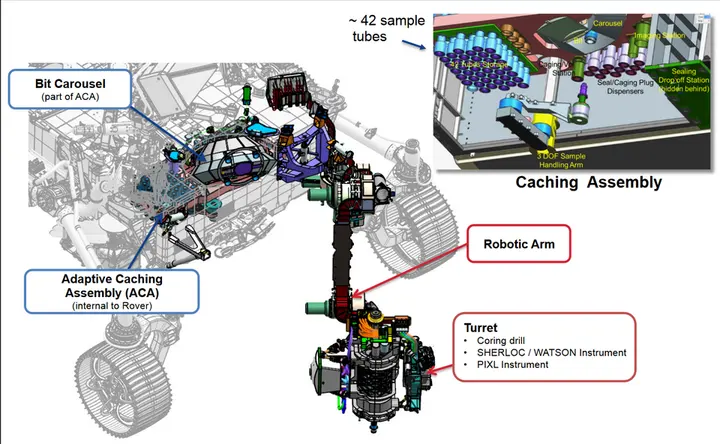
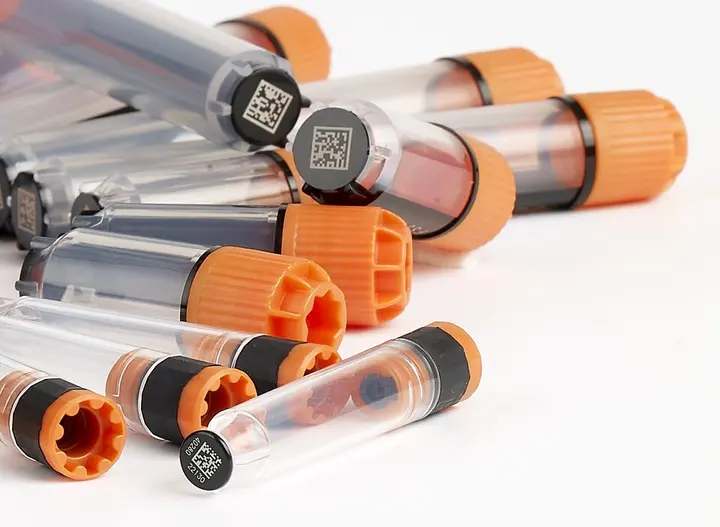
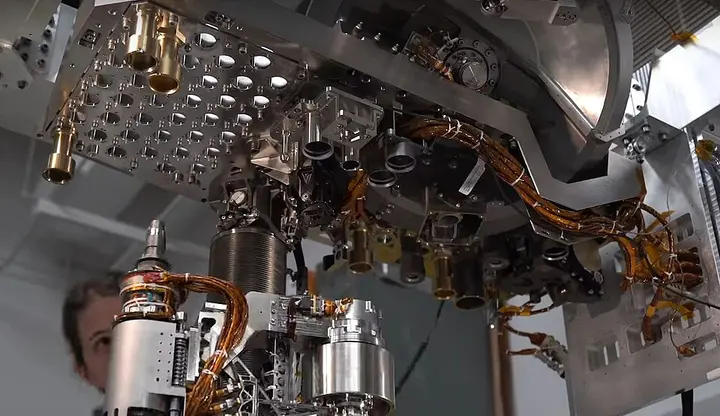
The internal mechanical structure of the sample caching system is extremely complex. This small robotic system located in the belly of the rover handles the sample tubes, measures their weight, photographs them, and hermetically seals them. After the tubes are sealed, they can be stored inside the rover or placed in a specific cache on the Martian surface. There is a plan to drop 20 to 30 sample tubes on the ground during the Perseverance mission.
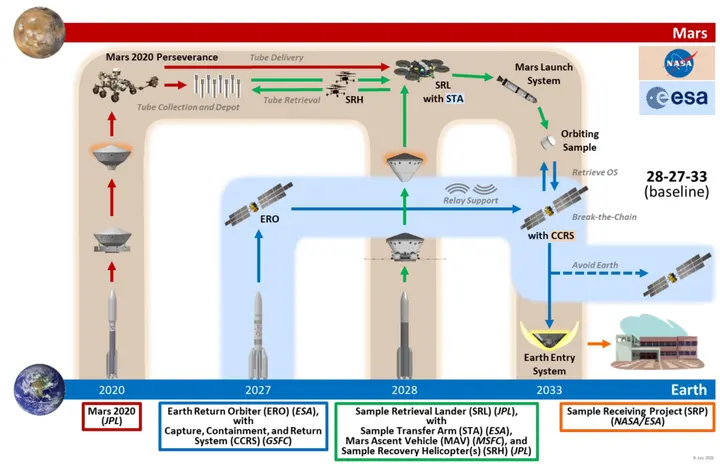
These samples are crucial for the joint Mars Sample Return (MSR) campaign by NASA and the European Space Agency (ESA). In a mission to be sent in the future, a fetch rover will collect these tubes and deliver them to a two-stage solid-fuel Mars Ascent Vehicle (MAV). The MAV will take off from the Martian surface and reach a 500-kilometer orbit. There, the sample container will be transferred to the Earth Return Orbiter and finally, these samples will be safely landed on Earth by the Earth Entry Vehicle (EEV).
The Perseverance rover utilized Terrain Relative Navigation (TRN) technology during its landing, which enabled a precise landing within an area of 7.7 km × 6.6 km with an error margin of no more than 40 meters. The rover successfully operated on Mars alongside the Ingenuity helicopter. Ingenuity served for 1042 sols (1071 days) before retiring on January 25, 2024. Perseverance rover continues to traverse the rugged terrains of Mars today, uncovering new mysteries of the universe for humankind.


