Nothing's First AI-Native Product: Can It Bridge the 'Context Gap' in Our Productivity?
London-based tech company Nothing has announced a screenless device designed to eliminate workflow bottlenecks with the help of artificial intelligence.

London-based consumer electronics company Nothing has created a new stir in the technology world. The company's CEO, Carl Pei, has announced that they are going to launch their first AI-native product next month. This will be a piece of hardware that will have no screen and cannot be replicated merely as a software application. According to the company, the main purpose of this product is to increase professional productivity and bridge the 'context gap' that exists in artificial intelligence. Carl Pei believes that the true value of AI lies in its ability to solve the complex problems we encounter in our work.

According to a report by The Hindu, there is a deep logic behind this strategy of Nothing. Looking at history, personal computers and mobile phones were established as important work tools decades before they became a part of consumers' lives. Currently, in the enterprise sector, AI is being used primarily in coding, IT, customer support, and legal services. This is why the company believes that productivity-enhancing tools will be the main engine for widespread adoption of AI. Although current AI models are very powerful, they are disconnected from the user's daily activities and immediate thoughts, which the company refers to as the 'context gap'.
The 'context gap' is a situation where an AI system has no knowledge of your current circumstances. For example, if you are in a meeting or working on a specific project, you have to provide all the information to current chatbots yourself. Nothing's new tool will bridge this gap by connecting AI directly to daily work tools. This means that instead of remaining just a text-based chatbot, the AI will be able to understand your work environment. In this way, it will act as a bridge between the user's thoughts and the activities surrounding them.
- Activity MonitoringAI continuously monitors the user's daily digital activities and working environment.
- Understanding ContextIdentifies the 'context gap' by understanding the user's immediate thoughts and needs.
- Direct IntegrationInstead of a chatbot, AI directly connects with work tools (email, calendar) to respond.
- Proactive AssistanceAutomatically suggests or completes necessary next steps without user commands.
The company has also emphasized better design in workplace technology. Citing design icons like the Olivetti typewriter from the 1960s, Nothing has argued that useful tools can also be beautiful and artistic. It is expected that this new product will not only be efficient but also visually appealing. In the future, AI will no longer be just a tool that a user has to interact with, but will become a proactive assistant that automatically handles daily tasks. This transformation could completely change our relationship with technology.
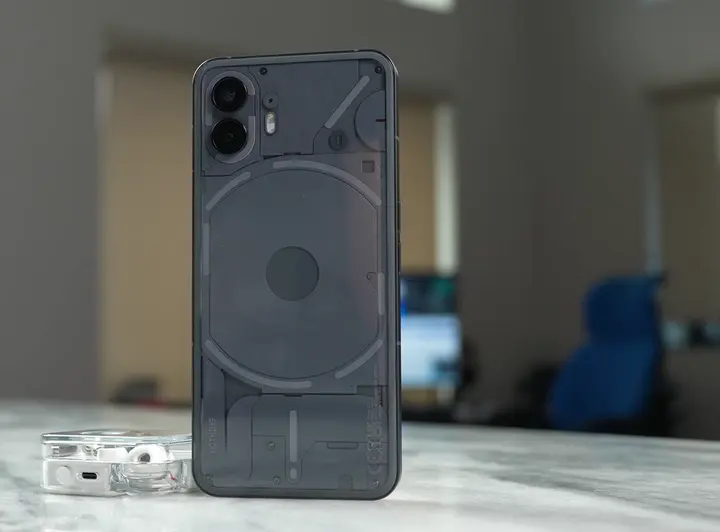
Nothing Technology Limited was founded in 2020 by Carl Pei, who was previously a co-founder of OnePlus. According to Wikipedia data, the company has generated over $1 billion in sales to date, and its annual revenue has surpassed $500 million. In India, Nothing has become the fastest-growing smartphone brand, recording a massive year-over-year growth of 577%. The company's transparent design and Glyph Interface—an LED lighting system located on the back of the phone—distinguish it from other brands. To date, the company has sold over 7 million devices and currently employs approximately 900 people.
The company's product range includes smartphones and audio products. Launched in 2021, the Ear (1) was their first product, which garnered attention for its transparent design. This was followed by the launch of the Phone (1), Phone (2), and most recently, the Phone (3). The Phone (3) features a Snapdragon 8s Gen 4 processor and a new 'Glyph Matrix' interface. The price of this phone starts at ₹79,999 in India. Nothing also launched a budget-oriented sub-brand called CMF, which was registered as an independent Indian company in 2026.
From a broader perspective of technology, Artificial Intelligence (AI) is a system capable of mimicking human intelligence. According to a Wikipedia report, AI began as an academic discipline in 1956. A major revolution occurred in this field after 2012, when Graphics Processing Units (GPUs)—specialized chips used for complex calculations—began to be used to accelerate neural networks. The advent of 'transformer architecture' in 2017 led to the development of Large Language Models (LLMs), which we see today in tools like ChatGPT.
Nothing's new AI product is the next stage of this evolution. Until now, we primarily used AI to obtain information or create content. However, according to Carl Pei's plan, AI will now act on our behalf. For example, it will be able to reply to your emails, schedule your meetings, or manage your projects. The absence of a screen on the device suggests that technology will become so integrated into our lives that we will no longer need to constantly look at screens. This could be the first step toward a 'screenless' future.
Nothing has also made significant progress in audio products. The recently launched Headphone (1) features an audio system tuned by KEF and offers a battery life of up to 80 hours. These headphones are equipped with analog buttons and rollers for volume control, which sets them apart from Apple or Sony headphones. The company has also introduced affordable options like the Ear (a) in the market, which has a battery life of 42.5 hours. All these products exhibit a blend of design and functionality, which has become the hallmark of Nothing.
કલાક (Battery Life)
The importance of Nothing is growing for the Indian market. The company launched the Phone (3a) and Phone (3a) Pro in 2025, which featured an AI tool named 'Essential Space'. This tool assists the user in various organizational tasks. By making British singer Charli XCX the brand ambassador in 2026 and Korean singer V in September 2026, the company has strengthened its grip on a global scale. After securing $200 million in funding from investors like Tiger Global, the company's valuation has reached $1.3 billion.
Ultimately, this new AI-native product from Nothing is an attempt to change the way technology is used. If it can successfully bridge the 'context gap', it will not remain just a gadget, but become an indispensable part of our professional lives. Are we ready to work with screenless devices? The answer to this question will be found next month with the launch of this product. What seemed like mere imagination until now is about to become a reality.