Measuring the Heartbeat of the Universe: The Remarkable Mechanics of LIGO and Laser Interferometry
An in-depth exploration of how LIGO, the most sensitive instrument ever built by humanity, detects Einstein's gravitational waves and the science behind it.

In September 2015, an unprecedented event occurred in human history. Approximately 1.3 billion light-years away from Earth, two massive black holes merged, and the ripples created in the fabric of space reached Earth. Scientists had worked for decades to capture these ripples, known as gravitational waves. The instrument through which this success was achieved is named LIGO, or Laser Interferometer Gravitational-Wave Observatory. Previously, all information about the universe reached us through light or other electromagnetic radiation, but LIGO has given us a new ability to 'listen' to the universe.
LIGO is the largest and most ambitious physics experiment to date. Its design is so precise that it can measure changes as minute as one-ten-thousandth the diameter of a proton. To achieve this level of accuracy, LIGO uses a technique called 'laser interferometry.' According to Wikipedia reports, this technique involves superimposing light waves onto each other to extract information. When two waves meet, the pattern created by their interaction is called interference.
| Observatory | Location | Arm length (km) | Sensitivity (Mpc) |
|---|---|---|---|
| LIGO | USA | 4 | 160-190 |
| Virgo | Italy | 3 | 80-115 |
| KAGRA | Japan | 3 | > 1 |
The Fundamental Principle of Interferometry
To understand interferometry, we must understand the principle of superposition of waves. When two waves of the same frequency combine, their intensity depends on the difference in their phase. If two waves are coherent, meaning their crests align with each other, it is called constructive interference, and the intensity of the light increases. Conversely, if the crest of one wave aligns with the trough of another, it is called destructive interference, and the light waves cancel each other out.
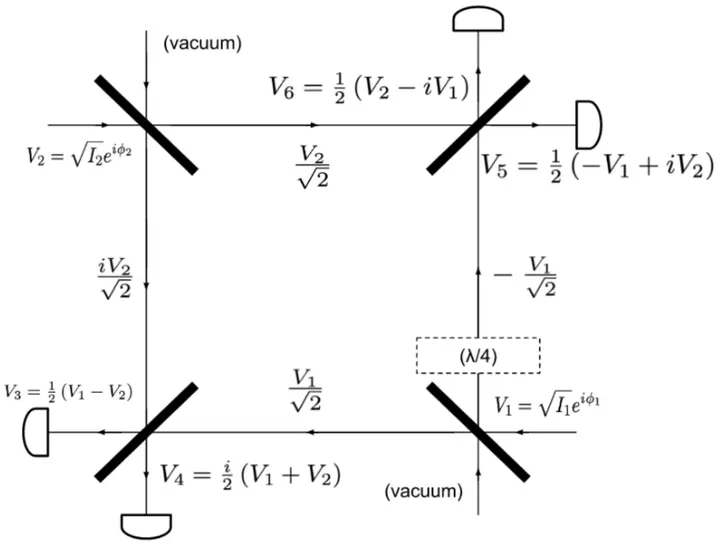
Most interferometers use a Michelson configuration. In this, light from a single laser source is split into two parts by a beam splitter. Both these beams travel along different paths and eventually recombine. If there is even a slight change in the length of these two paths, a phase difference occurs, and the light pattern seen on the detector changes. LIGO uses this same principle to measure the changes in the length of space caused by gravitational waves.
- Laser splittingA laser beam is divided into two parts by a beam splitter and sent into different arms.
- Reflection of lightLight hits mirrors 4 km away and returns, which is repeated multiple times.
- Meeting of wavesThe beams returning from both arms reunite and cancel each other out.
- DetectionWhen a gravitational wave arrives, the length changes and light appears on the detector, which is recorded as a signal.
The Remarkable Structure of LIGO
The two main centers of LIGO are located at Hanford and Livingston in the United States. Each center has two massive 'L'-shaped pipes, which are 4 kilometers in length. A complete vacuum is maintained inside these pipes so that the laser beam does not encounter any obstacles. Extremely pure and heavy mirrors are suspended at the ends of these 4 km long arms. When the laser beam hits these mirrors and returns, it has traveled thousands of kilometers.
According to scientists, LIGO's mirrors are kept so stable that even the normal vibrations of the Earth or the noise of vehicles do not affect them. For this, an extremely complex vibration isolation system is used. When a gravitational wave passes through the Earth, it stretches space in one direction and compresses it in another. Due to this, the length of one of LIGO's arms increases slightly while the other decreases. This extremely minute change causes a shift in the phase of the laser beam, which is detected by a photodetector.

Methodology: Step-by-step explanation
To understand the working mechanism of LIGO, we must follow the journey of the laser. First, light is emitted from a powerful laser source. This light beam hits a beam splitter, which divides it into two equal parts and sends them into two perpendicular arms. In each arm, the light bounces multiple times between the mirrors, which increases its effective travel distance to 1,120 kilometers. This increases the sensitivity of the instrument many times over.
- Splitting of laserA powerful laser beam is divided into two equal parts by a splitter.
- Travel and reflectionBoth laser beams travel in 4 km long arms and return after hitting the mirrors.
- Identification of wavesIf a gravitational wave passes, changes in the length of the arms cause flashes of light to appear on the detector.
In a normal state, when these two beams return, they are aligned in such a way that they completely cancel each other out (destructive interference). This means no light is visible at the detector. However, when a gravitational wave passes, this balance is disrupted due to the change in the length of the arms. As a result, flashes of light appear on the detector. From the pattern of these flashes, scientists can determine what type of astronomical event these waves originated from.

Statistics and limits of precision
LIGO's capability is astonishing. It can measure changes in the 4 km long arm with a precision of 10^-18 meters. For comparison, this measurement is thousands of times smaller than the nucleus of an atom. Hundreds of millions of dollars have been spent to achieve this level of precision. No waves were detected in the initial LIGO project between 2002 and 2010. Subsequently, it was upgraded at a cost of 200 million dollars to create 'Advanced LIGO', which had 4 times the sensitivity.
According to Wikipedia data, by February 2026, LIGO has completed a total of 4 observation runs and detected 391 gravitational waves. During the fourth run (O4) alone, 250 potential events were recorded, of which 77 have already been confirmed. Not only the United States, but Italy's Virgo and Japan's KAGRA observatories also collaborate in these experiments. Due to this global network, the direction from which the waves originate can be determined precisely.
| Detail | Number |
|---|---|
| Total potential events (Candidates) | 250 |
| Confirmed events | 77 |
| Under final analysis | 173 |
History and Nobel Prize
The existence of gravitational waves was predicted by Albert Einstein in 1916 in his General Theory of Relativity. However, the technology to measure them was not available at that time. In the 1960s, scientists like Joseph Weber began efforts to detect them. In the 1970s, Rainer Weiss proposed the idea of using a laser interferometer. Subsequently, the LIGO project was realized under the leadership of Kip Thorne and Barry Barish.
The LIGO project initially faced many obstacles. When Barry Barish became director in 1994, he gave this project a new lease of life. With a budget of 395 million dollars, it became the largest project of the National Science Foundation (NSF). After the first success in 2015, Rainer Weiss, Kip Thorne, and Barry Barish were awarded the Nobel Prize in Physics in 2017. This discovery proved how important patience and precision are in science.
Importance for India and the General Public
The success of LIGO is not limited to scientists alone. The development of this technology has revolutionized high-precision lasers, vacuum systems, and vibration control systems. India is now also set to make a major contribution in this field. Work is underway on the 'LIGO-India' project in Hingoli, Maharashtra, which will further strengthen the global network. This will provide Indian scientists and engineers the opportunity to connect with the world's most advanced science.
For the general public, this discovery is a new window to view the universe. Just as we can see inside the body through X-rays, similarly, through gravitational waves, we can understand the internal processes of mysterious objects like black holes and neutron stars. In the future, this technology may also help us detect waves from the time of the Big Bang, i.e., the origin of the universe. This journey of science has only just begun, and LIGO has proven to be a cornerstone in it.