The Secret Behind Hubble's Steady Gaze: The Remarkable Engineering of Fine Guidance Sensors
An in-depth analysis of the Fine Guidance Sensors and the interferometric technology that enable the Hubble Space Telescope to capture images while remaining stable in the depths of space.
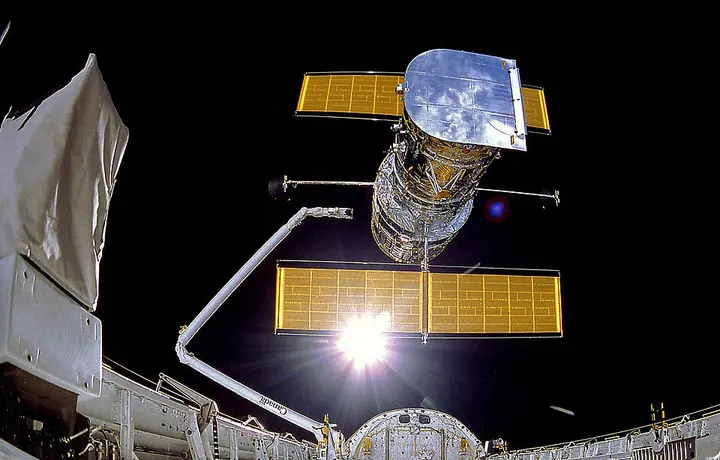
For a telescope orbiting Earth in space, the greatest challenge is to keep its gaze locked on a distant star or galaxy for hundreds of minutes without the slightest shift. Launched into low Earth orbit in 1990 by space shuttle mission STS-31, the Hubble Space Telescope has revolutionized the world of astronomy. Behind the success of this observatory lies as much credit to its extremely sensitive optical instruments, which keep the telescope oriented in the right direction, as to its primary 2.4-meter mirror. This specialized mechanism is known as the Fine Guidance Sensors (FGS).
If the orientation of the telescope deviates even slightly, long-exposure images become blurred. To achieve Hubble's scientific goals, its mirror and guidance systems were built to extremely stringent standards. In Hubble's operations, the Space Telescope Science Institute (STScI) determines its targets and processes data, while the Goddard Space Flight Center (GSFC) handles spacecraft control. However, the fundamental requirement of this entire arrangement is maintaining absolute lock on the target, a job handled by the FGS units.
Historical Background and Sensor Manufacturing
The concept of a space-based observatory was first proposed by Hermann Oberth in his 1923 book, and subsequently in 1946 astronomer Lyman Spitzer explained the advantages of placing a telescope outside Earth's atmosphere. Due to atmospheric instability on Earth, stars appear to twinkle, a limitation known as seeing. Obtaining diffraction-limited capability in space allows for an exceptional resolution of about 0.05 arcseconds. In the 1970s, the Marshall Space Flight Center (MSFC) was entrusted with the responsibility of giving shape to this project.
The design and manufacturing of the optical telescope assembly (OTA) and the Fine Guidance Sensors by MSFC was awarded to the renowned optics company Perkin-Elmer. The telescope is of the Ritchey–Chrétien Cassegrain design, utilizing two hyperbolic mirrors to achieve sharp imaging across a wide field of view. The sensors placed at precise intervals throughout Hubble's structure use the light coming from this very optical system for guidance.

Internal Structure of Sensors and Interferometry Technology
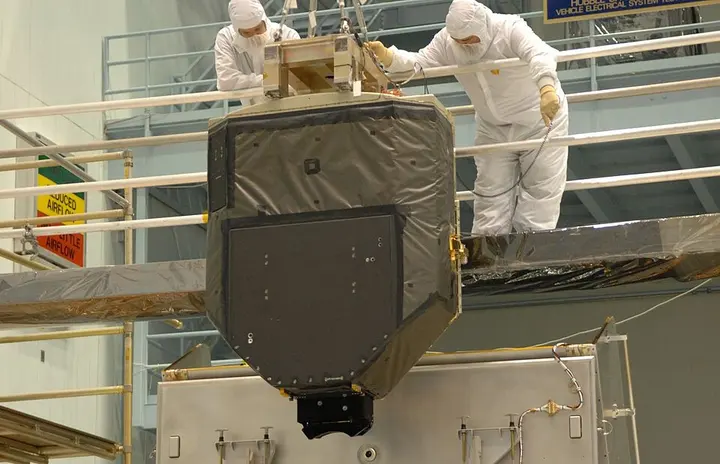
A total of three Fine Guidance Sensors are installed in the Hubble Space Telescope. These three sensors are arranged at 90-degree intervals along the periphery of the telescope's field of view. Rather than simply capturing images like a normal camera or sensor, Hubble's FGS units operate as interferometers. An interferometer is a specialized instrument that measures extremely minute distances and angles by utilizing the interference of light waves.
These sensors take advantage of the wave-like properties of incoming starlight. When starlight enters the sensor, it is split into two parts and recombined, creating an interference pattern. If the telescope drifts from its designated position by even an infinitesimal fraction of an arcsecond, a phase difference is created in the waves. This difference is instantly converted into an electrical signal and sent to the telescope's attitude control system (ACS).
- Light capture and splittingGuide star light coming from the perimeter of the telescope's field of view enters the sensor and is split.
- Interferometric interferenceLight waves are recombined to form an interference pattern, which detects even slight deviations.
- Generation of error signalIf the telescope moves even slightly, detectors generate an error signal based on the phase shift.
- Feedback to Attitude Control SystemThese signals are sent to the telescope's control system to correct and lock the pointing in real-time.
For telescope control, generally two of these three sensors are used simultaneously. These two FGSs lock onto predefined guide stars to keep the telescope completely stable in space. While these two sensors maintain the pointing, the remaining third sensor is freed to play a unique scientific role.
Beyond Guidance: The Role of Astrometry as a Science Instrument
Hubble's Fine Guidance Sensors are not limited to engineering control alone; they are also extremely powerful scientific instruments in their own right. The third free FGS is used for astrometry, which is the science studying the precise positions and movements of celestial objects. Due to the extraordinary accuracy of the FGS, it is used to measure precise distances between stars.
Furthermore, the FGS has proven crucial in the analysis of binary star systems. Stars that appear as a single point of light in ordinary telescopes can be resolved by the FGS to clarify whether they are truly twin stars. By measuring the extremely subtle wobble in the motion of nearby stars, it can also detect the presence of potential planets orbiting those stars. Additionally, this instrument makes important contributions to measuring the angular diameters of distant stars and galaxies.
| Feature | Hubble Space Telescope (HST) | James Webb Space Telescope (JWST) |
|---|---|---|
| Technical approach | Interferometric (light wave interference) | Imaging and centroiding detector |
| Total sensor units | 3 separate units (at 90-degree intervals) | 1 combined unit (integrated with NIRISS) |
| Use for scientific astrometry | Yes (third sensor available for research) | No (only for guiding and calibration) |
| Manufacturer / Supplier | Perkin-Elmer | COM DEV / Canadian Space Agency |
| Measurement rate / limit | Limited up to 50° from the Sun | 16 centroid measurements per second |
A Comparative Analysis of Hubble and James Webb Guidance
NASA's new James Webb Space Telescope (JWST) also features a guiding system named FGS, but its technology is entirely different from Hubble's. Provided by the Canadian Space Agency and manufactured by COM DEV International, the JWST FGS operates on an image centroiding method rather than an interferometer. To save weight and volume, it is integrated into a single unit with the Near-Infrared Imager and Slitless Spectrograph.
Unlike Hubble's FGS, JWST's sensor is not available to researchers for science proposals or astrometry studies; it is dedicated solely to guiding and calibration. JWST's sensor identifies the star field for target acquisition, centers the predetermined guide star in an 8 × 8 pixel window, and sends centroid measurements 16 times per second. On the other hand, Hubble's FGS directly provides interferometric measurements, facilitating advanced spatial measurements for researchers.

Operational Limitations and Historical Challenges
Because Hubble's FGS units are extremely sensitive optical instruments, they also have certain specific operational limitations. Due to the high sensitivity of these sensors, the FGS cannot be used when the telescope is pointed at an angular distance of 50 degrees or less from the Sun. The intense light of the Sun can damage these sensitive interferometric detectors, making it imperative to maintain this safety angle.
Throughout Hubble's history, its maintenance has been performed by astronauts. From the 1993 STS-61 mission to the final servicing mission in 2009, Hubble's instruments and FGS units were repaired and upgraded through five shuttle missions. Although the initially proposed 3-meter primary mirror was reduced to 2.4 meters due to budget constraints, these FGS units manufactured by Perkin-Elmer have provided steadfast support for Hubble in conducting landmark researches such as discovering the universe's expansion rate.
મીટર
Operating for over thirty years, this telescope is expected to remain operational until 2030 to 2040. Designed by Perkin-Elmer's engineers, this interferometric guidance architecture is still considered an exemplary model of precision and stability in space science.