The Gold-Coated MIRI Instrument of the James Webb Space Telescope Unlocking the Invisible Mysteries of the Universe
The intricate engineering art of capturing mid-infrared rays originating from distant galaxies and proto-planetary disks by operating at sub-zero temperatures.

December 25, 2021, is a day written in golden letters in the history of space science, when the James Webb Space Telescope (JWST) was launched via an Ariane 5 rocket from Kourou, French Guiana. Built through the joint venture of NASA, the European Space Agency (ESA), and the Canadian Space Agency (CSA), this telescope operates at the Sun-Earth Lagrange point 2 (L2), located approximately 1.5 million kilometers away from Earth. Prepared at a cost of 10 billion US dollars ($10 billion), this is the largest and most powerful space telescope of Earth.
The primary objective of the James Webb Telescope is infrared astronomy, which is the study of invisible infrared light coming from the universe. Webb is specially designed to observe the first galaxies formed in the initial stages of the universe's origin and ancient bodies up to a cosmic redshift of z≈20 (approximately 180 million years after the Big Bang). For this task, four state-of-the-art scientific instruments are installed on the telescope, of which the most important and complex device is 'MIRI', the Mid-Infrared Instrument (MIRI).
| Feature | Hubble Space Telescope | James Webb Telescope (MIRI) |
|---|---|---|
| Primary mirror diameter | 2.4 meters | 6.5 meters |
| Light gathering area | 4.0 square meters | 25.4 square meters |
| Operational temperature | 15 °C (288 K) | 7 K (-267.15 °C - MIRI) |
| Wavelength range | 0.1 - 2.5 microns | 0.6 - 28.5 microns (MIRI: 5-28 μm) |
| Orbit | 550 km (Earth orbit) | 1.5 million km (L2 point) |
Observing the Universe at Near-Zero Temperatures: What is MIRI?
According to Wikipedia reports, MIRI is the only scientific instrument of James Webb that operates in the mid-infrared, i.e., at wavelengths from 5 to 28.6 microns. The other three instruments of the telescope work only in the near-infrared region. The mid-infrared spectrum is extremely important because these rays can easily pass through dust clouds in space, making the clear study of dust-obscured newborn stars and nascent planetary systems (debris disks) possible.
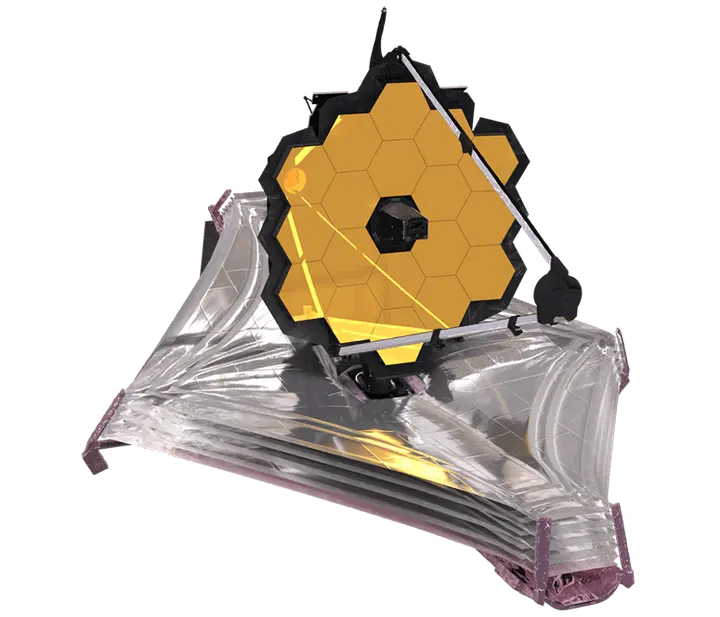
The primary mirror of the Webb telescope is made of 18 pentagonal beryllium segments, coated with an extremely thin layer of gold. The diameter of this mirror is 6.5 meters (21 feet) and its light-collecting area is 25.4 square meters, which is approximately six times larger than the 4.0 square meter area of the Hubble Space Telescope. This huge mirror focuses light onto devices like MIRI, allowing bodies 100 times fainter than those seen by Hubble to be easily viewed.
Cryocooler: The Unique Technology for Super-Cooling Down to 7 Kelvin
The greatest feature of the MIRI instrument is its remarkable ability to maintain cooling. Whenever an object is hot, it naturally emits infrared radiation. If the MIRI instrument itself were to remain hot, its own thermal noise would mask the faint light coming from distant stars. Therefore, MIRI has to be operated at an ultra-cold temperature of just 7 Kelvin (-267.15 °C), which is even colder than the vacuum of space.
The James Webb's five-layered sunshield made of Kapton E keeps the main structure of the telescope below 50 Kelvin (-223 °C). However, since MIRI requires even greater cooling than this, a special cryocooler system has been added to it. Developed by NASA and TRW, this system uses helium gas as a refrigerant.
- Step 1: Primary cooling by sunshieldFive-layered Kapton sunshield blocks heat from Sun and Earth, bringing the entire module below 50 Kelvin.
- Step 2: Pulse tube pre-coolerMIRI's special cryocooler uses helium gas to reduce temperature down to 20 Kelvin using a multi-stage pulse tube.
- Step 3: Joule-Thomson loop expansionHelium gas is passed through Joule-Thomson (J-T) loop by Oxford-style linear compressor to cool it more rapidly.
- Step 4: 7 Kelvin temperature and stabilityWith this technology, MIRI's arsenic-doped silicon detectors reach a low temperature of 7 Kelvin (-267.15 °C).
This cryocooler operates in two stages: in the first stage, the temperature is brought down to 20 Kelvin by a multi-stage pulse tube precooler. Thereafter, the helium gas is expanded through a Joule-Thomson (J-T) loop heat exchanger driven by an Oxford-style linear compressor, stabilizing MIRI's detectors at a precise temperature of 6 to 7 Kelvin. All this heat is radiated out into space by a radiator located on the spacecraft bus.

Architectural Design of the MIRI Instrument: Imager and Spectrometer
The MIRI instrument is primarily composed of two parts: an Imager and a Spectrometer. This instrument rests on a carbon-fiber hexapod structure called the Integrated Science Instrument Module (ISIM) of the telescope, which thermally isolates it.
MIRI's imager module has 10 different filters available (such as F560W, F770W, F1000W, etc.), which are capable of taking wide-area images. Its plate scale is 0.11 arcseconds/pixel and the field of view is 74 x 113 arcseconds. Apart from this, it also features a coronagraph with 4 special filters, which helps in capturing images of dust clouds or planets surrounding a bright star by blocking its light.
ચોરસ મીટર (m²)
MIRI's spectrometer section operates at wavelengths from 4.6 to 28.6 microns. It provides Low Resolution Spectroscopy (LRS) and Medium Resolution Spectroscopy (MRS). An Integral Field Unit (IFU) is used in the MRS mode, which creates a 3D image cube with a distinct spectrum for each pixel.

Arsenic-Doped Silicon Chips and Detector Technology
To convert light into digital data, MIRI uses special Focal Plane Modules (FPMs) made of arsenic-doped silicon (Si:As). There are a total of three such detectors in MIRI – one for the imager and two for the spectrometers. Each detector has a capacity of 1024 x 1024 pixels (1 megapixel).

These arsenic-doped silicon chips convert mid-infrared photons into electrons with extreme precision. In the low-resolution spectrometer, prisms of germanium (Ge) and zinc sulfide (ZnS) are used to disperse light from 5 to 14 microns.
The MIRI instrument is an excellent example of international scientific collaboration. Under the leadership of Prof. Gillian Wright of the UK Astronomy Technology Centre, a consortium of 10 European countries, along with NASA's JPL and a team led by Prof. George Rieke of the University of Arizona, built this magnificent instrument on a fifty-fifty partnership basis. Today, this super-cooled eyeball is showing us new frontiers in the birth of the universe's first stars and the atmospheres of distant planets.