A 'Time Machine' Camera Unlocking the Secrets of the Universe: The Remarkable Technology and Mechanism of the Time Projection Chamber
An in-depth exploration of the internal architecture of the Time Projection Chamber, which three-dimensionally captures the trajectories of invisible particles generated after particle collisions in the Large Hadron Collider.

When we think of massive scientific laboratories like the Large Hadron Collider, images of huge tunnels and magnets rise before our eyes. But the true heart of these experiments is the detectors that capture the movements of particles deep within the atom. The most important component among these detectors is the Time Projection Chamber (TPC). It is a device that reconstructs the 3D path of particles using a combination of an electric field and a magnetic field. According to a Wikipedia report, this technology is indispensable for identifying the thousands of fragments produced after particle collisions in physics.
The history of the invention of the Time Projection Chamber is very interesting. This concept was first introduced in 1974 by American physicist David R. Nygren. He developed this technology at the Lawrence Berkeley Laboratory in the late 1970s. Its first major use was in the PEP-4 detector, where electron-positron collisions with an energy of 29 GeV were studied. From then until today, many improvements have been made to the design of the TPC, but its fundamental principle remains the same as the one given by Nygren.
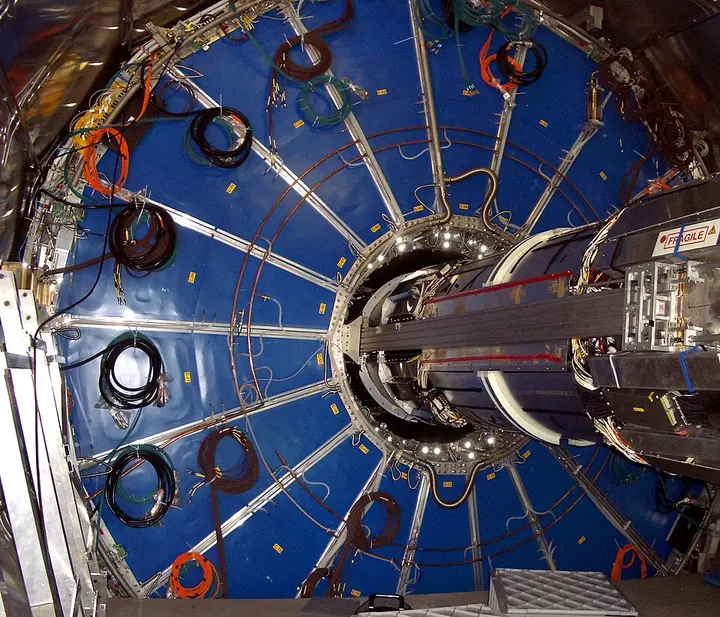
Basic Structure and Working Mechanism
A typical Time Projection Chamber resembles a gas-filled cylinder. A powerful electric field is established inside this cylinder. Right in the middle of the cylinder is a high-voltage electrode disc, which creates an electric field between the center and the end plates. When a charged particle passes through this gas, it collides with the gas atoms and knocks electrons free from them. This process is called ionization. Due to the electric field, these freed electrons begin to move toward the end of the cylinder.
The role of the magnetic field in this process is extremely crucial. A powerful magnetic field is applied along the direction of the cylinder's length. This field helps keep the electrons on a straight path and prevents them from diffusing sideways. If there were no magnetic field, the electrons would scatter by colliding with other gas atoms, which would reduce the accuracy of the particle's path. In this way, the electrons reach the sensors at the end in a straight line.
- IonizationCharged particles pass through gas or liquid, releasing electrons.
- Electron driftElectrons released due to the electric field move toward the sensor at the end.
- Signal amplificationElectrons reaching the wire planes generate weak electrical signals that are amplified.
- 3D ReconstructionBased on time and wire location, the computer reconstructs the entire particle path.
Converting Time into Distance: How It Works
TPC is named 'Time Projection' because it calculates distance through the measurement of time. When a particle passes through the gas, electrons are generated. Based on how long it took these electrons to reach the end, the depth (Z-coordinate) at which the particle was located in the cylinder is determined. For this, the drift time technique is used. Multi-wire proportional chambers (MWPC) are arranged at the ends of the cylinder, which capture these electrons.
The arrangement of the wires at the ends is such that it provides information on the other two dimensions of the particle (X and Y or radius and angle). The anode wires are in a circular direction which gives information on the radius, while the cathode plane strips give information on the angle. Combining these three pieces of information - drift time, radius, and angle - a computer creates a 3D image of the entire particle's path. This process is so rapid that it can process data of thousands of collisions occurring in a fraction of a second.
| Feature | Gas TPC | Liquid Argon TPC |
|---|---|---|
| Medium Density | Low | 1000 times higher |
| Main Application | ALICE (LHC) | Neutrino Experiments |
| Light Emission | Negligible | High (Scintillation) |
| Cost | Moderate | Higher (but efficient) |
Liquid Argon TPC: The Confluence of Density and Precision
Traditional TPCs used gas, but in modern experiments, the use of Liquid Argon (LAr) has increased. In 1974, William J. Willis and Veljko Radeka proved that the energy of particles can be measured in liquid argon as well. The biggest advantage of liquid argon is its density. It is about 1000 times denser than gas. This means that particles will experience more collisions in this medium, which is a boon for the study of hard-to-detect particles like neutrinos.
Since liquid argon is a noble gas, it does not absorb electrons, allowing the electrons to travel long distances. Furthermore, when a particle passes through liquid argon, it also produces flashes of light (scintillation). This light is captured by photomultiplier tubes. Because this light is produced at the exact time of the collision, it acts as a 'trigger', letting scientists know the exact time the collision began.

Signal Readout and Data Processing
The design of the LArTPC consists of three main components: a high-voltage cathode plate, a field cage, and anode wire planes. The cathode plate typically generates an electric field of about 500 V/cm. The field cage ensures that this electric field remains uniform throughout the chamber, preventing the electrons from drifting off course. On the anode side, there are multiple layers of wires. The inner layers are called induction planes, in which a current is induced when electrons pass through them. The final plate is called the collection plane, which absorbs the electrons.
Each wire is connected to a complex electronic circuit. When electrons approach a wire, they generate a bipolar signal—meaning the current first increases and then reverses direction. On the collection plane, this signal is unipolar. The intensity of this signal reveals how many electrons arrived, providing information about the particle's energy. This data is digitized to create 2D images, and then 2D images from different planes are combined to perform 3D reconstruction.
સાપેક્ષ ગુણોત્તર
Its Significance for Science
TPC technology is not limited to the LHC alone. It is also being used in the search for Dark Matter. In an experiment called the 'Dark Matter Time Projection Chamber' (DMTPC), low-pressure gas is used in an attempt to detect Weakly Interacting Massive Particles (WIMPs). Institutions such as MIT and Boston University are involved in these experiments. In 2010, this technology was used in an underground laboratory in New Mexico to collect important data regarding the existence of dark matter.
This technology is also important for India because Indian scientists are actively involved in CERN's ALICE experiment, which operates the world's largest TPC. This instrument helps us understand what the universe looked like in the early times following the Big Bang. Whether gas-based or liquid-argon-based, the Time Projection Chamber is an eye of modern physics that grants us the ability to see the invisible subatomic world.