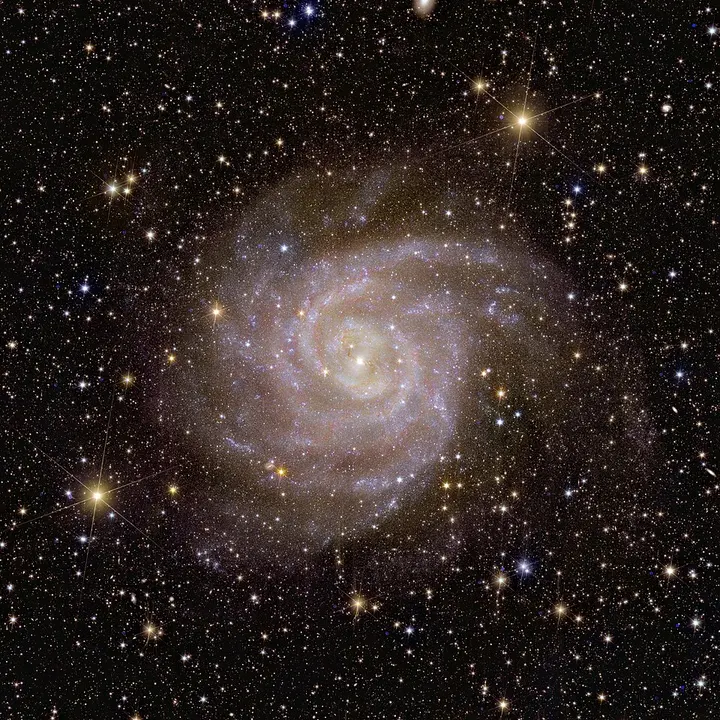
IC 342: A Magnificent Spiral Galaxy Hidden Behind the Dusty Veil of the Milky Way
Hidden behind the dust and stars of our own galaxy, the IC 342 galaxy serves as a key for scientists to unlock numerous mysteries of the universe.
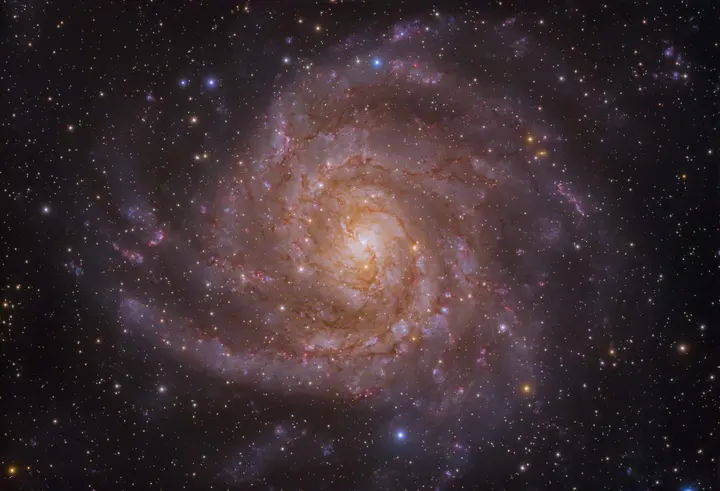
Countless galaxies are scattered across the vast canvas of the universe, but some of them are not easily visible despite being right before our eyes. One such wondrous galaxy is IC 342, which astronomers know as the 'Hidden Galaxy'. This galaxy is located very close to the galactic equator of our own galaxy, the Milky Way, where a dense veil of cosmic dust, gas, and stars is situated. This veil acts like a curtain, obstructing the light coming from IC 342.
If this dust curtain did not exist, IC 342 would be one of the brightest objects in the night sky and we would have been able to see it with the naked eye. This galaxy is located in the constellation Camelopardalis and is an intermediate spiral galaxy. Despite its luminosity and size, its position makes it difficult to view with standard telescopes, though it can be spotted with the help of binoculars. According to NASA's Astronomy Picture of the Day (APOD), this galaxy can be seen peeking out from the plane of our galaxy.
Discovery and Historical Significance
IC 342 was discovered in 1892 by the British astronomer William Frederick Denning. Ever since, this galaxy has been a subject of curiosity for scientists. The renowned astronomer Edwin Hubble initially thought that this galaxy was part of our 'Local Group'. The Local Group is a cluster of galaxies that includes galaxies like our Milky Way and Andromeda. However, later research revealed that it is not part of the Local Group, but is located very close to it.
In 1935, a scientist named Harlow Shapley noted that this galaxy appears even wider in the sky than a full moon. At that time, among known spiral galaxies, it was considered the third largest after Andromeda and Triangulum. According to modern estimates, its apparent size is about half to two-thirds of the moon's diameter. This galaxy is also known as 'Caldwell 5'.
| Characteristic | Detail |
|---|---|
| Other name | Caldwell 5, Hidden Galaxy |
| Type | Intermediate Spiral (Intermediate Spiral) |
| Constellation | Camelopardalis (Camelopardalis) |
| Discoverer | William Frederick Denning (1892) |
| Apparent size | 1/2 to 2/3 of the Moon's diameter |
The Mystery of Distance and Location
Determining the exact distance of IC 342 from Earth has always been a challenge for astronomers. The main reason for this is the dust of the Milky Way, which introduces errors in distance measurement calculations. According to recent reports from NASA, this galaxy is located approximately 10 million (1 crore) light-years away. However, various scientific studies have estimated this distance to be between 7 million and 11 million light-years.
This galaxy is one of the brightest members of the IC 342/Maffei Group. This group is the galaxy group closest to our Local Group. In the past, a theory was also proposed that IC 342 might have been ejected from the Local Group, but miscalculations caused by the dust of the Milky Way created this misunderstanding. Due to this dust, the light of the galaxy is dimmed, which is called 'extinction' in the language of astronomy.

Internal Structure and Magnetic Fields of the Galaxy
The structure of IC 342 is extremely complex and beautiful. It has a bright center called an H II nucleus. In this center, the process of new star formation is proceeding very rapidly. In the spiral arms of the galaxy, a bright glow of hydrogen gas is seen, which indicates the presence of young and hot stars there. However, the galaxy's own dust also intermittently blocks this light.
The most interesting thing for scientists is the magnetic fields of IC 342. Maps of this galaxy's magnetic fields have revealed that they play an important role in the formation of the spiral arms. It is a major mystery in astronomy how these spiral arms of a galaxy form and persist. The study of IC 342 shows that magnetic forces, along with gravity, may be playing a crucial role in this process.
Method of Observation
Since it is difficult to view IC 342 in ordinary light, scientists use infrared light to observe it. Infrared rays can pass through dust particles, revealing details hidden behind the galaxy. In infrared images captured by the WISE spacecraft, this galaxy is seen in its full splendor. In these images, the galaxy's warm dust clouds and regions of star formation are clearly visible.
- Emission of lightVisible and infrared light is emitted from the stars and gas of IC 342.
- Obstruction of dustMilky Way dust absorbs or scatters visible light.
- Infrared passing throughLonger wavelength infrared light passes through the dust to reach Earth.
- Telescope captureNASA's telescopes capture this infrared data and turn it into viewable images.
Satellite Galaxies and Neighbors
Small 'dwarf galaxies' orbit around large galaxies, which are called satellite galaxies. Compared to galaxies like Andromeda, IC 342 has very few such galaxies. In 2020, astronomers discovered a new galaxy named KKH 32, which is the first known dwarf spheroidal galaxy of IC 342. This tiny galaxy is 10.2 million light-years away from Earth and has a diameter of only 4,300 light-years.
Studying IC 342 teaches us a great deal not only about other galaxies, but also about our own home galaxy. Because it lies behind the plane of our galaxy, observing it also helps us understand the distribution of dust and gas within the Milky Way. Modern observatories like the Euclid telescope are now capturing more detailed images of this galaxy, which will unlock new mysteries of the universe in the future.