AI’s Hunger for Electricity and the New Global Network of Massive Power Substations
Gigawatt-scale substations are now required to power the continuous operation of artificial intelligence servers. The plan to establish Britain's largest substation in Teesside, UK, serves as a symbol of this revolution.

Nowadays, the discussion surrounding Artificial Intelligence (AI) is everywhere. From language models like ChatGPT to modern digital tools, massive data centers are working behind AI technology. However, software alone is not enough to train and run these complex AI models; they require an incredible amount of electricity. To meet this relentless power demand of AI data centers, a race to build massive electrical substations is now underway across the world.
Recently, the power transmission corporation named National Grid in Britain has signed a contract to purchase 29.5 hectares (approximately 73 acres) of land at Dorman Point, located in Teesside, North-East England. According to reports from The Times and Sky News, Britain's largest substation will be built at this site. This massive substation will supply electricity to a vast AI data center proposed to be spread over 500,000 square meters nearby. The capacity of this substation will be up to 3.2 Gigawatts (GW), which is capable of providing an unprecedented amount of electricity at a single location.
| Detail / Criterion | Value / Capacity |
|---|---|
| Land area | 29.5 hectares (73 acres) |
| Proposed power capacity | 3.2 GW (3.2 GW) |
| Data center area | 500,000 square meters |
| Main developer / operator | National Grid, Balfour Beatty, SRP |
The main reason behind this plan is that thousands of Graphics Processing Units (GPUs) remain operational day and night for the processing of AI models. These devices consume electricity at such a high density that traditional power networks cannot keep up with them. According to Tees Valley Combined Authority Mayor Ben Houchen, the biggest challenge for companies wanting to build data centers in the UK is obtaining sufficient electricity quickly. While other countries are attracting investment by providing power infrastructure rapidly, the creation of a 3.2 Gigawatt capacity at Teesside will enable the UK to compete globally in the AI sector.
What is a substation and how does it work?
In the flow from the generation of electricity to its arrival at the consumer, a substation (a center that changes and regulates the voltage of electricity) is an extremely important link. To transmit electricity generated in power plants to distant areas efficiently, its voltage (electrical pressure) is raised very high. However, electricity with such high voltage cannot be used directly in computers or factories. Substations primarily perform the task of converting this voltage from a high level to a low level (or from a low level to a high level).
The primary components of a substation in an electrical grid include transformers (devices that change voltage), circuit breakers (switches that cut off electrical current during a fault), and disconnectors. According to 2022 data, approximately 55,000 substations were in operation in the United States alone. Substations do not merely transform the flow of electricity; they also serve a protective function by isolating damaged parts when a fault occurs in the system, thereby shielding the entire grid from surges or blackouts.
- 1. Power GenerationLarge-scale electricity is generated through power plants or renewable sources.
- 2. Step-up transmission substationVoltage is stepped up significantly via transformers and sent through long-distance high-voltage lines.
- 3. Switching and grid controlThe substation safely controls the flow of electricity using circuit breakers and SCADA systems.
- 4. Step-down distribution substationHigh voltage is reduced to a medium level and sent to the data center's feeder lines.
- 5. Data center consumptionThe conditioned electricity provides continuous power to the data center's server racks and GPUs.
When electricity leaves a power plant, a transmission substation uses step-up transformers to increase the voltage and send it through long-distance lines. Subsequently, a distribution substation reduces this high voltage to medium or low voltage (such as 2.4 kV to 33 kV) so that it can be delivered to local consumers or data centers.
Types and Architectural Complexity of Substations
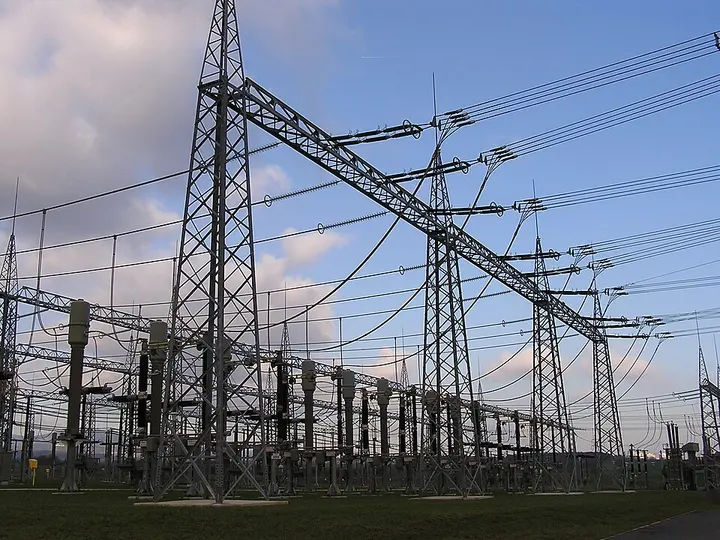
Substations are of different types based on their use and operation. A transmission substation connects two or more transmission lines and contains equipment such as capacitors and reactors for voltage control and power factor correction. Meanwhile, a collector substation typically gathers electricity from decentralized energy sources, such as wind farms or solar power plants, and sends it to the main grid.
With changing technology, converter substations have also become important, as they convert alternating current (AC) to direct current (DC) or to different frequencies. For data centers, switching stations are often used; these operate at the same voltage and perform the switching function of connecting or disconnecting lines.
When designing a substation, factors such as land availability, cost, environmental impact, and rapid construction are taken into account. Grid operators manage substations remotely using a digital remote control system called SCADA (Supervisory Control and Data Acquisition). By creating a 'single-line diagram' on graphical maps, the safety and switching plans for the substation are formulated.

AI Infrastructure and the Journey into the Future
According to a policy statement by the British government, data centers in the modern era are as fundamental to economic growth as traditional networks like railways and electricity. The National Grid is advancing this project in Teesside with the assistance of infrastructure companies such as Balfour Beatty and Steel River Power.
However, there is also local opposition to the construction of such massive substations and data centers. From the village of Auchtertool in Scotland to Brick Lane in London, local communities are expressing concerns regarding noise and environmental impacts. Nevertheless, there is no alternative to strengthening energy infrastructure to increase AI capacity on a global scale. In the future, these massive power substations will play the most critical role in ensuring a clean and rapid power supply for data centers.