The Blue Sapphire of the Andromeda Galaxy: A Stunning and In-Depth Analysis of the NGC 206 Star Cluster
Located 2.5 million light-years from Earth in our neighboring galaxy, NGC 206 pulses as one of the universe's largest star-forming regions.
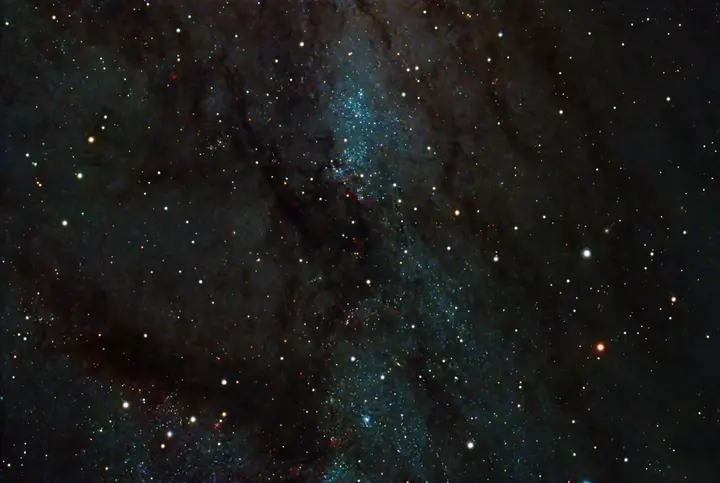
When we look toward the Andromeda Galaxy in the night sky, we see merely a faint patch of light. Yet, hidden within this vast spiral galaxy are countless mysteries, one of the brightest and most fascinating objects being NGC 206. This is no ordinary star, but a massive cluster of stars known in astronomical terms as a 'stellar association'. Located in the spiral arms of the Andromeda Galaxy, it appears from Earth as the brightest star cloud of this galaxy.
According to NASA and other astronomical sources, the Andromeda Galaxy is located approximately 2,500,000 light-years away from us. Despite being at such a vast distance, NGC 206 is large and bright enough to be studied in detail through modern telescopes. This star cluster is situated in the southwestern region of Andromeda, where the dusty arms of the galaxy and pink star-forming regions are found. Its luminosity and blue color set it apart from the surrounding dark space.

The history of NGC 206 is quite old. It was discovered in 1786 by the German-born British astronomer William Herschel. Herschel described it as a 'strip of milky brightness'. In early times, when we had limited knowledge about galaxies, scientists like Edwin Hubble identified it as a regular star cluster. However, as observational power increased, it became known that this is not a small group, but a massive association of thousands of stars.
- Discovery (1786)William Herschel discovered it as a bright patch within the Andromeda Galaxy.
- Identified as a star clusterEdwin Hubble initially described it as a giant star cluster.
- Modern classificationDue to its massive size and hot stars, it is now classified as an 'OB association'.
Today, NGC 206 is classified as an 'OB association'. This term means that the cluster consists primarily of O and B type stars. O-type stars are among the hottest and brightest stars in the universe, and have a blue color. These stars have a very short lifespan, which means that NGC 206 is a newly born nursery of stars. According to NASA's 'Astronomy Picture of the Day' (APOD) report, the youngest and most massive stars in this association are less than 10,000,000 (10 million) years old.
The physical structure of this stellar association is extremely vast. It is spread over an area of approximately 4,000 light-years. For comparison, ordinary star clusters found in our Milky Way are much smaller in size than this. The size of NGC 206 is as massive as NGC 604 located in the neighboring M33 galaxy or the Tarantula Nebula located in the Large Magellanic Cloud. Such a massive size indicates that thousands of stars must have been born here simultaneously from vast clouds of gas and dust at one time.

According to Wikipedia data, a special feature of NGC 206 is its double structure. This stellar association appears to be divided into two distinct parts. The age of one part is approximately 10 million years, while the age of the other part is between 40 to 50 million years. Between these two parts lies a dark band of interstellar dust, which visually separates them. This type of structure explains to scientists that star formation is not a continuous process, but it can take place in separate phases.
Furthermore, NGC 206 is located in a region where there is a deficiency of neutral hydrogen. Hydrogen gas is generally necessary for star formation, but the stars here have perhaps consumed the surrounding gas or pushed the gas away through their powerful radiation. In this cluster, there are more than 300 stars that are extremely luminous, whose absolute magnitude is greater than -3.6. Some of these stars are known as 'Cepheids', which help astronomers measure distances in the universe.
| Characteristic | Detail |
|---|---|
| Location | Andromeda Galaxy (M31) |
| Distance (from Earth) | Approximately 2.5 million light-years |
| Size (Diameter) | Approximately 4,000 light-years |
| Type of stars | O and B type (Blue Giants) |
| Age of youngest stars | Less than 10 million years |
| Number of bright stars | More than 300 (Mb < -3.6) |
Why is the study of objects like NGC 206 important? It provides us with an understanding of how stars are born and evolve outside our own galaxy. Since the Andromeda Galaxy is the large galaxy closest to us, it is like a laboratory. Instruments like NASA's Hubble Space Telescope and the upcoming Roman Space Telescope can resolve individual stars of NGC 206 and view them separately. These observations reveal how the process of star formation is linked with the dynamics of the spiral arms of the galaxy.
For the general public, NGC 206 is a symbol of the magnificence of the universe. When we look at these glowing blue stars through a telescope, we are observing light that is millions of years old. These stars are so hot that they emit abundant ultraviolet light. If we were on a planet inside NGC 206, our sky would be filled with extremely bright blue stars, which would be thousands of times more luminous than the stars visible from Earth.
પ્રકાશવર્ષ
Such astronomical studies are also a source of inspiration for India. Satellites like the Indian Space Research Organisation's (ISRO) AstroSat study galaxies via ultraviolet rays. Hot star clusters like NGC 206 shine brightest in the ultraviolet spectrum, allowing Indian scientists to also use such data to build stellar evolution models. These vast 'star-cities' of the universe remind us that our Earth is merely a tiny particle in this infinite space.
Ultimately, NGC 206 is not just a cluster of stars, but a page from the living history of the Andromeda galaxy. Its brightness, its size, and the stars of various ages within it remain a puzzle for astronomers. As our technology improves, we will be able to gain deeper insights into this sapphire-like brilliant cluster, which may well unlock new secrets of the universe's creation.