The Global Resurgence of Mangroves: Earth’s Coastal Guardians Are Flourishing Once More
After decades of destruction, satellite data reveals a significant increase in global mangrove forests since 2010, offering new hope in the fight against climate change.

Mangroves, or forests of vegetation growing in coastal saline soil, have long been considered one of the Earth's most endangered ecosystems. For decades, scientists and environmentalists were concerned about the rapidly shrinking area of these forests. However, a recent study published in the journal 'Science' and satellite data from NASA (National Aeronautics and Space Administration) have delivered surprising and encouraging news. Around the year 2010, a global rebound of mangrove forests began, which is akin to a major victory in the field of environmental conservation.
According to a NASA report, scientists have been using satellites to map mangrove forests since the 1970s. In the early decades, this data told only a story of destruction, but now the situation is changing. According to Zen Zhang, an environmental scientist at Tulane University, analysis of Landsat imagery between 1984 and 2023 has revealed an unexpected increase in mangrove area after 2010. The study found that after losing about 3,000 square kilometers of area between 1984 and 2010, mangrove forests covering about 2,000 square kilometers have regrown since 2010.
Mangroves are plants or trees that primarily grow in coastal saline or brackish water, meaning partially salty water. This vegetation is found in equatorial climates, particularly along coastlines and tidal riverbanks. Mangroves possess special adaptations to take in extra oxygen and remove salt, allowing them to survive in conditions that prove fatal to most other plants. These forests possess an extraordinary capacity for carbon sequestration—absorbing carbon dioxide from the atmosphere and storing it—which can be four times greater than that of ordinary terrestrial tropical forests.
Countries in Asia, Australia, and South America are leading this global rebound. Scientists have noted that modern mangrove forests have become denser and healthier compared to 2010. According to Zhang, two-thirds of this expansion is due to mangroves colonizing new areas, while the remaining one-third is due to restoration efforts by human endeavors and regrowth in degraded areas. This transformation demonstrates that if nature is given a little help, it can regenerate itself.
| Time period | Change in area (square km) | Main trend |
|---|---|---|
| 1984 to 2010 | -3,000 | Decline and destruction |
| 2010 to 2023 | +2,000 | Recovery and growth |
| Burma (1980-2010) | -28.6% | Deforestation for agriculture |
| Burma (after 2010) | +10% | Restoration and natural growth |
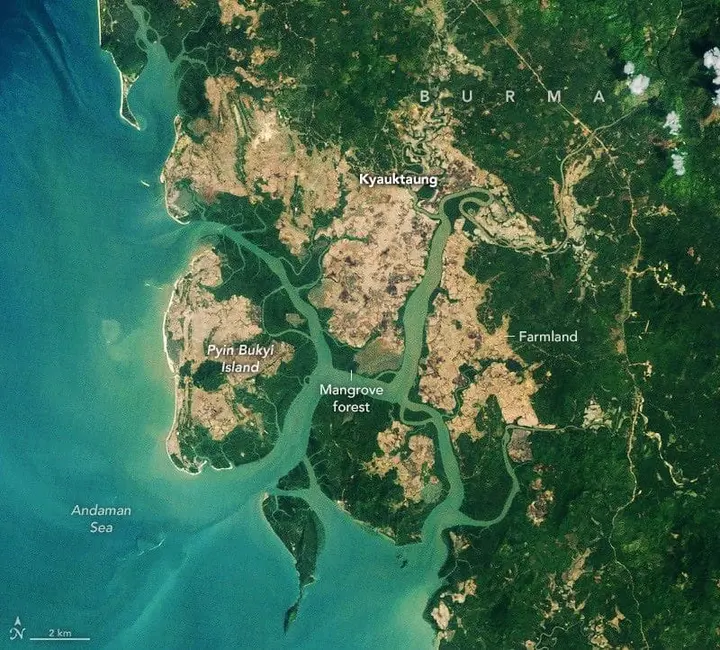
In Southeast Asia, the most notable improvement has been seen particularly in Burma (Myanmar). In the 1980s and 1990s, extensive destruction of mangroves occurred here due to agriculture, fishing, and logging for fuel. However, after the devastating tsunami of 2004, public awareness increased and the government strengthened legal protections. Images from NASA's Landsat 9 satellite show that mangrove forests are now thriving once again in abandoned paddy fields in Burma's Myeik District. After losing 28.6 percent of its area between 1980 and 2010, Burma's mangrove area has increased by 10 percent from 2010 to the present.
The biological structure of mangroves is extremely complex and fascinating. These plants use an ultrafiltration method to survive in saltwater, which blocks 90 to 95 percent of the salt through their roots. Trees like the red mangrove (Rhizophora mangle) use stilt roots to remain above the water's surface. On the other hand, the black mangrove (Avicennia germinans) features pneumatophores, or breathing roots, that emerge from the soil and act like 'straws' to obtain oxygen in waterlogged, muddy soil.
- Salt filtrationAbsorbing only pure water by blocking 90-95% of salt through roots.
- Respiratory adaptationObtaining oxygen in muddy soil through aerial roots like pneumatophores.
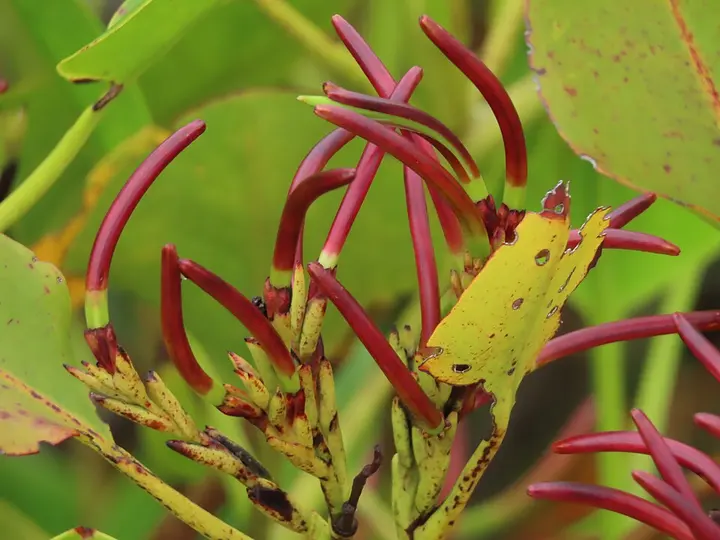
- ViviparitySeeds germinate while still on the tree to form 'propagules', which are capable of floating in water.
- New colonyFloating propagules get trapped in favorable mud and start a new forest.
Scientifically, mangroves are viviparous plants, meaning their seeds germinate while still attached to the parent tree. These germinated seeds are called propagules. When these propagules fall into the water, they can float over long distances and root in the soil as soon as they find a favorable environment. This process helps them spread to new areas via ocean currents. Due to this adaptive capacity, mangroves are moving northward into regions warming up due to global warming, such as the southeastern USA.
Ecologically, the importance of mangroves is incalculable. Their complex roots provide a nursery or sanctuary for marine life such as fish, shrimp, and crabs. Furthermore, they protect coastal communities from erosion and storm surges. According to estimates for 2025, there is a total of 15.9 million hectares of mangrove area in the world, with Indonesia leading at 3.40 million hectares. Brazil, Australia, Nigeria, and Mexico also possess large mangrove areas, which collectively account for half of the world's mangrove forests.
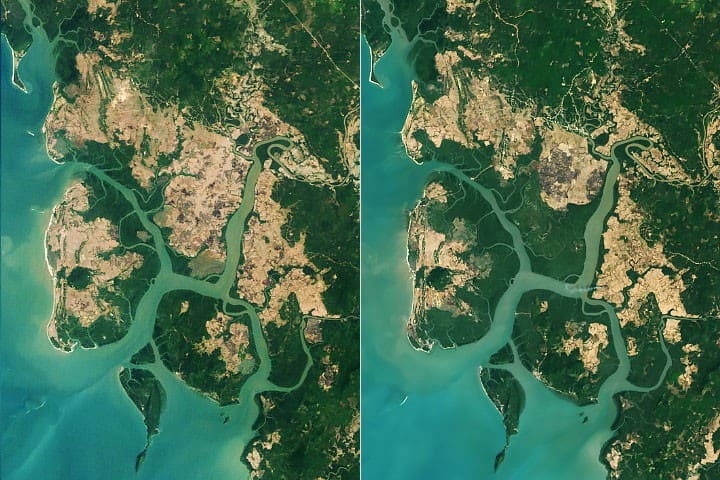
However, the good news is not everywhere. The destruction of mangroves still continues in areas like the Niger Delta, and forests have suffered damage due to storms in North America. Zhen Zhang warns that because of this global success, we do not need to become complacent. Stopping deforestation and supporting natural recovery is still imperative. This comeback of mangroves is proof that if we make serious efforts for environmental conservation, these forests, which are like the lungs of the Earth, can start pulsating again.
Internationally, July 26 is celebrated every year as the 'International Day for the Conservation of the Mangrove Ecosystem'. Satellite monitoring conducted by NASA and other organizations helps us understand the condition of these forests and make future plans. Mangroves are not just trees, but they are an extremely important link between the sea and the land, the protection of which is equally necessary for the survival of humankind.