The Dream of Human Settlement on the Moon: NASA's Artemis Wing Announces New Recruitment and Future Mission
NASA has initiated recruitment for new astronauts to establish a permanent base on the Moon; learn about the cutting-edge technology and upcoming missions of the Artemis program.
NASA, the space agency of the United States, has begun preparations to write a new chapter in human history. According to a report by Sandesh World, NASA has initiated the recruitment process for a new generation of astronauts for the year 2026. The primary objective of this recruitment is not merely to visit the Moon, but to establish a permanent human presence there and construct a robust Moon Base. These new astronauts selected under the Artemis program will play a vital role in realizing the dreams of India and the world to eventually reach the planet Mars.
The Artemis program is not just a single mission, but a comprehensive program for lunar exploration. According to Wikipedia data, the program is named after Artemis, the goddess of the Moon in Greek mythology, who is considered the twin sister of Apollo. This is the first time since the famous Apollo missions of the 1960s that humans are once again going to set foot on the lunar surface. Officially established in 2017 through Space Policy Directive-1, this program has now reached its critical phase.
The architecture of the Artemis program is extremely complex and phased. Two missions in this series have been successfully completed so far. The Artemis I mission was sent as an uncrewed flight in November 2022, which tested the capabilities of the Orion spacecraft. Subsequently, on April 1, 2026, the Artemis II mission sent four astronauts on a journey around the Moon. This mission became the first crewed mission to travel beyond Low Earth Orbit since the Apollo era.
In the coming years, NASA is planning even more complex missions. In late 2027, the Artemis III mission will test the Human Landing System (HLS) in Earth orbit. The most significant mission will be Artemis IV, scheduled for early 2028. This mission will land humans on the lunar surface for the first time since 1972. According to Wikipedia reports, the Artemis V mission will launch in late 2028, initiating the work of establishing a permanent base on the Moon.
| Mission Name | Estimated Time | Main Purpose |
|---|---|---|
| Artemis 1 | November 2022 | Unmanned test and Orion test |
| Artemis 2 | April 2026 | Circumnavigation of the Moon with four astronauts |
| Artemis 3 | Late 2027 | Testing the lander in Earth's orbit |
| Artemis 4 | Early 2028 | First human lunar landing since 1972 |
| Artemis 5 | Late 2028 | Start of construction of a permanent base on the Moon |
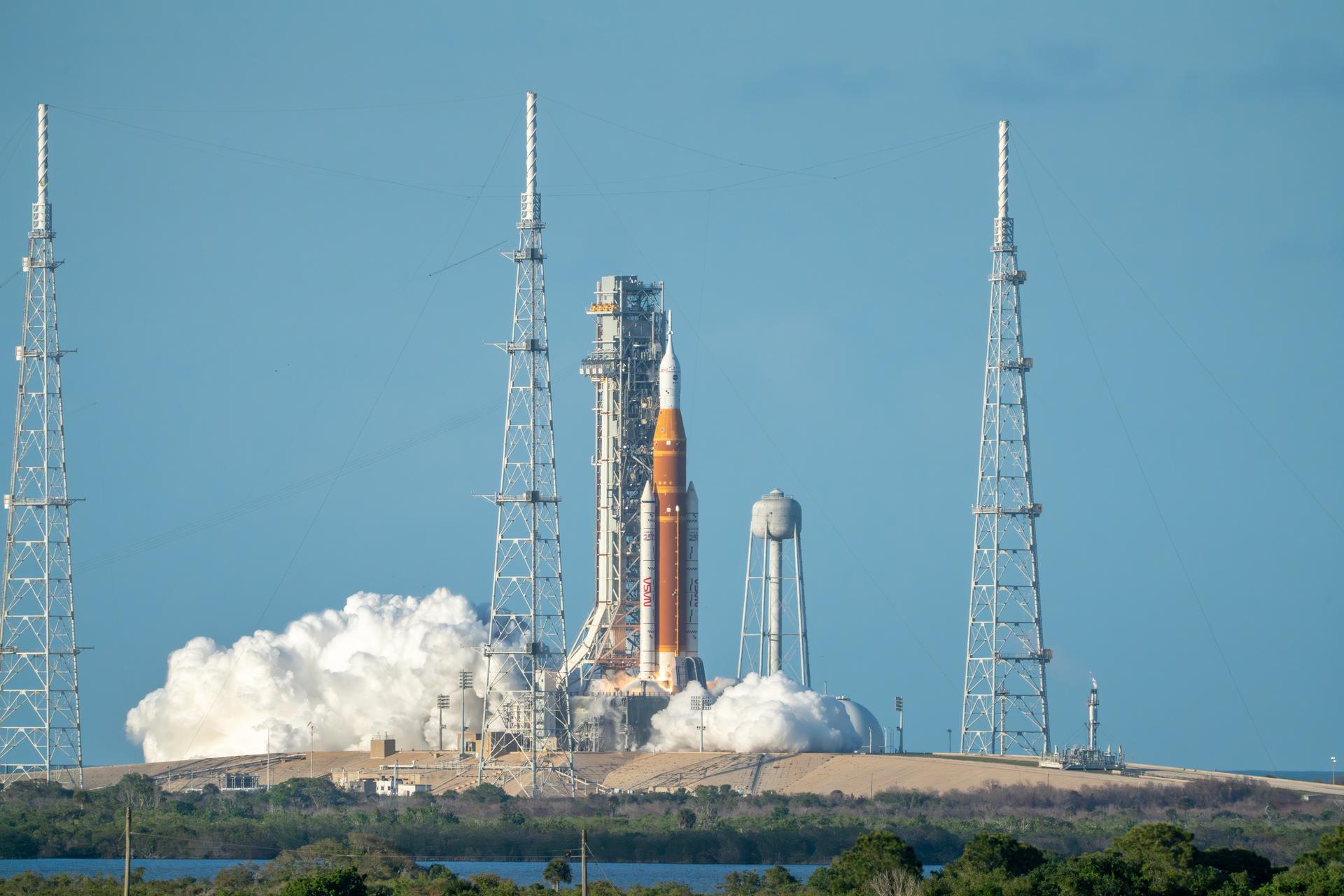
The success of this mission depends largely on its technology. NASA has developed an extremely powerful rocket named the Space Launch System (SLS) for this purpose. This rocket uses RS-25 engines and solid rocket boosters, which provide the immense thrust required to lift the spacecraft out of Earth's gravity. The astronauts will travel in a capsule named Orion, to which the European Service Module (ESM) will be attached, providing essentials such as electricity and water.
To land on the lunar surface, NASA has also partnered with private companies. SpaceX is developing its Starship lander, while Blue Origin is working on the Blue Moon lander. These landers will transport astronauts from lunar orbit to the surface and back. In this process, a small space station named the Lunar Gateway will also play an important role, orbiting the Moon and acting as an interim station for the astronauts.
- Leaving lunar orbitThe Orion spacecraft exits the lunar orbit and begins its journey towards Earth.
- Atmospheric entryThe heat shield provides protection against intense heat while entering Earth's atmosphere.
- Parachute deploymentLarge parachutes open upon reaching a specific altitude, slowing down the spacecraft's speed.
- Ocean splashdownFinally, the capsule safely splashdowns in the Pacific Ocean.
Looking at NASA's history, the agency was established in 1958 during the Cold War. According to Wikipedia, NASA succeeded the National Advisory Committee for Aeronautics (NACA). Since then, NASA has led space science through historical programs such as Project Mercury, Gemini, and Apollo. Jared Isaacman currently serves as NASA's Administrator, having assumed the position in December 2025. NASA currently has approximately 18,400 civil servants, and its approved budget for the year 2026 is 24.4 billion dollars.
Securing financial arrangements for the Artemis program has always been a challenge. According to a 2021 audit by the Office of Inspector General, the program's estimated cost was expected to reach 93 billion dollars by 2025. In the 2021 budget, the White House requested 3.7 billion dollars for the Human Landing System, but the US Congress approved only 700 million dollars. Due to this financial crunch, the mission schedule has had to be revised repeatedly, yet NASA remains committed to its goal.

For a permanent human settlement on the Moon, NASA is planning the 'Artemis Base Camp'. At this base camp, astronauts will be able to stay for long periods and conduct research. For this, a Lunar Terrain Vehicle—that is, a vehicle to travel on the Moon—and state-of-the-art spacesuits are being developed. Axiom Space is preparing special AxEMU spacesuits, which will protect astronauts in the harsh environment of the Moon.
International cooperation is also extremely important in the Artemis program. Through an agreement called the Artemis Accords, various countries have agreed to the peaceful and responsible exploration of the Moon. NASA is working together with the European Space Agency (ESA), Japan's JAXA, and the Canadian Space Agency (CSA). This cooperation is not limited to technology alone; there are also plans to send archives such as the 'Lunar Codex' to preserve the heritage of human civilization on the Moon.
$ અબજ
Speaking of the recruitment process, NASA is looking for highly skilled and physically capable candidates. Candidates who are selected undergo rigorous training for years, which includes underwater training, robotics, and the study of spacecraft systems. These astronauts will not only be scientists, but also the first citizens of a human colony on the Moon. According to a report by Sandesh World, the purpose of this recruitment is to establish a permanent presence on the Moon, which will serve as foundational work for future Mars missions.

Some decisions of the Artemis mission have also faced criticism. In particular, some experts have raised questions regarding the use of a specialized orbit called the 'Near-Rectilinear Halo Orbit' (NRHO) and its long-term sustainability. Nonetheless, NASA is continuously working on new technologies and alternative designs to overcome these challenges. In March 2022, NASA announced that it would also encourage upgrades to the Starship lander and other competitive designs so that there are no obstacles in the mission.
The procedure for the Artemis 4 mission will be extremely thrilling. Prior to this mission, a lander will be sent to lunar orbit via a support flight. Subsequently, four astronauts will depart in Orion via the SLS rocket. Upon reaching lunar orbit, they will transfer to the lander and touch down on the lunar surface. There, they will perform Extravehicular Activity (EVA)—that is, spacewalking activities—at least twice and collect samples. After completing their work, they will return to Orion and head back to Earth.
- Lander ConfigurationThe lander is sent to lunar orbit by a separate rocket before the main mission.
- Arrival of AstronautsFour astronauts board the Orion spacecraft and reach lunar orbit.
- Transfer and LandingAstronauts transfer from Orion to the lander and land on the lunar surface.
- Surface ExplorationWalking on the Moon at least twice to conduct scientific experiments and collect samples.
NASA's this journey is an important turning point in human evolution. Ever since 1961 when Alan Shepard went into space as the first American, NASA has seen numerous ups and downs up to today. The first step placed on the Moon by Neil Armstrong through Apollo 11 is today being transformed into a permanent base through Artemis. This mission will open doors of new opportunities and knowledge not just for science, but for all of humanity. Human settlement on the Moon is no longer just science fiction, but is going to become a reality by 2028.