The Heart of Modern Artificial Intelligence: The Transformer Architecture and Large Language Models
A deep analysis of how the attention technique, introduced by Google researchers in 2017 to understand and generate human language, transformed global technology.
Behind the artificial intelligence (AI) revolution we are witnessing today lies not magic, but a unique discovery in mathematics and computer science. The technology powering state-of-the-art chatbots like ChatGPT, Claude, Gemini, or DeepSeek is called a Large Language Model (LLM). These models are no longer limited to answering questions; they have reached the point of writing poetry, coding, summarizing long documents, and solving complex logical problems. The foundation of this entire revolution is based on a research paper published in June 2017 by Google researchers.
At its core, a Large Language Model is a system based on an artificial neural network, which is trained on text consisting of billions to trillions of words available on the internet. Beginning with the prediction of the next probable word in a language, this process gradually transforms into human-like linguistic comprehension. This field has gained unprecedented momentum since OpenAI introduced ChatGPT in late 2022. The specific engine running all these models is an architecture named the Transformer.
Past Limitations and the Rise of Attention
Before the Transformer, Recurrent Neural Networks (RNNs) and Long Short-Term Memory (LSTM) models were primarily used for language translation and processing. Popularized in 1997, LSTM models read words sequentially, one after another. A major limitation of this method was that if a sentence was very long, the model would forget the initial words by the time it reached the end of the sentence. In computer science, this is known as the vanishing gradient problem, where information from long contexts cannot be propagated forward.
To solve this problem, in 2014 Bahdanau and other researchers introduced the "attention mechanism". Subsequently, in 2016, Google implemented an eight-layer bidirectional LSTM-based Neural Machine Translation in its translation service. However, the biggest bottleneck in older systems was that since words were processed sequentially, they could not be trained in parallel on modern Graphics Processing Units (GPUs).
'Attention Is All You Need' and the New Era
At the 2017 NeurIPS conference, Jakob Uszkoreit of Google and his colleagues presented the original Transformer model containing 100 million (100M) parameters under the title "Attention Is All You Need". The core idea of this research was that there is no need to read the words of a sentence sequentially one by one. If all words are placed together and their mutual relationships are measured, language processing can become extremely fast and accurate. At the time, this idea was so contrary to conventional beliefs that even linguists were initially astonished by it.
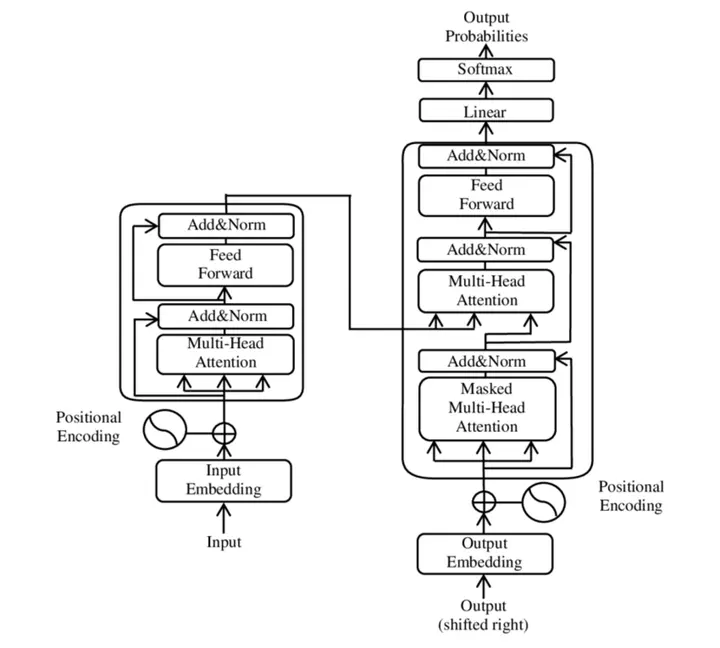
- 1. TokenizationThe original text is divided into small word-pieces, and each piece is given a unique numerical identifier.
- 2. Positional EncodingSince words are not processed sequentially, mathematical information about their position in the sentence is added.
- 3. Multi-Head Self-AttentionMutual relationships and grammatical context among all words in the sentence are measured in parallel.
- 4. Feed-Forward and NormalizationAfter each layer, data is normalized, and information is made more concise through a mathematical neural network.
- 5. Output GenerationThe next most coherent word is selected based on a probability distribution.
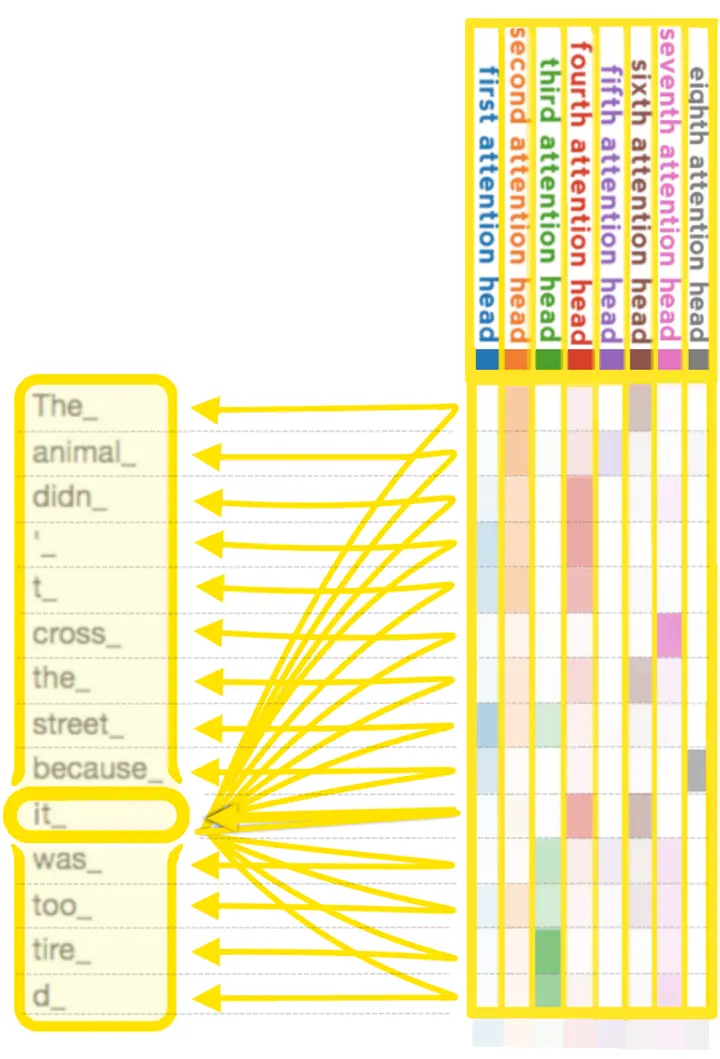
One of the greatest features of the Transformer model is that it compares each word in a sentence with all other words. For example, if the sentence is "The bank opened a new branch on the river bank to lend money", the model can understand that the word "bank" here is not related to the "river bank" but rather to "lend money" and "branch". This mechanism is called self-attention, which extracts the exact meaning of a word according to its context.
How Transformers Work: Step-by-Step Analysis
To understand any text, a Transformer first performs tokenization, in which the text is divided into small pieces called tokens. Generally, one token equals about three to four characters or half a word. Words are converted into integer numbers through methods like Byte-Pair Encoding (BPE) and WordPiece, because neural networks can understand only numbers, not words.
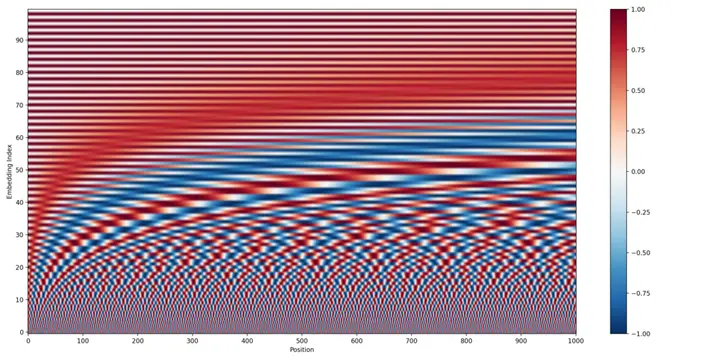
Since all words come in together, the model does not inherently know the sequence; therefore, positional encoding is added. This is a wave-like mathematical method that gives each token a unique vector indicating its precise position in the sentence. This is followed by the multi-head attention layer, where various grammatical and semantic relationships of the sentence are independently examined by different "heads".
Encoders, Decoders, and Model Families
The original Transformer had two parts: an encoder that analyzes the input and a decoder that generates new text. However, researchers later developed this framework in two distinct directions. In 2018, Google introduced BERT, which was an encoder-only model used for understanding text in search engines. On the other hand, OpenAI created the GPT series, which is a decoder-only model and has proven unmatched in generating new text.
In 2019, GPT-2 arrived with 1.5 billion parameters, which OpenAI initially withheld out of fear of misuse. GPT-3 arrived in 2020 with 175 billion parameters. GPT-4, released in 2023, demonstrated multimodal capabilities, meaning it could understand images in addition to text. In 2024, OpenAI released a model named o1, which executes a long chain of thought before providing a final answer.
The Open-Source Revolution and the Massive Cost of Computation
Closed models dominated initially, but after 2022 a wave of open-weight models emerged. Models from Meta's LLaMA and Mistral AI gave researchers the freedom to run models on their own computers. In January 2025, a Chinese company announced a 671-billion-parameter model named DeepSeek R1, which shook the entire tech world by delivering results as high as OpenAI o1 at an extremely low cost.
The cost of training such massive models has skyrocketed. Training GPT-2 in 2019 cost around $50,000, whereas today's state-of-the-art models demand millions of dollars and thousands of advanced GPU clusters. Complex computing methods like data parallelism and tensor parallelism are used to train the models.
Future Directions and Open Questions
Large Language Models have challenges as immense as their capabilities. Often, these models present false information with confidence, a phenomenon known as hallucination. Biases present in training data also reflect in the model's outputs. Furthermore, as natural human text on the internet is running out, new models are now being trained using synthetic data, meaning data generated by AI itself.
This technology brings a golden opportunity for Gujarati and other regional languages of India. Through proper pre-training and fine-tuning, revolutionary assistants for government services, education, and agriculture can be built in our languages. The Transformer architecture has proven that when the right structure and massive computational power are combined, 'language', which is among the most complex aspects of human intelligence, can be brought under machine control.