A Spectacular Streak of Light in the Sky: The Science and Thrill of 'Fireball' Meteors
When a small space rock enters Earth's atmosphere and unlocks the mysteries of the solar system, a 'fireball' is created. Discover the science behind this stunning astronomical event.
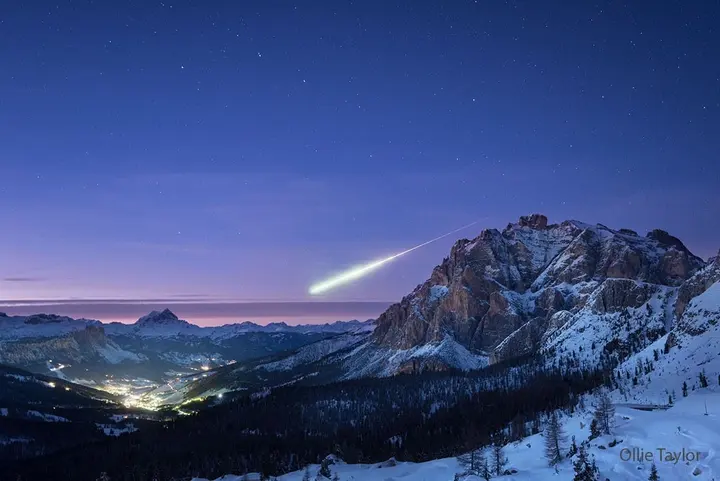
On a cold November night, while Italy's Dolomite Alps were covered in snow, an event occurred in the sky that mesmerized both astronomers and the general public. A photograph taken on November 14, 2017, which was recently republished by NASA (National Aeronautics and Space Administration), shows an extremely bright meteor or 'fireball'. This meteor passed from east to west on the northern horizon, below the Ursa Major constellation. This event was not only beautiful but also scientifically significant, as it became one of the most recorded meteor events in the European sky.
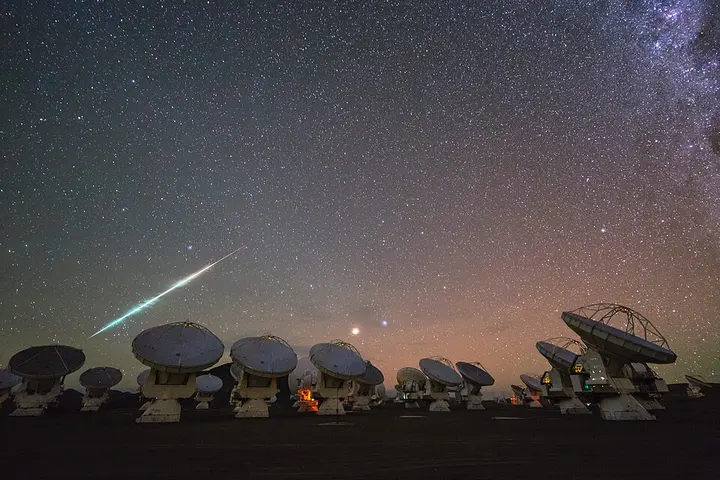
What we commonly call a 'shooting star' is, in the language of science, a meteor. Meteors are small rocks or particles in space called meteoroids. When these meteoroids enter the Earth's atmosphere at extreme speeds, they heat up and ignite due to friction and pressure against air molecules. This process is called incandescence, or light produced by heat. Most meteors are as small as grains of sand and burn up completely in the upper layers of the atmosphere. However, when the object is slightly larger in size, it takes the form of a 'fireball'.
In astronomy, there is a precise definition for a fireball. According to the International Astronomical Union (IAU), any meteor that appears brighter than any planet is called a fireball. In scientific terms, a meteor with an apparent magnitude of -4 or brighter is considered a fireball. In the magnitude scale, the lower (or more negative) the number, the brighter the object is considered to be. For example, if a meteor appears to have a magnitude of -1 near the horizon, it could actually be a fireball because if it were directly overhead (at the zenith), its brightness would be as high as -6. The meteor seen in Italy was so bright that it could be clearly seen from Germany and other European countries as well.
Meteors begin to appear in the Earth's atmosphere in the layer known as the mesosphere, that is, at an altitude of approximately 76 to 100 kilometers above the ground. Their speed is astonishing. The Earth orbits the Sun at a speed of 30 km per second, and when meteors come toward it, their combined speed can reach hundreds of thousands of kilometers per hour. When an object enters the air at such a speed, it is heated not only by friction but also by 'ram pressure,' which is the sudden increase in air pressure. Due to this pressure, the air around the meteor becomes ionized, meaning the air molecules become charged and begin to glow.
| Color | Element |
|---|---|
| Orange-yellow | Sodium |
| Yellow | Iron |
| Blue-green | Magnesium |
| Purple | Calcium |
| Red | Atmospheric Nitrogen and Oxygen |
Interestingly, the color of each meteor can be different. This color depends on the minerals the meteor is composed of and the speed at which it is entering the atmosphere. For example, if a meteor appears yellow-orange, it is likely to contain sodium. If it is blue-green, it may contain magnesium. In the case of the event in Italy, the meteor's path was measured over Germany, and it was found to be part of the 'Northern Taurid' meteor shower. This meteor shower is caused by dust particles left behind by a comet named Encke.
When the Earth passes through the orbital path of a comet, a meteor shower occurs due to the debris present there. When a comet approaches the Sun, its icy surface turns into vapor, leaving behind a long trail of dust and rocks. This path is called a 'dust trail.' Every year, when the Earth reaches this specific path, we see many meteors appearing to come from a single point in the sky. This point is called the radiant. The Northern Taurid meteor shower is known for its slow but extremely bright fireballs.
- Space travelA rock known as a meteoroid orbits the sun in space.
- Entry into the atmosphereAs it enters the Earth's atmosphere at an altitude of 75-120 km, it heats up and begins to glow.
- MeteorDue to air pressure, it burns and a bright streak appears in the sky.
- Friction and disintegrationMost meteors burn up completely at an altitude of 50-95 km.
- MeteoriteIf any part survives and falls to the ground, it is called a meteorite.
Sometimes fireballs are so bright that they explode in the air. Such an explosive fireball is called a bolide. If its brightness exceeds -17 magnitude, it is called a superbolide. In such cases, sound is often heard as well. This sound can be of two types: one is a sonic boom, which is heard a few minutes after the meteor passes, and the other is an 'electrophonic' sound, which is heard at the very moment the meteor is seen. Scientists believe that this instantaneous sound is produced when radio waves generated in the meteor's path collide with objects on the ground.
Historically speaking, until the beginning of the 19th century, meteors were not considered celestial events. People understood them to be atmospheric phenomena like lightning. But the Leonid meteor shower that occurred in November 1833 changed everything. That night, thousands of meteors rained from the sky, which proved that these stones come from space. Subsequently, an astronomer named Giovanni Schiaparelli established the relationship between meteors and comets. Today, organizations like NASA continuously monitor such events through the 'All-Sky Fireball Network'.
NASA was established in 1958, and since then, it has not been limited to just sending humans to the Moon or landing rovers on Mars. Its Science Mission Directorate also conducts in-depth studies of the atmosphere around Earth and space rocks. The dust that comes to Earth through meteors can affect atmospheric chemistry and perhaps even the climate. Every day, millions of meteors enter Earth's atmosphere, but since most of them fall over the ocean or during the day, we cannot see them. During the spring season, the probability of seeing a fireball increases by 10 to 30 percent, a reason for which scientists have not yet fully understood.
For the general public, a fireball is not just a beautiful sight, but also an opportunity to contribute to science. Organizations like the American Meteor Society and the International Meteor Organization calculate the path and origin of a meteor based on reports from ordinary citizens. In this incident in Italy as well, reports from people proved to be extremely helpful. If you ever see such a bright streak in the sky, understand that you are watching a fragment of the solar system's millions-of-years-old history colliding with Earth.
| Detail | Measurement / Value |
|---|---|
| Normal size | 1 mm (like a grain of sand) |
| Entry speed | Approximately 30 km/second |
| Visibility altitude | 75 to 120 kilometers |
| Disintegration altitude | 50 to 95 kilometers |
| Duration of glow | Approximately 1 second (for a normal meteor) |
In countries like India, where the tradition of sky watching is centuries old, awareness about such events can increase interest in science. Meteors teach us that Earth is not alone in space, but is in constant dialogue with the universe. Even though these stones are small, their speed and energy make us realize the vastness and power of the universe. In the coming time, whenever you look at the night sky, perhaps by luck, you might also see a fireball that will disappear before your eyes after traveling millions of kilometers.