StateBench: Can AI track information changes in long-form text? A new benchmark
A new testing framework called 'StateBench' has been introduced to evaluate the ability of artificial intelligence models to understand the evolving flow of information within long documents.

In today's era, Artificial Intelligence (AI) and specifically Large Language Models (LLMs) are changing the way we work. These models can read thousands of pages of documents and provide summaries of them. But do these models truly understand how information changes throughout a long text? To find the answer to this question, researchers at the Allen Institute for AI (Ai2) have introduced a new benchmark called 'StateBench'. This benchmark specifically measures a model's ability to perform 'state tracking', that is, monitoring sequential changes in information.
State tracking is the foundation of any intellectual task. Suppose you are reading a mystery novel. At the beginning of the story, John has a knife. A few chapters later, John gives that knife to Mary, and Mary gives it to Edward. If a murder occurs at the end, as a reader, you must remember who currently has the knife. The same applies when reading programming code, where the values of variables—names used to store values—constantly change. If an AI model cannot accurately track these changes, it may fail in long and complex tasks.
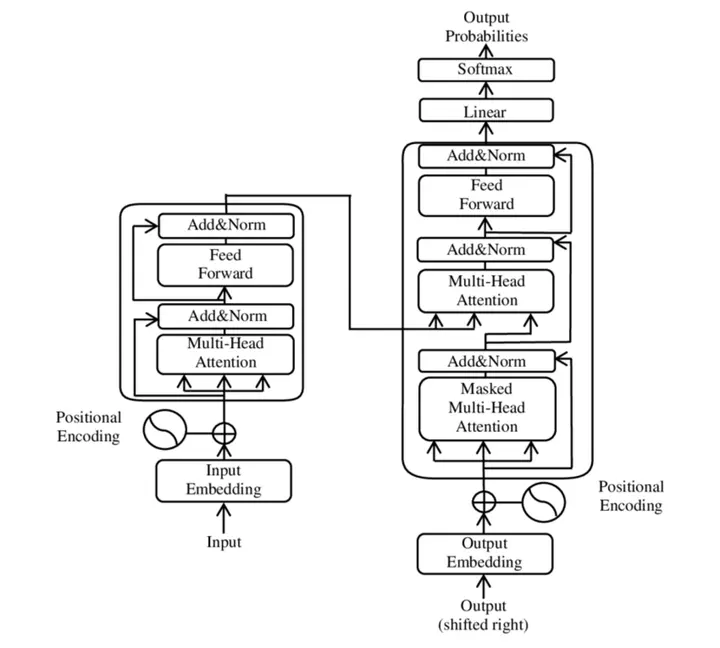
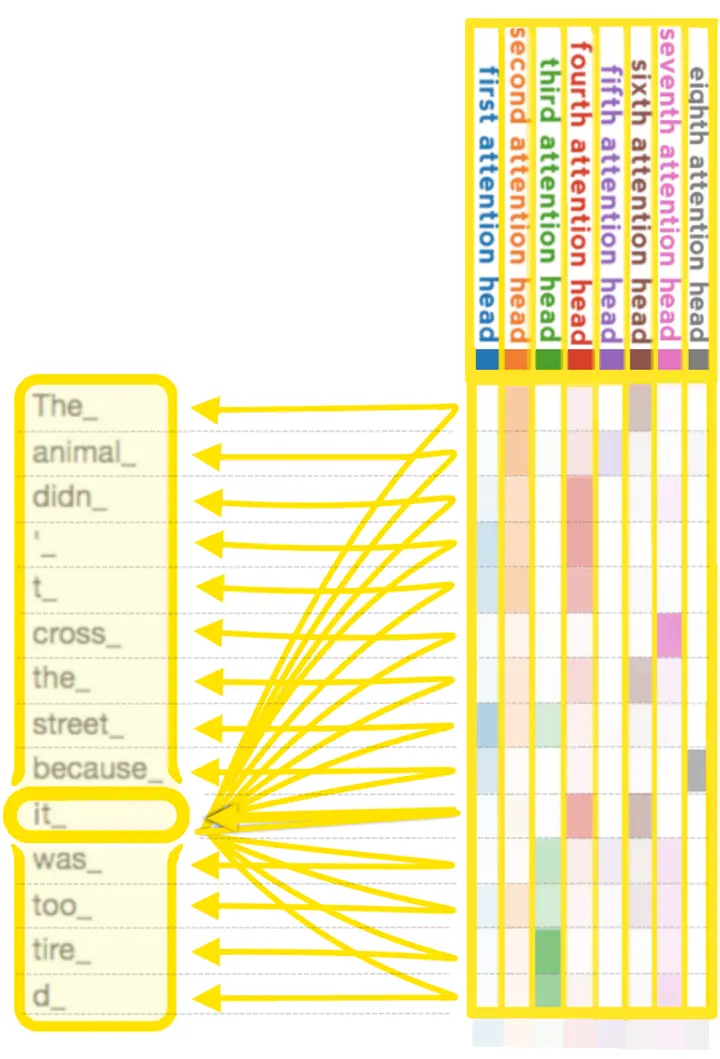
Most current AI models are based on the 'transformer' architecture. A transformer is a type of neural network that uses an 'attention mechanism' to understand the relationships between different parts of a text. However, researchers have noted that there are certain theoretical limitations in the state tracking capability of transformer models in long texts. Especially when the chain of information changes is very long, these models often forget the final state or become confused. StateBench has been designed to understand these limitations more deeply.
- Input sequenceThe model is given a long chain of variable assignments, such as 'A = 5' and then 'B = A'.
- State updateAt each new step, the model must internally remember which variable's value has changed.
- Complexity levelsInformation changes can range from simple (r-trivial) to extremely complex (general finite).
- Final resultAfter reading the entire sequence, the model must state the last correct value of each variable.
StateBench is divided into four different levels of difficulty. These levels are based on the mathematical 'Krohn–Rhodes theory', which breaks down state tracking problems into fundamental elements. The first level is 'r-trivial', which is the simplest. In it, the model only has to remember which change was last made to an object. The second level is 'aperiodic', which is slightly more complex. The third level is 'soluble' and the fourth is 'general finite', which is the most difficult. In this final level, information changes are interdependent, meaning that if the model misses even a single step, the entire answer can be incorrect.
| Level | Description |
|---|---|
| r-trivial | Simplest: only the last change needs to be remembered. |
| aperiodic | Medium: slightly more complex state tracking. |
| soluble | Hard: information changes are dependent on each other. |
| general finite | Hardest: missing even one step results in an incorrect answer. |
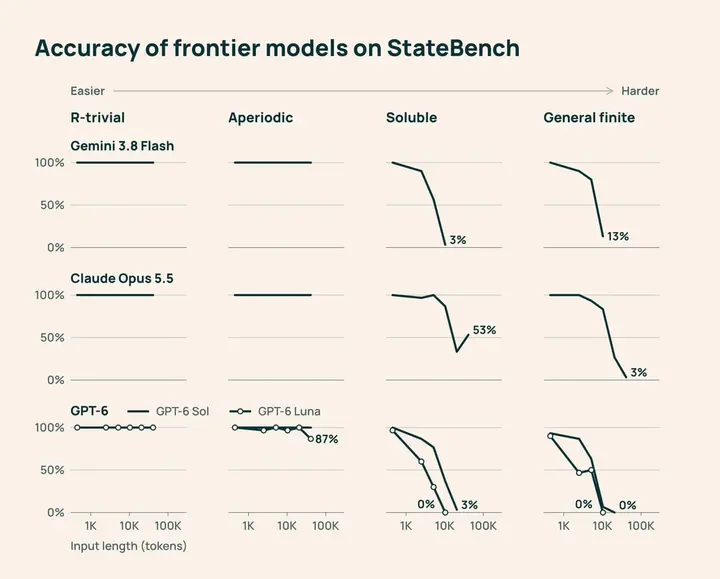
Researchers used various types of models for this test. These included open-source models, whose code and data are public, such as Olmo 3 and Olmo Hybrid. In addition, testing was conducted on what are considered the world's most powerful frontier models, such as Gemini 3.8 Flash, Claude Opus 5.5, and GPT-6 Sol and Luna. These models were given long texts consisting of thousands of tokens (a small piece of a word) to see how accurate they could remain.
The results of the test were shocking. When the text is short, almost all models perform well. But as the length of the text increases, their accuracy begins to decline. Especially at the most difficult 'general finite' level, the accuracy of models like GPT-6 and Claude fell below 13%. This means that no matter how smart these models appear, they are still deficient in tracking long and complex chains of information. According to the researchers, the main reason for this problem is 'sensitivity'; that is, at complex levels, even a small error completely changes the final result.
| Level Name | Description | Example |
|---|---|---|
| r-trivial | Simplest, only remember the last change | x = 5, then x = 10. What is x now? |
| aperiodic | Medium complexity, sequential changes | Tracking changes occurring in a specific order |
| soluble | Harder, math-based changes | One change depends on another |
| general finite | Most complex, remembering the entire chain | Complex programming code or mysterious story |
As a solution to this problem, researchers have focused on 'recurrent' and 'hybrid' architectures. Transformer models view the entire text at once, while recurrent models such as Gated DeltaNet process information sequentially and maintain a 'running memory'. When these models were trained directly on StateBench data, they performed remarkably well. Gated DeltaNet models succeeded in state tracking even in texts 250 times longer than their training data. This shows that perhaps future AI models will need to incorporate not just transformers, but also recurrent layers.
- Data inputThe model is given text thousands of tokens long in which variable values keep changing.
- State trackingThe model has to track the current state of each variable throughout the entire process.
- Evaluation of resultFinally, the model is asked what the last value of the variable is and its accuracy is measured.
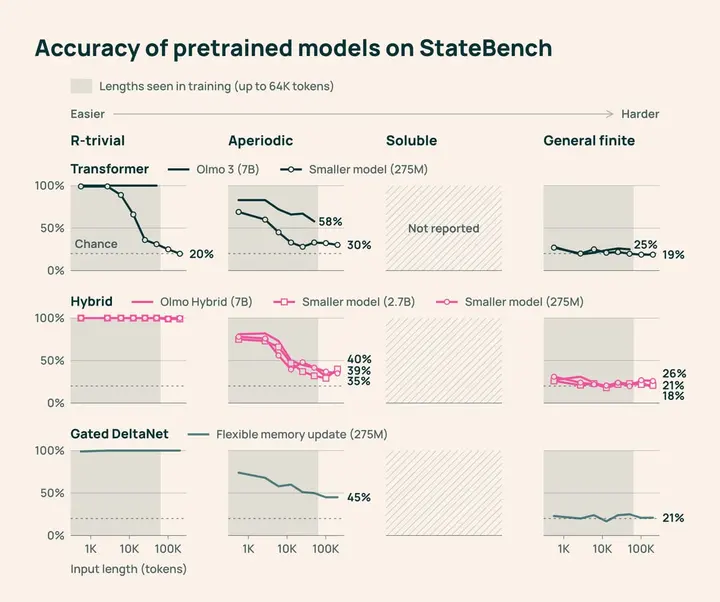
An interesting observation was also that the result changes depending on how the question is asked to the model. For example, when a hybrid model with 275 million parameters (a measure of a model's learning capacity) was asked a question in plain text format, it performed well. But when the same question was asked in a spreadsheet editing format, its accuracy decreased. Therefore, in StateBench, the same problem is presented in different formats to measure the model's true understanding.
In countries like India, where AI is being used for the analysis of legal documents or reading long medical reports, such research is of great importance. If an AI lawyer misses tracking a change in a crucial piece of evidence within a case spanning thousands of pages, it could lead to serious consequences. Tools like StateBench will help developers understand for what types of tasks their model is safe and where it needs further improvement.

However, StateBench also has its own limitations. Currently, this test assumes that the number of variables in the information is fixed. In real life, such as during long conversations, new characters or new objects can be added at any time. Researchers are now working in the direction of how to measure the ability to track information arriving in an uncertain quantity. Additionally, how numerical precision affects a model's performance is also an open question.
In conclusion, StateBench is like a 'North Star' or guiding light for AI researchers. It not only highlights the weaknesses of models but also suggests a direction for developing new and more robust architectures. As we move toward more complex AI systems, rigorous testing of their memory and reasoning capabilities has become inevitable. According to the company's announcement and technical report, this dataset and code have now been made available to the public so that researchers worldwide can utilize them.