Chandrayaan-3: India’s Triumph at the Lunar South Pole and the Remarkable Technology of Vikram-Pragyan
A detailed explanation of how ISRO learned from past failures to achieve a soft landing on the challenging lunar south pole and the discoveries made by the Pragyan rover.

The Chandrayaan-3 mission, conducted by the Indian Space Research Organisation (ISRO), is a landmark event in the field of space science, not just for India but for the entire world. The primary objective of this mission was to land safely on the lunar south pole and conduct a scientific analysis of its surface. After the crash of the Chandrayaan-2 lander in 2019, ISRO learned from those mistakes and made Chandrayaan-3 more robust and precise. This mission consisted of three main parts: the propulsion module, the Vikram lander, and the Pragyan rover.
Chandrayaan-3 was launched on 14 July 2023 from the Satish Dhawan Space Centre (SDSC) in Sriharikota, Andhra Pradesh, via an LVM3 M4 rocket. This rocket placed the spacecraft into an orbit around the Earth with a perigee (the closest distance to Earth) of 170 km and an apogee (the farthest distance from Earth) of 36,500 km. Subsequently, through a series of maneuvers, it was sent towards the Moon and entered lunar orbit on 5 August.

Propulsion Module and its Functionality
The propulsion module is a box-like structure whose primary task was to carry the lander and rover to a 100 km lunar orbit. On one side, it had a large solar panel attached, and on the top, it featured a cylindrical structure to hold the lander. According to company announcements and ISRO reports, this module was also equipped with two Radioisotope Heating Units (RHUs) developed by the Bhabha Atomic Research Centre (BARC). These units generate heat through the decay of radioactive materials, which helps keep the spacecraft's instruments at operational temperatures.
When the Vikram lander separated from the propulsion module on 17 August, the module's primary task was complete. However, ISRO continued its use, and it was brought back into a high Earth orbit. This module carries an instrument named SHAPE (Spectro-polarimetry of Habitable Planet Earth), which observes the Earth from lunar orbit. It performs spectral (the separation of light into colors) and polarimetric (the direction of light waves) measurements of light coming from Earth, which could be helpful in the search for life on other planets in the future.
Vikram Lander: Technology for Soft Landing
The Vikram lander is named after the founder of ISRO, Dr. Vikram Sarabhai. Compared to Chandrayaan-2, several significant changes were made to the Vikram lander. It has four landing legs and four engines, each capable of generating 800 Newtons of thrust (push). Chandrayaan-2 had five engines, but this time the central engine was removed to maintain greater stability during landing.
To ensure the lander's safety, its legs were made much stronger so that they would not break even if it landed at a higher speed. A new instrument named Laser Doppler Velocimetry (LDV) was added, which can precisely measure the lander's movement in three directions. The attitude correction capability was also increased from 10°/second in Chandrayaan-2 to 25°/second, which helps the lander quickly change its orientation during descent.
- Rough Braking PhaseSpeed was slowed down by firing engines at an altitude of 30 km.
- Altitude Hold PhaseLander turned from horizontal to vertical position at an altitude of 7.2 km.
- Hovering PhaseLander remained stationary at an altitude of 150 meters to search for a safe landing site.
- TouchdownSuccessful soft landing on the south pole of the Moon at a slow speed.
The Landing Process: 15 Minutes of Terror
On 23 August 2023 at 18:04 hours IST, the Vikram lander made a soft landing on the lunar surface. This process began at an altitude of 30 km from the Moon's surface. The lander's four engines initiated a braking manoeuvre, which slowed its speed. After 11.5 minutes, the lander reached an altitude of 7.2 km and hovered there for 10 seconds. At this stage, it rotated from a horizontal position to a vertical position.
Subsequently, the lander used two of its engines to descend to an altitude of 150 meters and hovered there for 30 seconds. During this time, its sensors scanned and identified the safest and flattest location for landing. Finally, it descended slowly and successfully touched down near the south pole at 69°S latitude. With this, India became the first nation in the world to reach the lunar south pole and the fourth country to achieve a soft landing on the Moon.
Pragyan Rover: Six Wheels on the Lunar Surface
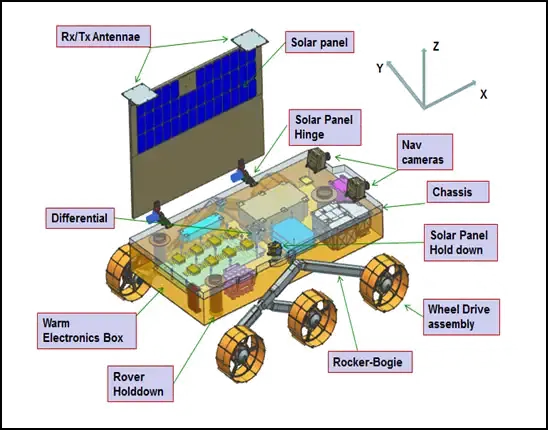
A few hours after the landing, a ramp deployed from the Vikram lander, and the Pragyan rover rolled out. The word 'Pragyan' means 'knowledge' or 'wisdom' in Sanskrit. This is a 26 kg, six-wheeled robotic vehicle. It is 917 mm long, 750 mm wide, and 397 mm high. It generates 50 watts of power through its solar panel and travels at a speed of 1 cm per second.
The Pragyan rover features a rocker-bogie suspension system, which helps it navigate easily across the cratered and uneven terrain of the Moon. On its front, it carries two 1-megapixel monochromatic NAVCAMs. These cameras provide the ground control team with a 3D view, based on which the rover's path is planned. The software for map generation and motion planning of this rover was developed by IIT Kanpur.
ડિગ્રી પ્રતિ સેકન્ડ
Scientific Experiments and Payloads
The primary objective of the Chandrayaan-3 mission was to conduct a chemical analysis of lunar soil and rocks. For this purpose, various payloads (scientific instruments) were sent on the lander and rover. The Vikram lander carried an instrument named ChaSTE (Chandra's Surface Thermophysical Experiment), which measured the temperature and thermal conductivity of the lunar surface. ILSA (Instrument for Lunar Seismic Activity) measured seismic shocks occurring on the Moon.
The rover carried two main instruments: APXS (Alpha Particle X-ray Spectrometer) and LIBS (Laser-induced Breakdown Spectroscopy). Using laser beams, LIBS detected the presence of elements such as magnesium, aluminum, silicon, calcium, titanium, and iron in the lunar soil. Additionally, the lander carried a Laser Retroreflector Array (LRA) provided by NASA, which serves as a location marker for satellites in lunar orbit.
Hop Experiment and the End of the Mission
On September 3, 2023, ISRO conducted a surprising experiment known as the 'hop experiment.' The Vikram lander restarted its engines, lifted 40 cm off the lunar surface, and landed again 50 cm away. This experiment is significant for future missions that aim to bring samples back to Earth from the Moon or send human missions. India became the second country to perform such an experiment after NASA's Surveyor 6 in 1976.
One day on the Moon is as long as 14 days on Earth. The Chandrayaan-3 instruments were designed for only one lunar day (14 Earth days) because they were not capable of withstanding the freezing lunar night (temperatures below -120 °C). On September 3, the rover was put into sleep mode. When the sun rose again on September 22, ISRO attempted to wake it, but no response was received. Thus, having completed its defined goals, the mission has become a permanent monument on the lunar surface.
- Soft LandingDemonstrate safe and soft landing on the lunar surface.
- Rover MobilityObserve the rover's capability to move on the lunar surface.
- Scientific ExperimentsConduct on-site experiments to understand lunar elements and atmosphere.
There is a possibility of water ice being present at the Moon's south pole. This ice could become a source of oxygen, drinking water, and hydrogen fuel for future human missions. The data obtained by Chandrayaan-3 will prove to be very important in this direction. The success of this mission has proven that India can execute complex space missions at a low cost and with cutting-edge technology.