Imaging the Cosmic Void: The Science Behind the Event Horizon Telescope and Black Hole Photography
A technical and scientific exploration of how researchers utilized an Earth-sized virtual telescope to capture the image of a black hole—a phenomenon from which even light cannot escape.
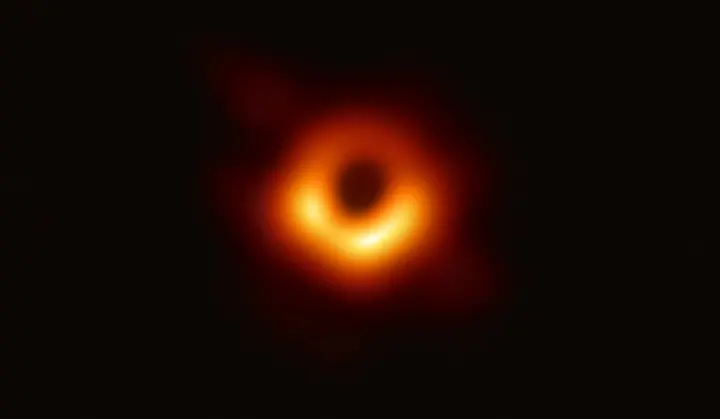
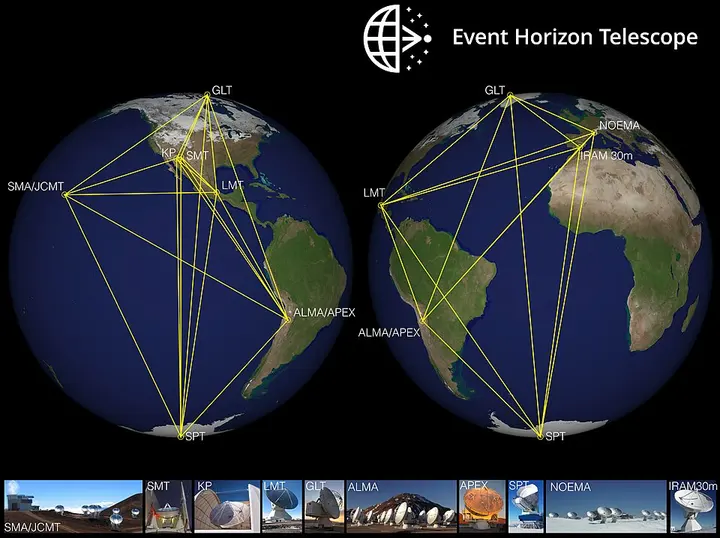
Black holes are at the forefront of the universe's most mysterious objects. Black holes are so powerful that their gravity does not even allow light to escape from them. For decades, black holes were limited only to mathematical equations and imagination, but on April 10, 2019, humanity saw the actual image of a black hole for the first time. This historic achievement was obtained by the Event Horizon Telescope (EHT). The EHT is not a single telescope, but a powerful network of radio telescopes spread across the world, which together form a virtual telescope the size of the Earth.
The main objective of this project was to capture an image of the 'event horizon' of a black hole. The event horizon is the boundary around a black hole from which nothing that enters can ever return. The EHT focused on the supermassive black hole located at the center of a galaxy named Messier 87. Even though this black hole is millions of light-years away from Earth, scientists were successful in capturing the ring of light surrounding it. A complex method called 'Very Long Baseline Interferometry' (VLBI) is responsible for this success.
How does Very Long Baseline Interferometry (VLBI) work?
VLBI is a method of radio astronomy in which multiple radio telescopes located at different places on Earth observe the same celestial object simultaneously. When the data from all these telescopes is combined, it acts as a telescope whose size is equal to the distance between the two farthest telescopes. This distance is called the 'baseline'. In the case of the EHT, this baseline was as large as the diameter of the Earth, which made its resolution, or the ability to see details, unprecedented.
Each telescope captures radio waves coming from the celestial object. These waves are extremely weak, and to record them accurately, each telescope has its own highly precise atomic clock, called a hydrogen maser. This clock is synchronized with the GPS time standard. When a radio signal reaches the telescope, the exact time is also recorded along with it. This data is converted into digital format and stored on hard drives.
- Signal receptionRadio telescopes across the world simultaneously capture radio waves coming from the black hole.
- Time stampingEach telescope uses an atomic clock to record the exact time of signal arrival.
- Data storageMassive amounts of data are stored on hard drives and sent to the lab by plane.
- SupercomputingSupercomputers combine data from different telescopes based on time (Correlation).
- Image formationData is converted into a visual image using complex mathematical algorithms.
A mountain of data and the need for 'Sneakernet'
The data collected by the EHT is so vast that it is impossible to transmit it via the internet. During the 2017 observation campaign, telescopes ranging from the South Pole to Hawaii and Mexico collected petabytes of data. Hard drives containing this data are transported to central laboratories by airplane. This method is jokingly called 'sneakernet' because the data travels physically rather than through wires.
Obtaining data from the South Pole telescope, in particular, presents significant challenges. No flights can operate there during the winter months from April to October. For the 2017 data, scientists had to wait until December when the shipment of hard drives from the South Pole arrived. All this data is sent to the MIT Haystack Observatory in the United States and the Max Planck Institute for Radio Astronomy in Germany. There, supercomputers equipped with around 800 CPUs analyze this data.
| Detail | Messier 87 (M87*) | Sagittarius A* (Sgr A*) |
|---|---|---|
| Location | M87 galaxy | Milky Way (our galaxy) |
| Distance | 55 million light-years | 27,000 light-years |
| Mass (in multiples of the Sun) | 6.5 billion | Approximately 4 million |
| Event horizon diameter | 40 billion km | Much smaller than M87* |
The complex process of creating an image from data
When all the hard drives reach the central location, a process called 'correlation' begins. Supercomputers compare the data from each telescope according to the time from their atomic clocks. Due to changes in the Earth's atmosphere and the distances between telescopes, there may be nanosecond differences in signal arrival times, which must be corrected. For this, a technique called 'closure phase' is used, which was developed by Roger Jennison in the 1950s.
Mathematical algorithms are used to create the final image of the black hole. The EHT team formed four independent teams to verify the reliability of the results. These teams used different algorithms such as CLEAN and CHIRP. The CHIRP algorithm was developed by Katie Bouman and her team. In 2023, scientists also created clearer and sharper images from the 2017 data using a new algorithm called PRIMO.
M87* and Sagittarius A*: Two distinct targets
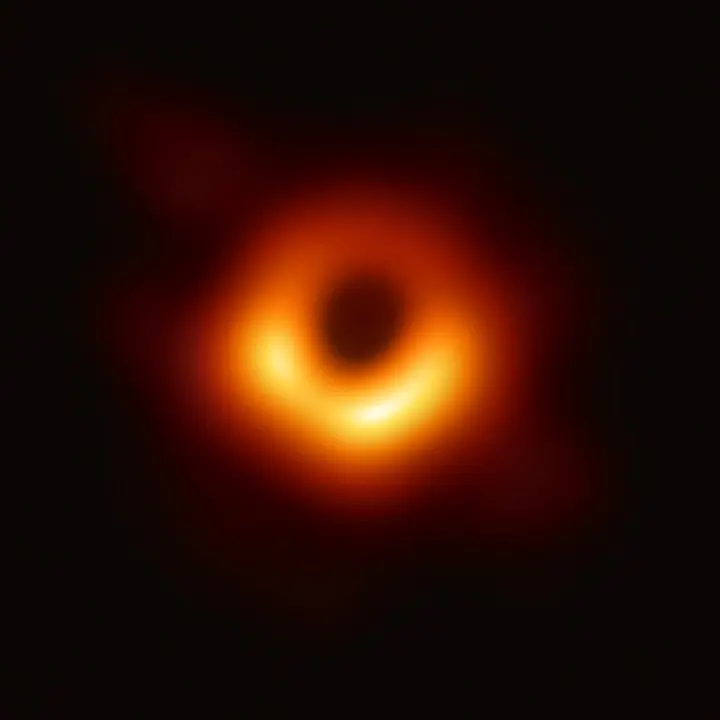
The EHT has mainly focused on two black holes. The first is M87*, which is at the center of the Messier 87 galaxy. It is 55 million light-years away from Earth and its mass is 6.5 billion times that of the Sun. The diameter of its event horizon is approximately 40 billion kilometers. The orange ring seen in the image released in 2019 is actually extremely hot gas orbiting the black hole, moving at speeds close to the speed of light.
The second target is Sagittarius A*, the black hole at the center of our own galaxy, the Milky Way. It is 27,000 light-years away from Earth. Although it is much smaller than M87*, its proximity to Earth makes its apparent size in the sky look roughly the same. On May 12, 2022, scientists released the first image of Sagittarius A*. Despite the significant difference in the size of these two black holes, there is a surprising similarity in their appearance near the event horizon, which supports Albert Einstein's theory of General Relativity.
The Importance of These Images for Science
These images of black holes are not just photographs, but a test of the fundamental laws of physics. According to Einstein's theory, the immense gravity of a black hole bends light around it, creating a 'shadow'. In the images captured by the EHT, this shadow appeared exactly as predicted by mathematics. These observations have proven that Einstein's theory holds true even under the most extreme conditions.
Furthermore, in March 2021, an image of M87* was taken in polarized light. This image provides information about the magnetic fields surrounding the black hole. Scientists can now understand how a black hole consumes surrounding matter and how powerful jets are ejected from it. The EHT has also captured extremely clear images of jets from other galaxies, such as Centaurus A, at a wavelength of 1.3 mm.

Future Plans and Challenges
The EHT project is constantly evolving. Since 2018, the telescope network has had the capability to observe at a wavelength of 870 μm (345 GHz), providing a resolution of 19 microarcseconds. This is the highest resolution of any ground-based telescope to date. In the future, scientists plan to add more telescopes to this network and observe at shorter wavelengths so that 'videos' of black holes can also be created.
Space-based VLBI (Space VLBI) is also opening up a new path. Satellites like Russia's Spektr-R have worked in conjunction with telescopes on Earth, achieving a baseline larger than the diameter of the Earth. This has made it possible to obtain a resolution as fine as 8 microarcseconds. As more telescopes and more powerful algorithms are added, our understanding of these dark monsters of the universe will become increasingly clear.