In Search of the Universe's Origin: How Do the Large Hadron Collider's Superconducting Magnets Work?
An in-depth explanation of the powerful magnets that propel protons at the speed of light through a 27-kilometer tunnel and the remarkable science behind them.

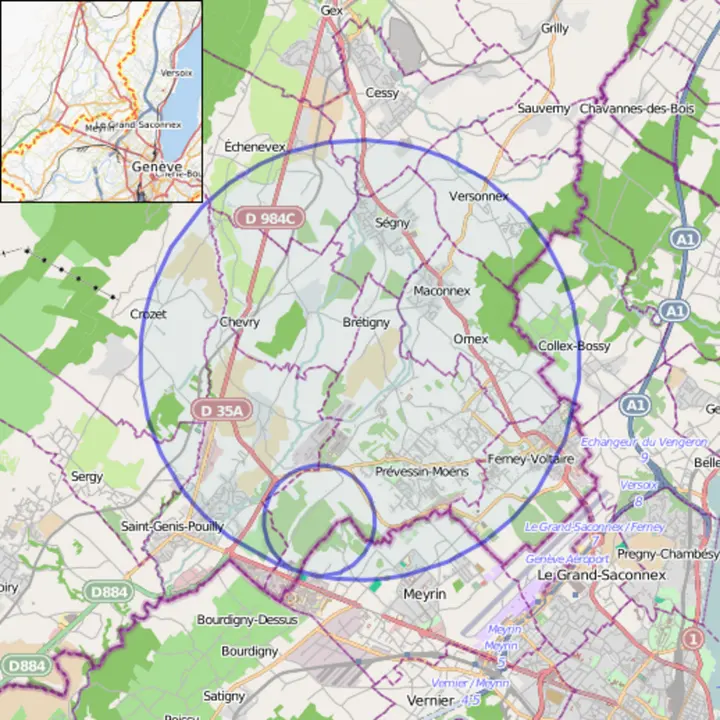
The Large Hadron Collider (LHC), constructed by the European Organization for Nuclear Research (CERN), is the largest and most complex scientific instrument in human history. This machine pulses within a 27-kilometer-long circular tunnel located 175 meters underground near Geneva, on the border of France and Switzerland. The primary objective of this massive apparatus is to collide hadrons—subatomic particles composed of particles called quarks, such as protons—with one another at extremely high energies. Through these collisions, scientists attempt to understand the fundamental laws of the universe and the structure of matter. Playing the most critical role in this entire process are its thousands of superconducting magnets.
Superconducting magnets are electromagnets made from coils of superconducting wire. Superconductivity is a state of matter in which it exhibits zero resistance to the flow of electricity. When a metal is cooled to an extremely low temperature, it acquires this property. The magnets used in the LHC are kept at 1.9 Kelvin (-271.25 degrees Celsius), which is colder than the vacuum of space. Because there is no resistance in the wire at such low temperatures, a very large electric current can be passed through it, resulting in the generation of an extremely powerful magnetic field. This magnetic field is responsible for maintaining the proton beams along the 27-kilometer circular path.
The design of the LHC primarily utilizes two types of magnets: dipoles and quadrupoles. A total of 1,232 dipole magnets are installed throughout the ring, each weighing 35 tons. The primary function of these dipole magnets is to bend the proton beam into a circular path. If these magnets were not present, the protons would travel in a straight line and collide with the tunnel wall. In addition, 392 quadrupole magnets are used to focus the proton beams. The function of these magnets is to ensure that the protons do not scatter while in motion and remain concentrated within a narrow tube. It is through the precise coordination of both types of magnets that protons are able to circulate in the tunnel at 0.999999990 times the speed of light.
Liquid helium is used to keep these magnets in a superconducting state. The LHC uses approximately 96 tonnes of superfluid helium-4, making it the world's largest cryogenic facility. Cryogenics is the study and production of materials at extremely low temperatures. This helium keeps the magnet coils cool so that they can maintain superconductivity. A niobium-titanium (Nb-Ti) alloy is used to construct the magnet coils. Inside these wires is a copper matrix that provides mechanical strength and offers an alternative path for the electrical current should superconductivity ever be lost.
- Proton sourceProtons are obtained by removing electrons from hydrogen gas.
- Initial acceleration (Linac4 & PSB)Protons are given energy up to 2 GeV via linear accelerator and booster.
- Intermediate stage (PS & SPS)Energy is increased up to 450 GeV via Proton Synchrotron and Super Proton Synchrotron.
- Main LHC ringProtons enter the main ring and reach a maximum energy of 6.5 TeV in 20 minutes.
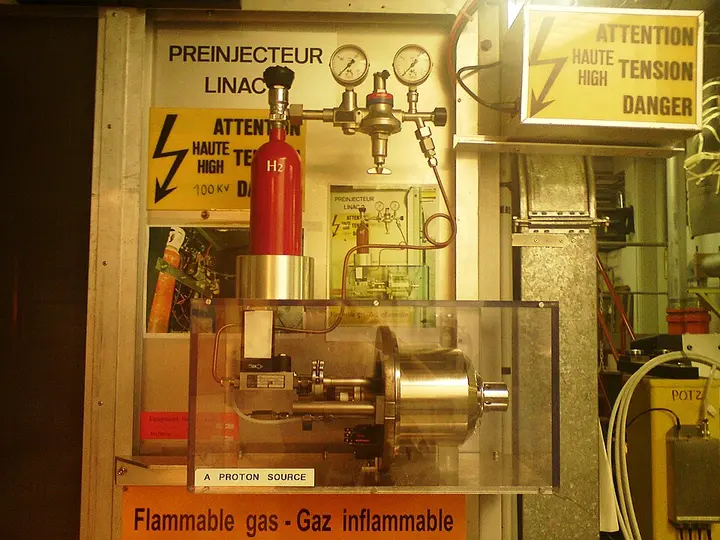
Before protons are sent into the main ring of the LHC, they are passed through a series of smaller accelerators. This process begins with a cylinder of hydrogen gas, from which hydrogen atoms are obtained. First, a linear accelerator called Linac4 gives the hydrogen ions an energy of 160 MeV (mega electron volts). They are then sent to the Proton Synchrotron Booster (PSB), where the electrons are removed, leaving only protons. From here, the protons gain an energy of 2 GeV (giga electron volts) and move to the Proton Synchrotron (PS). Finally, they are accelerated to 450 GeV by the Super Proton Synchrotron (SPS) and then injected into the main LHC ring.
| Detail | Value / Number |
|---|---|
| Total dipole magnets | 1,232 |
| Total quadrupole magnets | 392 |
| Operating temperature | 1.9 K (-271.25 °C) |
| Maximum magnetic field | 7.7 Tesla |
| Liquid helium used | 96 tons |
| Power consumption (total site) | 200 MW |
Once the protons are in the main ring, it takes about 20 minutes to accelerate them from 450 GeV to 6.5 TeV (tera electron volts). During this time, the magnetic field of the superconducting dipole magnets is increased from 0.54 tesla to 7.7 tesla. Tesla is the unit used to measure the intensity of a magnetic field. As the energy of the protons increases, a more powerful magnetic force is required to keep them on a circular path. This is the reason why the electrical current flowing through the magnets is gradually increased. Once the protons reach their maximum energy, they are circulated in the ring for hours and collided at four main points.
The greatest danger in the operation of a superconducting magnet is a quench. A quench is an extraordinary condition in which a part of the superconducting coil suddenly returns to a normal state and begins to exhibit electrical resistance. This can happen when the magnetic field increases significantly or there is a slight increase in temperature. When a quench occurs, heat is suddenly generated in that part (Joule heating), which pushes the surrounding parts into a normal state as well. This is like a chain reaction that can heat up the entire magnet in seconds. In 2008, during the initial phase of the LHC, one such major quench occurred, which caused damage to many magnets and necessitated their replacement.
To avoid such risks, a Quench Detection System (QDS) and protective heaters have been installed in the LHC. If the system detects even the slightest imbalance in voltage, it immediately activates safety equipment. These devices safely extract the immense energy stored in the magnet and transfer it to large metal blocks that heat up and dissipate the energy. This process protects the magnet from permanent damage. For scientists, a quench is a common occurrence, but controlling it is extremely important because the cost of a single dipole magnet is in the millions of dollars.
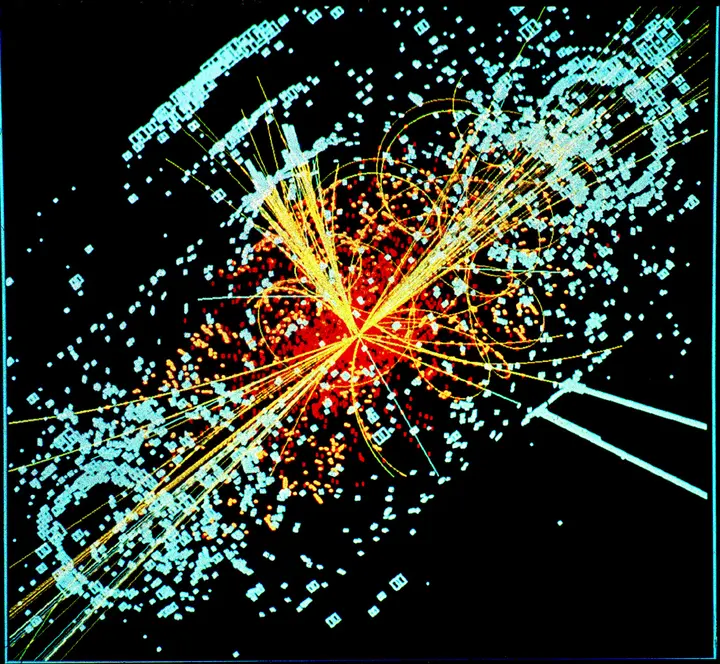
The LHC collides not only protons but also heavy ions such as lead. Through this process, a state of quark–gluon plasma is created, which is believed to have existed in the first moments of the universe's formation. Huge detectors such as ALICE, ATLAS, CMS, and LHCb are used for these experiments. These detectors are essentially giant cameras that take pictures of millions of collisions per second. The discovery of the Higgs boson particle in 2012 was made possible due to the precision of these detectors and magnets. The Higgs boson is the particle that gives mass to all other particles.
The LHC is also of great importance to India. Indian scientists and engineers have made significant contributions to the construction of the LHC. In particular, India's role in the support systems for superconducting magnets and vacuum technology has been notable. Through collaboration with CERN, Indian researchers gain experience in advanced technology and data analysis, which can be used in India's own future accelerator programs. Furthermore, technologies used in the LHC, such as superconducting magnets, are now being used in the medical field in MRI machines and in maglev trains currently being built in Japan.
Work is underway on the 'High-Luminosity LHC' project to make the LHC more powerful in the future. For this, a new type of superconducting material called niobium-tin (Nb3Sn) will be used, which will be capable of generating a magnetic field of 12 to 15 tesla. This will result in a tenfold increase in the number of collisions, which will help scientists solve mysteries such as dark matter and extra dimensions. The Large Hadron Collider is not just a machine, but a remarkable example of human curiosity and engineering skill that leads us toward the profound truths of the universe.