The Hunt for the Universe's 'Ghost Particles': The Science Pulsing Beneath Japan's Mountains in Super-Kamiokande
Located 1,000 meters deep within the Earth, this massive water vessel is unraveling the mysteries of neutrinos and the tales of the universe's origin.

There are countless particles in the universe that pass around us and through our bodies every second, yet we do not even feel them. These mysterious particles are called neutrinos, which have no electrical charge and a negligible mass. To capture these 'ghost particles', a remarkable laboratory has been built 1,000 meters (3,300 feet) deep beneath Mount Ikeno near Hida City in Gifu Prefecture, Japan, known as Super-Kamiokande or 'Super-K' for short. Operated by the Institute for Cosmic Ray Research of the University of Tokyo, this observatory is one of the most important links in the scientific world.
Super-Kamiokande is not just a laboratory, but a peerless specimen of engineering and physics. It is located inside the Mozumi Mine underground so as to avoid interference from other cosmic rays reaching the Earth's surface. The primary objective of this observatory is to detect high-energy neutrinos, investigate proton decay, and study neutrinos originating from the sun and the atmosphere. Additionally, it also keeps a watch on supernovae, which are stellar explosions occurring in our galaxy, the Milky Way.
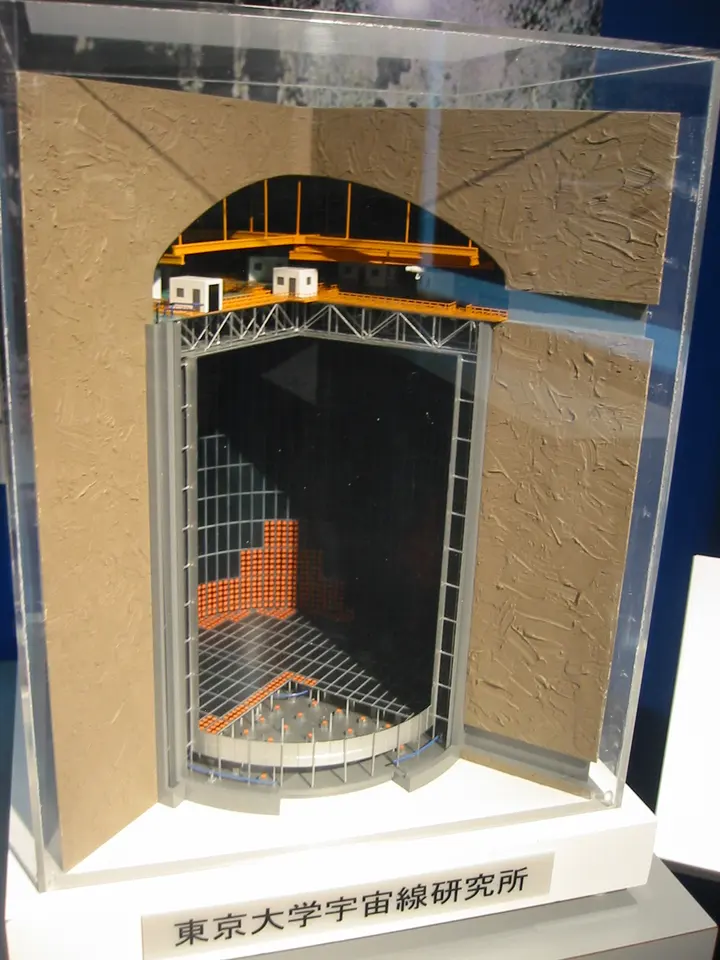
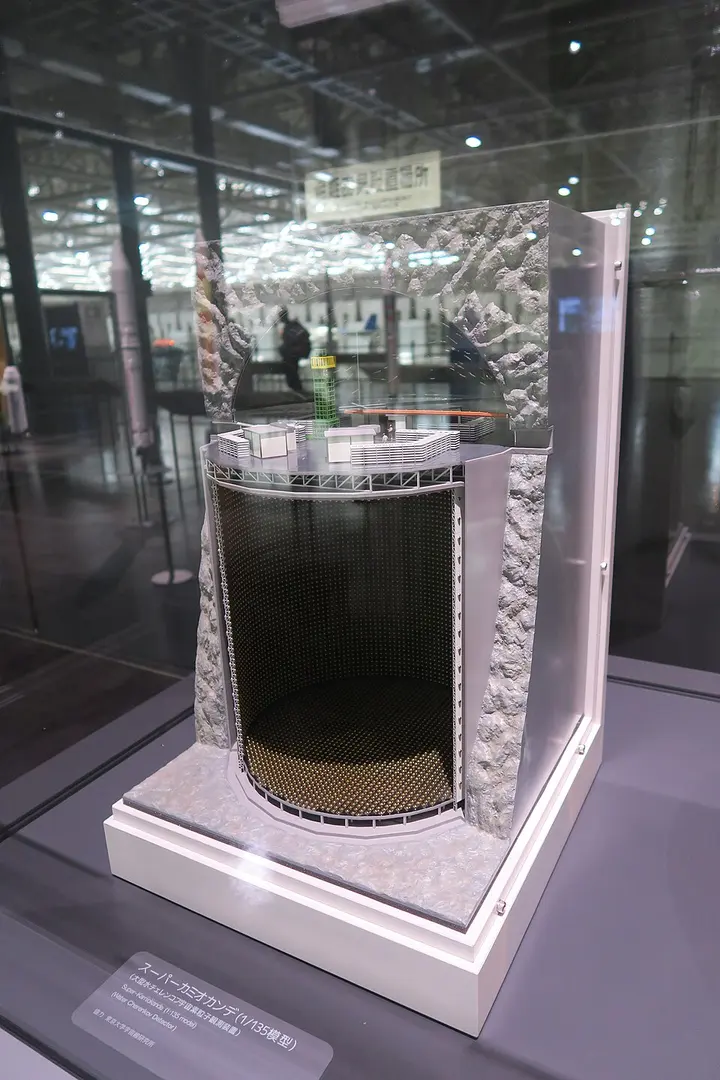
The design of this detector resembles a gigantic cylindrical stainless steel tank. This tank has a height of 41.4 meters (136 feet) and a diameter of 39.3 meters (129 feet). This massive vessel is filled with 50,220 tons of ultrapure water. The interior structure of the tank is divided into two parts by a stainless steel framework: the Inner Detector (ID) and the Outer Detector (OD). The Inner Detector has a height of 36.2 meters and a diameter of 33.8 meters, which mainly works to record the interactions of neutrinos.
| Detail | Measurement/Number |
|---|---|
| Tank diameter | 39.3 meters |
| Tank height | 41.4 meters |
| Total water weight | 50,220 tons |
| Inner Detector PMTs | 11,146 |
| Outer Detector PMTs | 1,885 |
To capture neutrinos, thousands of photomultiplier tubes (PMTs) are installed inside this tank. These tubes are actually extremely sensitive light sensors. The Inner Detector is fitted with 11,146 PMTs having a diameter of 50 cm (20 inches), facing inwards. On the other hand, the Outer Detector has 1,885 PMTs with a diameter of 20 cm (8 inches). To keep these two parts optically isolated, a barrier of Tyvek and black sheets has been created so that light from one part does not pass into the other.
- Neutrino entryNeutrinos enter the detector tank and collide with water molecules.
- Particle creationCollisions produce charged particles like electrons or muons.
- Cherenkov lightThese particles travel faster than light in water, producing blue Cherenkov light.
- Light registrationPMTs mounted on the tank walls capture this circle of light and send data.
When a neutrino collides with an electron or nucleus within a water molecule, it generates a charged particle. This particle travels through the water faster than the speed of light in that medium. It is noteworthy that while the speed of light is highest in a vacuum, it slows down in media such as water. When a particle exceeds the speed of light in a medium, it produces a cone of blue light known as 'Cherenkov radiation'. This phenomenon is similar to the 'sonic boom' produced by an aircraft, but here it involves light instead of sound.
This Cherenkov light appears as a ring or circle on the walls of the detector, which is recorded by the PMTs installed there. By using the time and charge information recorded by each PMT, scientists determine where the neutrino came from, its direction, and its flavor. If the edges of the light ring are fuzzy, it could be an electron, as electrons scatter more. If the edges are quite sharp, it is more likely to be a muon.
ટન (પાણી)
The history of Super-Kamiokande is also quite interesting. Construction of its predecessor detector, 'KamiokaNDE', began in 1982. Its primary objective was to detect proton decay, which is a fundamental question in physics. Although KamiokaNDE did not find proton decay, in 1987 it detected 10 neutrinos coming from a supernova (SN 1987A). This was a major achievement because it proved that the sun is a source of neutrinos. Following this success, the need for a more sensitive detector arose, which paved the way for the construction of Super-Kamiokande.
The Super-Kamiokande project was approved by the Japanese government in 1991, with approximately $100 million in funding allocated. The United States also contributed $3 million to this project. It began operations in 1996, and just two years later, in 1998, it presented evidence of neutrino oscillation. This discovery proved that neutrinos have non-zero mass. For this revolutionary discovery, Super-Kamiokande researcher Takaaki Kajita was awarded the Nobel Prize in Physics in 2015.

A tragedy is also recorded in the history of the detector. On November 12, 2001, during maintenance, a PMT suddenly burst, and the shock caused a chain reaction that destroyed approximately 6,600 surrounding tubes. After this damage, the detector was rebuilt. To ensure such an incident does not happen in the future, each PMT has been covered with an acrylic and fiber-reinforced plastic shield. With these improvements, various phases of the detector (from SK-I to SK-VII) have remained operational.
From a technological perspective, the SK-IV upgrade carried out in 2008 was highly significant. The old analog system was replaced with the new QBEE (QTC-based electronics with Ethernet) system. This system utilizes custom-built ASIC chips and FPGAs, which enhance the speed and accuracy of data processing. This new electronics system can measure charges ranging from 0.2 to 2500 picoCoulombs (pC), possessing five times the capacity of the old system.
In 2020, a new turn came in this experiment, which is known as the 'Super-KGd' (SuperKGd) project. Scientists added a salt named gadolinium to the ultrapure water of the tank. Gadolinium has an extraordinary capacity to capture neutrons. When an anti-neutrino collides with a proton in the water, it produces a neutron and a positron. Gadolinium absorbs this neutron and produces a flash of gamma rays. This enables scientists to clearly understand the difference between neutrinos and anti-neutrinos.

Maintaining water purity is the most challenging task of this experiment. If there are impurities in the water, they absorb or scatter the Cherenkov light, preventing the signals from reaching the PMTs. Super-Kamiokande features an extremely complex water purification system that continuously cleans the water. After adding gadolinium, the challenge was to remove impurities from the water while retaining the gadolinium. For this, scientists developed a special kind of filtration system.
- Anti-neutrino processAnti-neutrinos collide with protons to create positrons and neutrons.
- First flashPositrons immediately produce the first flash of Cherenkov light.
- Neutron captureAfter about 30 microseconds, Gadolinium absorbs the neutrons.
- Second flashWhen neutrons are absorbed, a second flash of gamma rays occurs, which identifies the anti-neutrino.
Super-Kamiokande is important not only for Japan, but for the entire world. It can send an alert to astronomers worldwide within a second of a supernova explosion. The information obtained through this detector helps us understand the processes taking place at the core of the Sun and the imbalance between matter and anti-matter in the early universe. Although it is hidden deep underground, its gaze is fixed on the deepest mysteries of the universe.