ALMA Radio Network Captures the Birth of Stars and Planets in the Darkness of Space
Comprising 66 antennas and situated at an altitude of 5,000 meters in Chile's Atacama Desert, the ALMA Observatory is unraveling the mysteries of the early universe using interferometry technology.
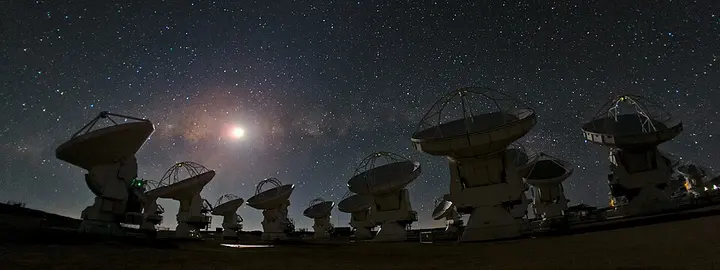
ALMA (Atacama Large Millimeter/submillimeter Array) is the most complex and expensive ground-based astronomical instrument built by humankind to capture extremely faint signals coming from deep space. This international observatory is established on the Chajnantor plateau at an altitude of 5,000 meters (16,000 feet) in the northern Atacama Desert of Chile, South America. Here, 66 giant radio telescope antennas work together to receive electromagnetic radiation at millimeter and submillimeter wavelengths. This grand facility has been built with the international cooperation of Europe, the United States, Canada, Japan, South Korea, Taiwan, and Chile, with a total cost of approximately US$ 1.4 to 1.5 billion.
ALMA has proven unprecedented in obtaining a detailed picture ranging from the birth of stars in the universe's early Stelliferous era to the process of local star and planet formation. The scientific observation work of this radio network began in the latter half of 2011, and its first images were released on October 3, 2011. Since March 2013, this giant telescope array has been fully operational. ALMA provides superior sensitivity and high resolution compared to single-dish telescopes such as the James Clerk Maxwell Telescope or older interferometer networks like the Submillimeter Array or IRAM Plateau de Bure facility.
એન્ટેનાની સંખ્યા
Chajnantor Plateau: Why was this hostile location chosen?
Millimeter and submillimeter waves are extremely important for the study of radio astronomy, but the moisture and vapor present in Earth's atmosphere absorb these signals. To overcome this problem, ALMA was established on the Chajnantor plateau, which is one of the driest and highest places on Earth. This site is located near the Llano de Chajnantor Observatory and the APEX (Atacama Pathfinder Experiment). Due to the high altitude and extremely low moisture, signal attenuation caused by the atmosphere is reduced, and noise is minimized.
The area surrounding ALMA is extremely desolate and mountainous. This harsh location gives astronomers the opportunity to clearly capture waves with wavelengths ranging from 0.32 to 3.6 millimeters (31 to 1000 GHz frequency) coming from the depths of the universe, far from the obscuring effects of Earth's atmosphere.
- 1. Wave ReceptionAntenna dishes around the world collect millimeter and submillimeter waves coming from space.
- 2. Transporter PositioningSpecial 28-wheel transporter vehicles position antennas at distances between 150 meters and 16 km.
- 3. Signal LinkingData from three or more antennas are combined together to eliminate single-dish imperfections.
- 4. Resolution ImagingProcessing data from all antennas produces an extremely high-resolution astronomical image.
Array Architecture and Interferometry Principle
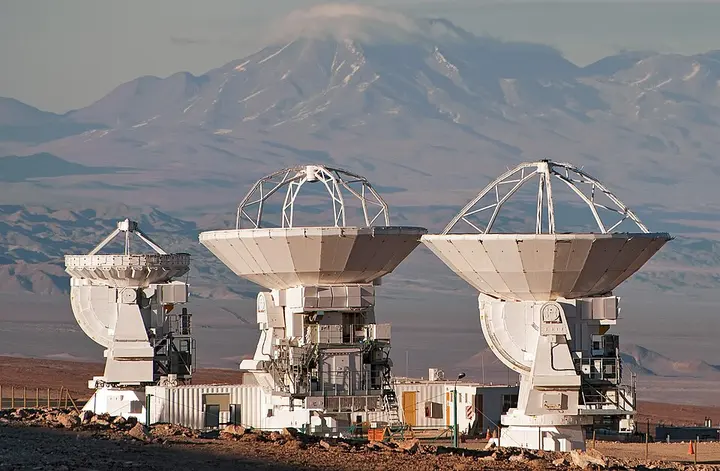
The main secret behind ALMA's exceptional power lies in its interferometer technique and large number of antennas. The main array consists of 50 giant 12-meter diameter antennas, of which 25 antennas were provided by North American partners and 25 antennas by European partners. Apart from this, an additional array has been built with the contribution of East Asian countries, which is called the Atacama Compact Array (ACA). The ACA includes four 12-meter diameter and twelve 7-meter diameter antennas.
Using smaller antennas, the ACA can capture a large field of view at a given frequency. When the antennas are arranged close to each other, they become capable of imaging celestial sources with a wide angular extent. The ACA works in conjunction with the main array and greatly enhances the wide-field imaging capability of the network. These antennas can be moved across the plateau at distances ranging from 150 meters to 16 kilometers, giving ALMA a powerful variable zoom.
| Parameter | Detail |
|---|---|
| Location and Altitude | Chajnantor Plateau, Atacama Desert, Chile (5,000 meters altitude) |
| Total Antenna Count | 66 antennas (50 main 12-meter dishes, 16 ACA antennas) |
| Operating Wavelength | 3.6 to 0.32 millimeters (31 to 1000 GHz frequency) |
| Array Zoom Area | 150 meters to 16 kilometers |
| Total Project Cost | US$ 1.4 to 1.5 billion (Design and Construction) |
In the interferometry process, signals coming from multiple telescopes are combined and processed together as if they were a single giant dish kilometers wide. Astronomers and engineers successfully connected three antennas together for the first time at an altitude of 5,000 meters in late 2009. Errors that occurred using only two antennas could be corrected by the three-antenna connection, which paved the way for high-resolution imaging.

The 28-wheel giant transporter and the adventure of construction
The history of ALMA lies in three major astronomical projects: the United States' Millimeter Array (MMA), Europe's Large Southern Array (LSA), and Japan's Large Millimeter Array (LMA). In 1997, the NRAO and ESO agreed to merge the MMA and LSA to create a joint project. In March 1999, the project was named the 'Atacama Large Millimeter Array' (ALMA). In Spanish, Alma means 'soul' and in Arabic, it means 'knowledgeable'. On February 25, 2003, a final agreement was signed between Europe and North America, and on September 14, 2004, an agreement was signed with Japan's NAOJ to establish the Enhanced ALMA.
Transporting the massive 115-tonne antennas from the Operations Support Facility (OSF) located at an altitude of 2,900 meters to the site at an altitude of 5,000 meters was a monumental task. For this, two specially built 28-wheel self-loading heavy transporter vehicles manufactured by the German company Scheuerle Fahrzeugfabrik were used. These vehicles are 10 meters wide, 20 meters long, and 6 meters high, and weigh 130 tonnes. They are equipped with 500-kilowatt twin-turbocharged diesel engines for power.
Special arrangements were made to keep an oxygen tank on the transporter's driver seat to help drivers breathe in the thin air of the mountainous region. These vehicles position the antennas onto the pads with extreme precision. The first vehicle was tested in July 2007, and both transporters were delivered to Chile on 15 February 2008. By 28 July 2011, as the 16th antenna (the first European antenna) reached the site, the minimum number required to begin science observations was met. By October 2012, 43 antennas had been installed.
Key Specifications and Partner Contributions
Leading companies from around the world participated in the construction of ALMA. General Dynamics C4 Systems manufactured 25 antennas, while the European manufacturer Thales Alenia Space supplied another 25 main antennas, which was the largest European commercial contract in the history of ground-based astronomy. Japan's Mitsubishi Electric company assembled the 16 antennas for NAOJ. All antennas were delivered to the site between December 2008 and September 2013.
In the history of space science, ALMA is the most expensive ground-based telescope project, although the costs of space telescope projects like Hubble and James Webb were much higher than this. ALMA is operated through an international partnership of ESO, NSF, NRC Canada, NAOJ Japan, ASIAA Taiwan, and the Republic of Chile.
Revolutionary Discoveries in Science: Formation of Stars, Black Holes, and Planets
In its very early testing phase, ALMA proved its capabilities. A submillimeter image taken by ALMA of the colliding galaxy pair named the Antennae Galaxies revealed cold and dense gas clouds where new stars are being born. These dusty clouds cannot be seen in visible light.
On 11 August 2014, scientists announced a detailed study of the distribution of HCN, HNC, H2CO, and dust inside the coma of comets C/2012 F6 (Lemmon) and C/2012 S1 (ISON) using ALMA. In the same year, a picture of a protoplanetary disc around a young star named HL Tauri was captured, showing bright rings and gaps. This discovery challenged older theories of planet formation because planet formation was not expected in a system only 1,000,000 years old. In 2022, ALMA launched the exoALMA program, which conducts an in-depth study of 15 protoplanetary disc systems to search for newly forming exoplanets.
In addition, ALMA played an important role in the discovery of the intensely hot galaxy cluster SPT2349-56, which formed 12 billion years ago. ALMA also played a major role in the Event Horizon Telescope project, which captured the first direct image of a black hole in human history, published in 2019. ALMA data was also used in the claim of discovering phosphine gas in the atmosphere of Venus, which is considered a biological signature, a subject currently awaiting further measurements. Today, ALMA is creating a new revolution in astronomy by illuminating the darkest regions of the universe.