Generating Electricity from Sunlight: The Deep Science of the Internal Structure and Mechanism of Photovoltaic Cells
How do solar panels work? A deep-dive into the process of generating electricity through the interaction between semiconductor materials and light particles.

The solar panels visible around us are becoming a major source of energy today, but the science behind them is extremely fascinating and complex. When sunlight falls on a specific material and directly generates electricity from it, the process is called the photovoltaic effect. This is a physical phenomenon in which a semiconductor material produces electrical energy upon coming into contact with light. According to a Wikipedia report, this effect is closely related to the photoelectric effect, but there is a fundamental difference between them.
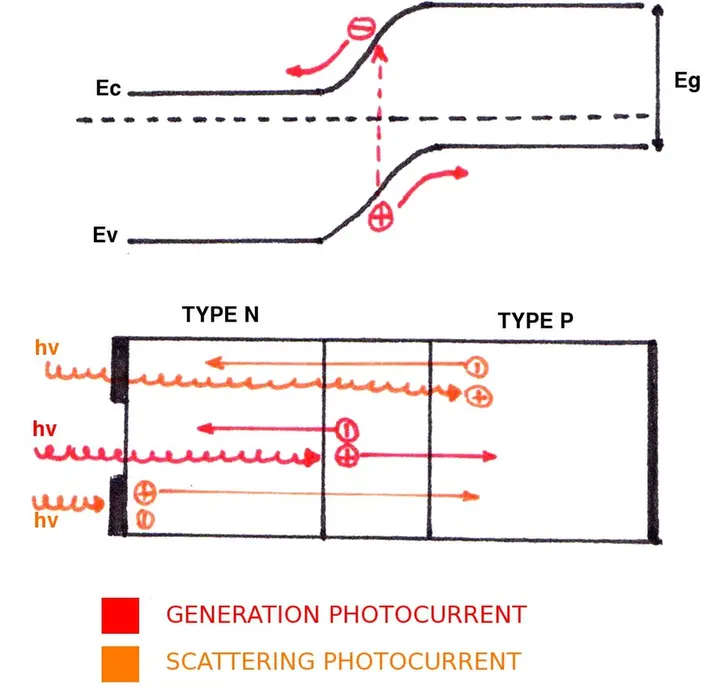
In the photoelectric effect, when light falls on a material, electrons are ejected from that material, whereas in the photovoltaic effect, the excited charge carriers remain inside the material. In this process, particles of light, namely photons, are absorbed by the material and elevate electrons to a higher energy level. As a result of this, a potential difference, meaning voltage, is generated in the material. This very voltage is responsible for driving the flow of electricity.
- Absorption of lightPhotons of sunlight are absorbed in the semiconductor material of the solar cell and give energy to electrons.
- Creation of charge carriersElectrons gain energy and are freed, leaving behind 'holes', which are called excitons.
- Charge separationThe internal electric field of the p-n junction pushes electrons and holes in opposite directions.
- Conduction of electric currentThe freed electrons flow through an external circuit, generating direct current (DC).
The Photovoltaic Effect: Conversion of Light into Electricity
To understand the functioning of a photovoltaic cell, it is necessary to understand the properties of semiconductor materials. Most modern solar cells are made from semiconductor materials like silicon. When sunlight falls on these cells, their electrons absorb energy from the valence band—that is, the outermost orbit of the atom—and leap into the conduction band, which is the free state. When these freed electrons begin to flow, an electric current is produced.
In this process, the p–n junction plays a crucial role. This is a junction where two different types of semiconductor materials meet: one in which the number of electrons is greater (n-type) and the other in which there is a deficiency of electrons or 'holes' (p-type). An internal electric field is formed at this junction which pushes the freed electrons in a specific direction. According to Source 1, due to this process, an electromotive force is generated and light energy is directly converted into electrical energy.
| Type of technology | Main material | Market share | Main application |
|---|---|---|---|
| Crystalline silicon | Silicon (Si) | 95% | Residential and commercial panels |
| Thin-film CdTe | Cadmium telluride | Minor | Large-scale solar farms |
| Multi-junction | Gallium arsenide | Very low | Satellites and space missions |
| Thin-film CIGS | Copper indium gallium | Minor | Flexible solar applications |
Pages of History: From Becquerel to Bell Labs
The history of the discovery of the photovoltaic effect is quite old. First, in 1839, the French physicist Edmond Becquerel demonstrated this effect experimentally at the age of only 19. He observed that when platinum or gold plates are immersed in an acidic solution and sunlight is incident on them, an electric current is generated. However, at that time this discovery was limited only to the laboratory and its efficiency was extremely low.
Then in 1884, Charles Fritts created the first solar cell using a thin layer of selenium and gold, but its efficiency was only about 1%. In the development of the modern solar cell, the quantum theory model of light given by Albert Einstein in 1905 proved foundational, for which he received the Nobel Prize in 1921. In 1954, the first practical photovoltaic cell was demonstrated at Bell Laboratories by Calvin Fuller, Daryl Chapin and Gerald Pearson, which opened the doors for the commercial application of this technology.
From Cell to Array: The Structure of a Solar Panel
A single solar cell can typically generate a voltage of only about 0.5 to 0.6 volts. Therefore, to obtain higher power, multiple cells are connected together. When multiple cells are arranged in a single plane, it is called a solar module or solar panel. In these panels, connecting the cells in series increases the voltage, while connecting them in parallel increases the electrical current.
Special attention is also paid to safety in the construction of the solar panel. On the upper side of the panel is a layer of glass that allows sunlight to enter but protects the semiconductor wafers from environmental impacts. Bypass diodes are often used in panels. These diodes come in handy when a part of the panel is in shadow. They isolate the shaded cells from the entire circuit so that the efficiency of the entire panel does not drop and the cells are not damaged.
Semiconductor Materials and Variety of Materials
95% of solar cells available in the market today are made from crystalline silicon. Silicon is abundantly available and its efficiency is also good. However, with the development of technology, other materials have also begun to be used. In thin-film technology, materials such as cadmium telluride (CdTe) and copper indium gallium selenide (CIGS) are used. This technology is lightweight and flexible, though its efficiency may be slightly lower than that of silicon.
According to Source 2, the output of a solar cell is affected by factors such as temperature, material properties, weather, and the intensity of solar rays (irradiance). For example, excessive temperature can reduce the efficiency of a solar cell. This is why solar panels are designed in such a way that they absorb less heat and convert maximum light into electricity. In modern utility-scale systems, a major reduction in costs has also been observed, which dropped to 0.94 dollars per watt in 2020.
The Development of Solar Technology in Space
The most important and initial use of solar cells occurred in space science. In 1958, solar cells were used for the first time in the Vanguard satellite. Using solar cells as an alternative to batteries significantly increased the lifespan of the satellite. By the 1960s, solar cells had become the primary source of energy for Earth-orbiting satellites and space probes because their power-to-weight ratio was much better than other sources.
Solar cells used in space are different from those used on Earth. Gallium arsenide-based multi-junction cells are used there. These cells have multiple layers with different bandgaps, which can capture energy from various parts of the solar spectrum. This greatly increases their efficiency. Modern satellites now use rollable solar arrays, which occupy less space during launch and unfold once in space.
Modern Research: AC PV and Solar Cars
Traditionally, solar cells produce direct current (DC), which has to be converted into alternating current (AC) using an inverter. However, in 2017, scientists at the Georgia Institute of Technology demonstrated the AC photovoltaic (AC PV) effect. In this technology, when light falls on the cell at a specific frequency, it can directly generate AC current. This research could reduce the need for inverters in the future and make the system much simpler.
The use of solar energy in transportation is also increasing. In the first World Solar Challenge held in 1987, General Motors' Sunraycer car won by achieving a speed of 40 miles per hour. In solar cars, the energy captured by panels is used directly to run the motor or charge the battery. Although solar cars have not yet become commercially common, experiments in that direction are promising for future pollution-free transportation.
Photovoltaic technology is not merely a means of generating electricity, but a magnificent convergence of physics and engineering. This journey, which began with 19th-century experiments, has today reached everything from space satellites to the roofs of our homes. As new materials and manufacturing methods continue to develop, solar energy will become more affordable and efficient, potentially bringing a permanent solution to the global energy crisis.