The Greatest Migration in Human History: How the Bantu Revolution Reshaped the Map of Africa
Unveiling the genetic, linguistic, and archaeological mysteries of the Bantu population, which spread across the entire continent from a small region in West Africa.

Around 6,000 to 4,000 years ago, the largest and longest migration in human history began from a small region in West Africa, which scientists know as the 'Bantu expansion'. This migration completely transformed the demographics, culture, technology, and genetic makeup of the southern hemisphere of the African continent. Today, more than 350 million (35 crore) people speaking approximately 500 different Bantu languages, ranging from the Zulu of South Africa to the Swahili of East Africa, are descendants of this great journey.
This ancient migration spread not only language, but an entire new way of life. Among groups living a hunter-gatherer lifestyle, Bantu communities introduced settled agriculture, animal husbandry, pottery—that is, the art of making clay vessels—and most importantly, iron smelting. However, in the absence of written history, understanding the routes and methods of this massive migration has remained a major puzzle for scientists. Now, joint teams of linguists, archaeologists, and geneticists are lifting the veil on this mystery.
- Original home (approx. 6,000 to 4,000 years ago)Proto-Bantu speaking communities emerged in the Mambilla and grassfields region on the Cameroon and Nigeria border.
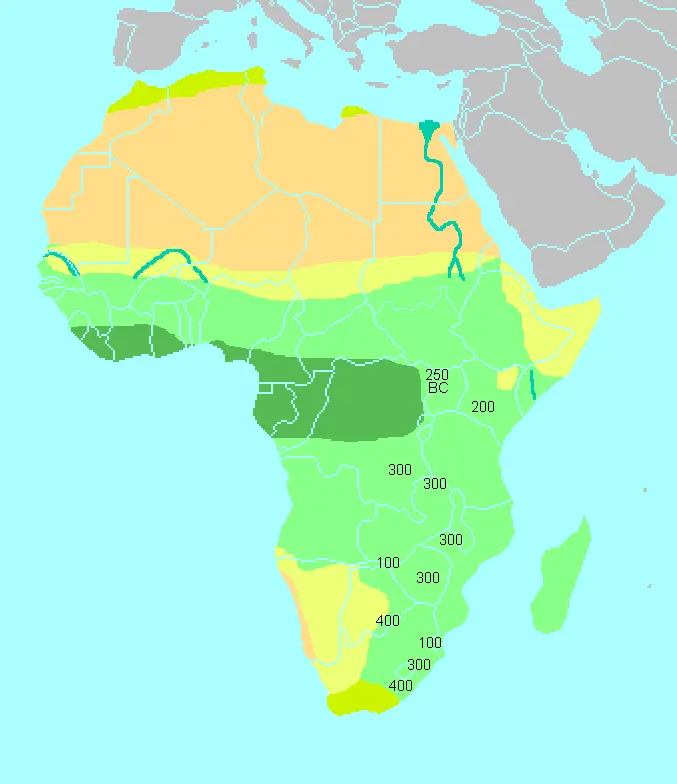
- Western and Eastern streams (approx. 500 BCE)The Western stream passed along the Atlantic coast and through the Congo rainforest to reach Angola, while the Eastern stream moved towards Lake Victoria.
- Expansion into South Africa (approx. 300 to 500 CE)Eastern and Southern communities reached the coastal areas of South Africa and the Limpopo province.
- Creation of great empires (1000 to 1700 CE)Empires with sophisticated iron production and stone architecture, such as Great Zimbabwe, developed.
Linguistics and Nomenclature: Where did the word 'Bantu' come from?
The first evidence of the Bantu migration came from the similarities among languages. In 1497, when the Portuguese navigator Vasco da Gama journeyed along the southern coast of Africa, a crew member aboard his ship who had spent time in west-central Africa was able to communicate easily with the local people of southeast Africa. In the 19th century, German linguist Wilhelm Bleek coined the term 'Bantu' for this language group in his 1862 research. In the Proto-Bantu language, the root word '-ntʊ́' means 'person', and by attaching the plural prefix '*ba-', the word 'Bantu'—meaning 'people' or 'humans'—is formed.
Today, roughly 440 to 680 different languages of the Bantu branch are spoken in Africa. Although these languages are spread over such a vast area, a strong similarity is observed in their grammar and vocabulary. For example, the word for 'people' is 'Bantu' in Kikongo and Lingala, 'Watu' in Swahili, 'Anthu' or 'Wanthu' in Chichewa and Tumbuka, and 'Wanhu' in Shona. According to linguists, the region with the greatest linguistic diversity is its original center of production, which points toward West Africa.
The Origin in West Africa: A journey that began in the mountains of Cameroon
Genetic and linguistic data show that the original home of the Bantu communities is the mountainous region on the border of Cameroon and Nigeria in west-central Africa. The Mambilla region, spanning 60,000 square kilometers located on the Nigeria-Cameroon border, and the Bamileke/Bamenda mountainous area in the south, are places where the descendants of the 'Bantu who stayed behind' still live today. Research by archaeologists Jean Hurault and Rigobert Tueche shows that cultural continuity has been maintained in this area since 3000 BCE.
The oldest pottery found from a cave or rock shelter named 'Shum Laka' in the northern part of Cameroon dates back to 5000 BCE (7,000 years ago from today). Initially, the pottery here featured only engravings and impressions, but from layers dating back 4,000 years, highly sophisticated vessels with patterns carved into wet clay using rope or wooden tools have been found. Based on dental evidence, scientist Joel Irish concluded that communities living at Gobero during the Kiffian period of the Green Sahara migrated southwards toward Cameroon and Nigeria as arid climatic conditions developed in the Sahara desert region around 7000 BCE.
| Ethnic Group | Main Country | Estimated Population (in Millions) |
|---|---|---|
| Luba | Democratic Republic of the Congo | 28.8 (2010) |
| Shona | Zimbabwe | 17.6 (2020) |
| Zulu | South Africa | 14.2 (2016) |
| Sukuma | Tanzania | 10.2 (2016) |
| Xhosa | South Africa | 9.6 (2011) |
| Kikuyu | Kenya | 8.1 (2019) |
Through Forests and River Routes: The Western and Eastern Streams
From the original center in West Africa, this journey split into two main streams or currents: the Western Stream and the Eastern Stream. Initially, the migration was very slow because during this period they did not have iron tools, making it difficult to cut through and advance into the dense Congo rainforest. People of the Western stream moved along the Atlantic coast and the Congo River basin, reaching central Angola by 500 BCE.
A team led by archaeologist Alexander Livingstone Smith and linguist Birgit Ricquier from the Royal Museum for Central Africa in Belgium discovered pottery fragments dating from 2,300 to 2,000 years old from villages along the Congo River between 2010 and 2023, which proves the presence of the first Bantu settlers from the west. On the other hand, people of the Eastern stream moved along the northern border of the forest or the Ubangi River route, reaching the Great Lakes region (the area west of Lake Victoria) by 500 BCE.

Technology and Science: Pottery, Agriculture, and the Art of Iron Smelting
The primary reason for the success of the Bantu communities was their 'technological package'. Near Lake Victoria, pottery of the 'Urewe' culture and state-of-the-art iron-smelting furnaces have been discovered. By the first century BCE, the Bantu societies of the Great Lakes region had developed an iron metallurgy that enabled them to produce carbon steel. By 300 CE they had reached KwaZulu-Natal in South Africa, and by 500 CE the Limpopo province.
Massive iron-smelting furnaces have been discovered in the Mashava area of the 'Great Zimbabwe' empire, which flourished in southern Africa between 1000 and 1700 CE. According to Ezekiel Mtetwa, an archaeometallurgist at Chicago's Field Museum, these furnaces were as wide as an adult human's armspan, and the fingerprints of ancient humans are still present on their inner clay surfaces today. These furnaces could withstand temperatures exceeding 2,100 degrees Fahrenheit. Most remarkably, they featured an engineering system that automatically drew in air using natural-draft technology without the help of bellows, relying on natural wind currents. This technology enabled the large-scale production of axes, hoes, and spearheads, making it extremely easy to clear forests and engage in agriculture.

DNA and Genetics: What do the genetic evidences say?
Was this migration merely a spread of culture or a physical migration of people? This controversy was resolved through molecular genetics. A 2009 genetic study examined the DNA of 2,432 Africans, revealing that despite geographical distances, Bantu-speaking people share a close genetic similarity. An analysis of the genomes of 1,763 Africans led in 2024 by geneticist Carina Schlebusch of Uppsala University, Sweden, revealed that genetic diversity is highest among the Bantu of West Africa and decreases as distance increases—a clear sign of population dispersal.
Sandra Beleza, a population geneticist at the University of Leicester, compared the DNA of Bantu communities in Angola (south of the Congo rainforest) and Mozambique (East Africa) in a 2023 study. Surprisingly, the samples from Mozambique bore a closer resemblance to the Angolan samples than to those from Cameroon in West Africa! This indicates that the Bantu communities first crossed the Congo rainforest to reach the southern border, and from there branched out into eastern and southern streams. Furthermore, researchers from France's Institut Pasteur and CNRS have charted over 2,000 samples from 57 populations to confirm this very route. The patrilineal haplogroup predominantly found in Bantu men is E1b1a1-M2.
મિલિયન
Relations with local hunter-gatherers: The blending of culture and genes
During their migration, the Bantu farmers encountered the Pygmy hunter-gatherers of Central Africa and the Khoisan communities of Southern Africa. Genetic analysis shows that some Bantu groups in Central Africa derive 1/8th (approximately 12.5%) of their DNA from Pygmy communities, and groups in Southern Africa from Khoisan people. This genetic admixture reveals a very interesting pattern.
In a 2021 study, geneticist Ananyo Choudhury of the University of the Witwatersrand in South Africa noted that the proportion of Khoisan genes is higher in the mitochondrial DNA (which is inherited exclusively maternally) of Bantu communities, while Bantu genes dominate the Y chromosome (which is inherited paternally). This indicates that marital unions between Bantu men and Khoisan women were more common. The impact of this social interaction also extended to language; click sounds characteristic of Khoisan languages merged into Southern African Bantu languages such as Zulu and Xhosa.

Future Research and Unresolved Questions
Despite a wealth of information regarding the Bantu expansion, some scientists remain cautious about the archaeological data. According to archaeologist Manfred K. H. Eggert, pottery remains recovered from the forests of Central Africa are still very fragmentary, so directly correlating pottery styles with language or population movements would be premature. In his 2024 research, Seidensticker also demonstrated that one should not make the mistake of equating pottery distribution with language geography.
Nevertheless, through the convergence of DNA technology and computational linguistics, the picture of this great African history is becoming clearer by the day. Beginning from the small hill farms of Cameroon, this journey transformed the demographic landscape of entire sub-Saharan Africa and laid the foundation for great Iron Age empires such as Great Zimbabwe, which continues to be a subject of wonder for the scientific world today.