James Webb Space Telescope: A New Scientific Leap in the Search for Exoplanetary Atmospheres and Life
Stationed 1.5 million kilometers from Earth, NASA's advanced infrared telescope is detecting the presence of water and gases in the atmospheres of planets beyond our solar system.

In the history of astronomy, humankind has always tried to find an answer to one question: Are we alone in the universe? To find a scientific answer to this question, the 'James Webb Space Telescope' (JWST) was designed as a joint venture of the National Aeronautics and Space Administration (NASA), the European Space Agency (ESA), and the Canadian Space Agency (CSA). Launched on December 25, 2021, by an Ariane 5 rocket from Kourou in French Guiana, this telescope is the largest and most powerful instrument humankind has ever sent into space.
This telescope is named after NASA's former administrator James E. Webb, who led NASA from 1961 to 196 8 during the Mercury, Gemini and Apollo programmes. Having Northrop Grumman as the primary contractor, this project was managed by NASA's Goddard Space Flight Center located in Maryland, while the Space Telescope Science Institute (STScI) located in Baltimore actively operates it. Prepared at a cost of approximately 10 billion US dollars ($10 billion), this telescope released its first images in July 2022.
ચોરસ મીટર
The Search for Life in the Universe and the Space Telescope Revolution
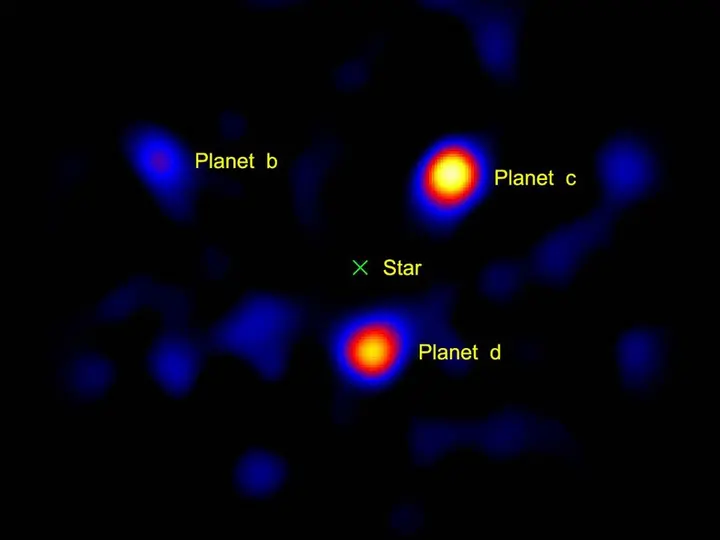
Planets that exist outside our solar system are called 'exoplanets'. The first confirmed exoplanet was discovered in 1992 around a pulsar star, while the first planet orbiting a normal star (51 Pegasi b) was discovered in 1995. According to data up to October 2026, scientists have discovered 6,445 confirmed exoplanets across 4,834 planetary systems, of which 1,070 systems contain more than one planet. Estimates suggest that in the Milky Way galaxy, 1 out of every 5 Sun-like stars has an Earth-sized planet located in its 'habitable zone' or Goldilocks zone.
The habitable zone is that precise distance from a star where the temperature is such that liquid water can exist on the planet's surface. Scientists estimate that among the 200 billion stars in our galaxy, there could be approximately 11 billion potential Earth-like habitable planets, and if red dwarf stars are also taken into account, this number can reach up to 40 billion. To find out on which of these vast numbers of planets life could flourish, it is necessary to study their atmospheres.
| Feature | Hubble Space Telescope | James Webb Space Telescope |
|---|---|---|
| Mirror diameter | 2.4 meters | 6.5 meters |
| Collection area | 4.0 square meters | 25.4 square meters |
| Wavelength spectrum | 0.1 to 2.5 μgs (UV/Visual) | 0.6 to 28.5 μgs (Infrared) |
| Operating temperature | 15 °C (288 K) | Below -223 °C (50 K) |
| Orbital location | 550 km altitude from Earth | 1.5 million km from Earth (L2 point) |
James Webb Telescope: Design and Physical Capabilities
The James Webb Telescope is primarily designed for infrared astronomy, meaning the study of astronomical objects through infrared waves. Compared to the Hubble Space Telescope, Webb is half its weight, but its primary mirror has a diameter of 6.5 meters (21 feet). This mirror is made of 18 gold-coated hexagonal beryllium segments. Its total light-collecting area is 25.4 square meters, which is more than 6 times that of Hubble's 4.0 square meters area with its 2.4-meter mirror.
Infrared waves have longer wavelengths than visible light, so a larger mirror is required to achieve the same resolution. The Webb Telescope observes wavelengths ranging from 0.6 to 28.5 micrometers. Because of this, it can see objects 100 times fainter than Hubble can. Furthermore, due to the expansion of the universe, the light of distant early stars is shifted towards longer wavelengths, a phenomenon known as 'redshift'. Webb can observe objects with redshifts up to z ≈ 20, corresponding to a period just 180 million years after the Big Bang.
- 1. Planet TransitWhen an exoplanet passes in front of its parent star, the star's light passes through the planet's atmosphere.
- 2. Infrared light absorptionMolecules such as water, carbon dioxide, and methane present in the atmosphere absorb specific infrared light.
- 3. Spectrum analysisJWST's NIRSpec and NIRCam instruments analyze these light waves to obtain spectrum data.
- 4. Identification of gasesFrom the graph of absorbed lines, scientists determine the precise presence of gases in the planet's atmosphere.
How exoplanet atmospheres are investigated
To investigate the atmospheres of exoplanets, 'transit photometry' and spectroscopy methods are used. When a planet passes in front of its parent star, a small amount of the star's light passes through the planet's atmosphere and travels toward Earth. Specific gases present in the atmosphere—such as water vapor, carbon dioxide, methane, and ozone—absorb light of specific infrared wavelengths.
Advanced instruments on the Webb Telescope, such as NIRCam (Near Infrared Camera) and NIRSpec (Near Infrared Spectrograph), analyze this light and create a spectrum graph. From the lines of absorbed light, scientists can precisely determine which chemical constituents are present in that planet's atmosphere. Conducting this study from Earth using ground-based telescopes is difficult because Earth's own atmosphere absorbs many bands of infrared light, and the water and carbon dioxide within it interfere with the observations.

1.5 million kilometers from Earth: The L2 point and sunshield
To prevent heat emitted by its own instruments from interfering with observations, it is necessary to keep the James Webb Telescope extremely cold—at temperatures below 50 Kelvin (-223 Celsius). For this purpose, the telescope has been positioned at the Sun-Earth L2 'Lagrange point', located approximately 1.5 million kilometers (930,000 miles) away from Earth. L2 is a location in space where the gravitational forces of the Sun and Earth balance, allowing the satellite to orbit the Sun alongside Earth.
To protect the telescope from the heat and light of the Sun, Earth, and Moon, a large 5-layered 'sunshield' has been provided. This sunshield is made of Kapton E film coated with aluminium and silicon. Its dimensions are 14.162 meters × 21.197 meters and its Sun Protection Factor (SPF) is 10,000,000. To fit inside the 4.57-meter diameter section of the rocket, this sunshield was folded and packed 12 times, which was successfully deployed after reaching space.
Comparison of Hubble and Webb, and Future Possibilities
The Hubble Telescope orbits at a height of only 550 kilometers from the Earth and its mirror remains at a temperature of 15 degrees Celsius, which prevents it from looking deeply into the infrared spectrum. Meanwhile, Webb's extremely low temperature and large mirror lead it into a new era of space science. To align the 18 segments of Webb's primary mirror with extreme precision, 132 small actuator motors are used, which can set the mirror with an accuracy of 10 nanometers.
The importance of this technology for humankind is immense. For scientists across the world, including India, data from the James Webb Telescope is playing a vital role in understanding the origin of the universe, the formation of the first galaxies, and—most importantly—searching for traces of life beyond the solar system. In the future, this telescope has a strong possibility of accurately identifying biosignatures, that is, gases indicating life, in the atmospheres of exoplanets.