Nuclear Fusion: Humanity's Greatest Experiment to Bring the Sun's Energy to Earth
The scientific secret of harnessing endless, clean, and emission-free energy through atomic synthesis, its history, and the complete details of ITER, the world's most complex experiment.
At the center of our sun and the stars lies a relentless, inexhaustible source of energy known as nuclear fusion. This is an atomic process in which the atomic nuclei of two or more light atoms join together to form a heavier nucleus. During this process, a slight difference remains between the mass of the initial atoms and the newly formed atom, which is released as immense energy according to the law of nuclear binding energy. All elements lighter than nickel (atomic number 28) in the universe have been formed solely through the Big Bang and the fusion processes operating at the centers of stars.
For decades, humanity has generated electricity using nuclear fission technology, in which the atoms of heavy elements such as uranium are split. However, the fusion process is the exact opposite. In fusion, extremely light atoms like isotopes of hydrogen are joined together. From just 1 gram of a mixture of deuterium and tritium, 90,000 kilowatt-hours (kWh) of energy can be generated through fusion, which is equivalent to the energy obtained from burning about 11 tons of coal. Most importantly, this process emits no carbon dioxide, carries no possibility of a reactor meltdown, and produces radioactive waste that remains active for a very short duration.
ટન કોલસો / ૯૦,૦૦૦ kWh
How does the fusion process work?
In nature, because atomic nuclei carry a positive charge, they repel each other with a strong force known as Coulomb repulsion. To make the fusion process possible, this repulsion must be overcome to bring the atoms close enough so that the strong nuclear force can take effect. For this, a thermonuclear fusion process must be carried out, which requires the triple product of extremely high temperature (one hundred million Kelvin or kilo-electron-volt scale), high density, and the necessary confinement time.
When a gas is heated to such an intense temperature, it transforms into plasma (ionized gas), the fourth state of matter. In this plasma, the atoms fuse with one another through the process of quantum tunneling. Physicist Friedrich Hund discovered quantum tunneling in 1927, and in 1928 George Gamow applied it to atomic nuclei. The most favorable reaction for fusion is between deuterium (21D) and tritium (31T), which releases helium (42He) and neutrons having 14 MeV of energy.
Deuterium is abundantly available from sea water, whereas tritium is present in nature in extremely small quantities. Only 20 kilograms of tritium is produced annually worldwide by CANDU nuclear reactors. Therefore, in future fusion reactors, technology is being developed to produce tritium inside the reactor itself by using a lithium blanket, which is called the Jetter cycle.
The Journey from Scientific Discovery to Military Weapons and Peaceful Energy
American chemist William Draper Harkins first introduced the concept of nuclear fusion in 1915. In 1919, Francis William Aston invented the mass spectrometer, which revealed that the weight of four hydrogen atoms is greater than that of one helium atom. Based on this, Arthur Eddington predicted in 1920 that the primary source of stellar energy is the fusion of hydrogen into helium. In 1938-39, Hans Bethe discovered the proton-proton chain and the CNO cycle, demonstrating how fusion operates in the Sun and other stars.
In the laboratory in 1932, John Cockcroft and Ernest Walton performed the first artificial nuclear transmutation by bombarding lithium with protons. In 1933 at the University of California, Ernest Lawrence accidentally achieved the first deuterium-deuterium fusion during cyclotron experiments. In May 1934, Mark Oliphant, Paul Harteck, and Ernest Rutherford purposefully carried out deuterium fusion to discover tritium and helium-3, which is considered the first successful experimental manifestation of fusion. In 1938, Arthur Ruark observed the deuterium-tritium (D-T) reaction for the first time.
During the Second World War, research into the military applications of fusion began under the Manhattan Project. Enrico Fermi and Edward Teller conceived the idea of using the heat of a fission bomb to initiate fusion. In 1952, the United States detonated an explosion equivalent to 10 megatons of TNT in the first thermonuclear test named Ivy Mike. Subsequently, in 1954, a 15-megaton explosion was conducted in the Castle Bravo test. The Soviet Union successfully tested the RDS-6s and RDS-37 hydrogen bombs in 1953 and 1955, respectively.
| Country / Experiment | Year | Explosive capacity (Megaton) |
|---|---|---|
| USA (Ivy Mike) | 1952 | 10 megatons |
| Soviet Union (RDS-6s) | 1953 | 400 kilotons |
| USA (Castle Bravo) | 1954 | 15 megatons |
| Soviet Union (RDS-37) | 1955 | 1.5 megatons |
However, efforts to achieve controlled fusion for peaceful energy have been underway since the 1930s. In 1958, the first laboratory-scale thermonuclear fusion took place in the Scylla I device at Los Alamos. During 1993-1996, Princeton University's TFTR reactor generated 10.3 megawatts (MW) of peak power and 1.6 gigajoules (GJ) of energy. In 1997, Britain's JET tokamak achieved 16 megawatts of peak power and a core Q-factor of 1.3. According to results released in February 2024, JET set a record by generating 69 megajoules (MJ) of energy using only 0.2 milligrams of D-T fuel.
On December 5, 2022, the US National Ignition Facility (NIF) achieved a historic milestone in laser-based inertial confinement fusion. By delivering 2.05 megajoules of energy to the target, they obtained 3.15 megajoules of fusion energy, marking the first time greater energy than the input energy (net energy gain) was produced. In April 2025, NIF achieved a Q-factor of 4.13. France's WEST tokamak reactor set a record by sustaining plasma at a temperature of 90 million degrees Celsius for a continuous duration of 6 minutes.
ITER: The Most Complex Scientific Experiment in Human History
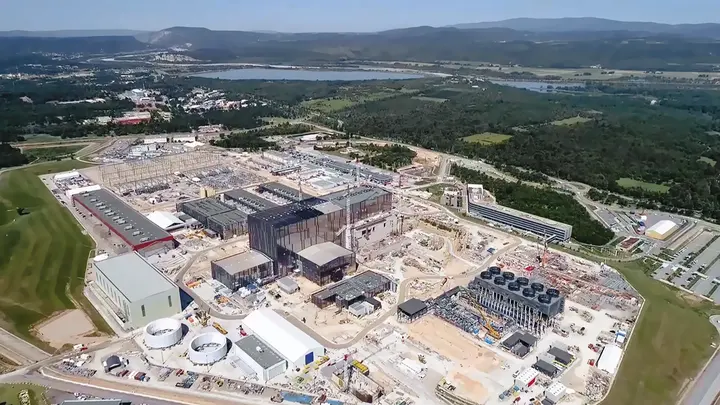
Aimed at generating commercial electricity from controlled fusion, the world's largest experiment, ITER (formerly the International Thermonuclear Experimental Reactor), is taking shape in Cadarache, France. In Latin, ITER means 'the way' or 'the road'. There is an interesting diplomatic history behind the establishment of this project. Discussions that began with the INTOR project in 1978 were finalized at the Geneva Summit in 1985 between Soviet General Secretary Mikhail Gorbachev and US President Ronald Reagan. Scientists such as Alvin Trivelpiece from the America and Yevgeny Velikhov from Russia played a major role in this science diplomacy. The original concept of the tokamak was introduced by Nobel laureate Andrei Sakharov and Igor Tamm.
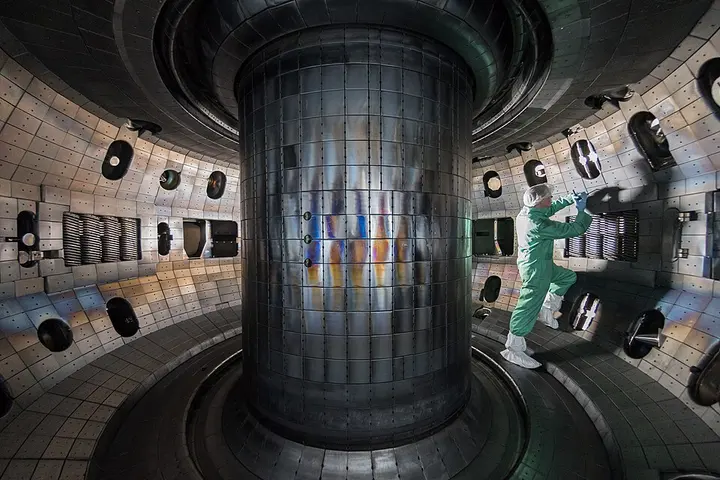
The ITER project has seven main partners: China, the European Union (EU), India, Japan, Russia, South Korea, and the United States. It will be the world's largest tokamak reactor, with a plasma volume six times larger than that of Japan's JT-60SA reactor. A tokamak is a powerful donut-shaped magnetic chamber in which ultra-hot plasma is suspended in the air by superconducting magnets so that it does not touch the walls of the chamber.

- 1. Donut shaped chamberA powerful donut shaped magnetic chamber is created in the reactor.
- 2. Generating plasmaGas is heated to an extremely high temperature and converted into ionized gas, i.e., plasma.
- 3. Floating by magnetic fieldThe ultra-hot plasma is made to float in the air with the help of superconducting magnets.
- 4. Protection of wallsThe plasma never touches the walls of the chamber, so that the high temperature remains safe.
The primary objective of ITER is not to generate electricity, but to provide a scientific demonstration. Its target is to achieve Q = 10. The Q-factor is the ratio of the heating energy supplied to the plasma to the thermal energy obtained from fusion. In ITER, supplying 50 megawatts (MW) of thermal power will generate 500 megawatts of fusion heat, which will be continuously sustained for 400 to 600 seconds. Additionally, it will achieve a 'burning plasma' state, in which more than fifty percent of the energy required to keep the plasma hot comes from the internal fusion process itself rather than external heating.
Statistics, Revised Schedule, and Cost
The ITER project is the most complex engineering venture in human history. At the project's inception in 2006, its estimated cost was approximately €5 to €6 billion (billion euros). However, due to design changes, rising raw material prices, and technical challenges, its total construction and operational cost has now reached €18 to €22 billion (according to some independent estimates, this cost could be $45 to $65 billion). After the International Space Station ($150 billion), this is humanity's most expensive scientific experiment.
To operate this reactor, a tremendous amount of electricity will be required, ranging from 110 megawatts in the initial phase to 620 megawatts for a 30-second duration during plasma operation. However, being a research reactor, instead of generating electricity from the energy obtained, it will be released into the atmosphere as steam.
Following the start of construction in France in 2013, the assembly phase of the tokamak was launched in 2020 by French President Emmanuel Macron. According to the revised schedule of July 2024, ITER will achieve its first plasma in 2033-2034 and begin deuterium-deuterium experiments in 2035. Full-scale deuterium-tritium (D-T) fusion is expected to begin in 2039.
In addition to government experiments, the private sector is also investing heavily in fusion. In the single year of 2021, private fusion startups such as Commonwealth Fusion Systems, Helion Energy, General Fusion, TAE Technologies, and Zap Energy received $2.6 billion in private funding.
The Future of Fusion for India and the World
India is an active partner country holding more than a 10% share in the ITER project. India has built and shipped the world's largest stainless steel vacuum vessel (Cryostat), in-vessel shielding, and cryogenic systems for ITER, which help keep the plasma cooled at minus 193 degrees Celsius.
After the success of ITER experiments, EUROfusion will construct a reactor named DEMO (Demonstration Power Plant). DEMO will be the world's first fusion furnace that will actually generate electricity for the power grid. For commercial power plants, engineers calculate that the Q-factor should be around 100 so that net profitable electricity can be obtained even after deducting all external power consumption of plasma heating, magnets, and cryogenics.
In this era of climate change and energy crisis, if humanity can successfully bring nuclear fusion down to Earth, it will prove to be the greatest scientific revolution in the history of human civilization—an energy that will never run out and will not harm the Earth's environment in the slightest.