The Largest Machine in Human History Unlocking the Deep Mysteries of the Universe: The Large Hadron Collider
Pulsing within a 27-kilometer tunnel beneath the Swiss-French border, CERN's Large Hadron Collider is pushing the frontiers of physics by colliding particles at the speed of light.

What is the Large Hadron Collider and why is it important?
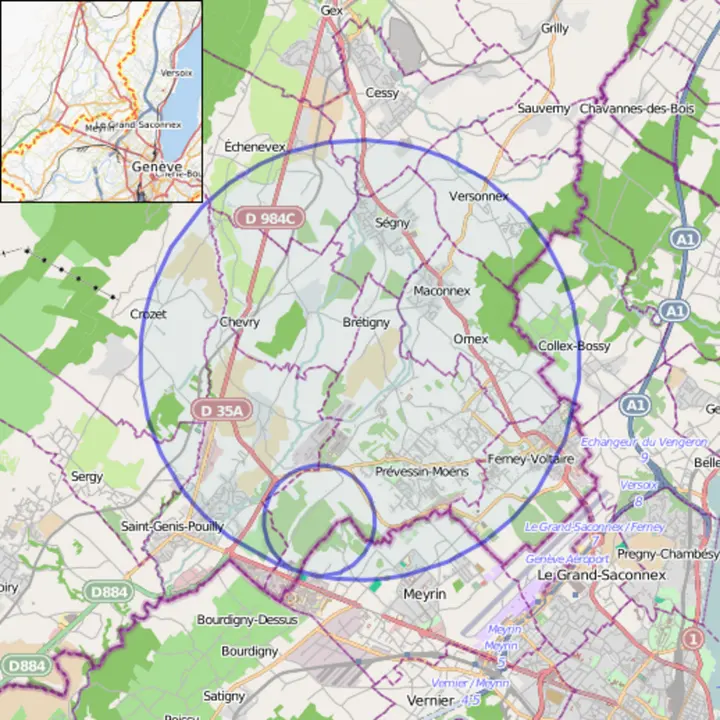
To find answers to complex questions such as how our universe was formed, where matter gets its mass from, and what the fundamental laws of nature are, the European Organization for Nuclear Research (CERN) built the Large Hadron Collider (LHC), the world's largest and most powerful particle accelerator. This massive laboratory is located underground at a depth of 50 to 175 meters in a 27-kilometer (26.7 kilometers) circular tunnel near Geneva on the border of Switzerland and France. It was constructed between 1998 and 2008 through the joint collaboration of more than 10,000 scientists, associated universities, and laboratories from over 100 countries.
Hadrons are subatomic particles made of fundamental particles called quarks, which are held together by the strong nuclear force, such as protons and neutrons. A collider is an accelerator that smashes two beams of particles coming from opposite directions against each other at extremely high speeds. Compared to experimenting by firing particles at a stationary target, colliding them head-on yields much higher center of mass energy: the total kinetic energy available during particle collisions. It is from such high-energy collisions that ephemeral new particles are created, and by studying them, scientists can understand the profound laws of nature.
Unsolved questions of physics and the purpose of the LHC
The primary objective of the LHC is to test the fundamental principles of particle physics. The Standard Model of particle physics—the theory explaining the fundamental particles of matter and their forces—was completed in 2012 with the discovery of a particle called the Higgs boson by the LHC. The discovery of the Higgs boson proved how fundamental particles acquire mass. However, since the Standard Model cannot explain all the mysteries of the universe, the LHC is seeking answers to deeper questions.
With the help of the LHC, scientists are investigating whether supersymmetric partners of all Standard Model particles exist, a concept known as the supersymmetry theory. Beyond this, research is also underway on whether extra dimensions predicted by string theory exist and whether they can be detected. Determining the true nature of dark matter, the invisible substance that makes up 27% of the universe's total mass-energy, is also one of the primary goals of the LHC.
In addition, other fundamental questions are also studied here through heavy-ion collisions, such as: Are the electroweak force and the strong nuclear force different forms of a single universal force? Why is the gravitational force so much weaker than the other three fundamental forces? What reasons are responsible for the asymmetry between matter and antimatter? Furthermore, what are the characteristics of the quark-gluon plasma—an extremely hot liquid form of quarks and gluons—that existed in the early universe?
The Great Journey of Particles: From Linac4 to the Main Ring
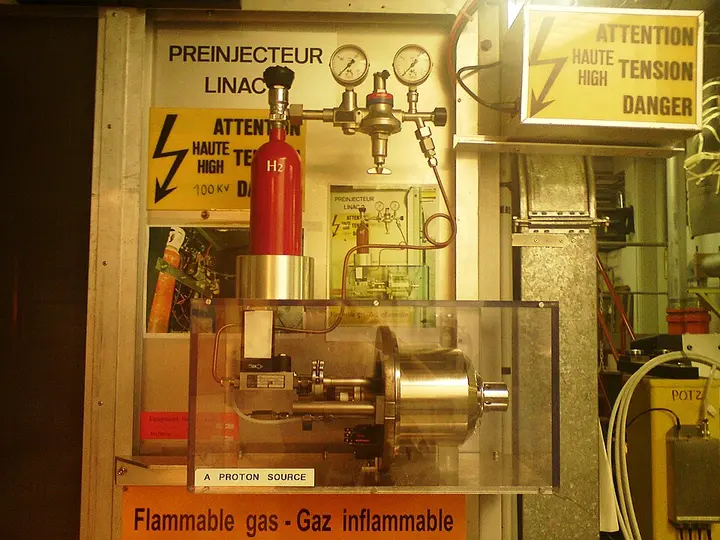
Before injecting protons into the main ring, they are passed through a series of accelerator systems to increase their energy in stages. This process begins with the linear accelerator Linac4, which gives hydrogen ions an energy of 160 MeV (mega-electronvolts). These ions then go to the Proton Synchrotron Booster (PSB), where their electrons are removed, leaving only the proton nuclei, and their energy is increased to 2 GeV (giga-electronvolts).
- 1. Linac4 Linear AcceleratorHydrogen ions are accelerated up to 160 MeV and sent to the Proton Synchrotron Booster.
- 2. Proton Synchrotron Booster (PSB)Electrons are removed leaving only proton nuclei and they are accelerated up to 2 GeV.
- 3. Proton Synchrotron (PS)Protons are further accelerated and their energy is increased to 26 GeV.
- 4. Super Proton Synchrotron (SPS)Before entering the main ring, the energy of the protons is increased to 450 GeV.
- 5. LHC Main RingIn a period of 20 minutes, particles are accelerated to their maximum 6.5 TeV energy and collided for 5 to 24 hours.
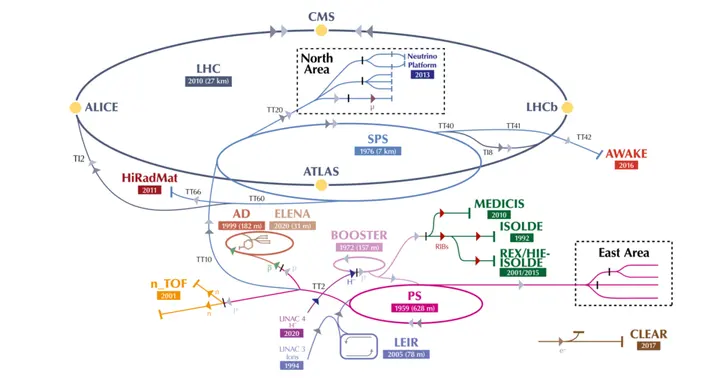
Subsequently, these protons are sent to the Proton Synchrotron (PS) and given an energy of 26 GeV. From there, these protons attain an energy of 450 GeV in the Super Proton Synchrotron (SPS). After all these preliminary processes are completed, the protons are injected into the main LHC ring. In the main ring, proton bunches are accumulated and accelerated to their maximum energy of 6.5 TeV (tera-electronvolts) over a period of 20 minutes, where they circulate continuously for 5 to 24 hours and collide at four intersection points.
Engineering Marvel: Magnets, Cryogenics, and Power
The LHC's underground tunnel is 3.8 meters wide and concrete-lined; it was constructed between 1983 and 1988 and was previously used for the Large Electron-Positron Collider. This 26.7-kilometer ring contains two parallel beamlines (or pipes) in which particles circulate in opposite directions. To keep the beams on a circular path, 1,232 dipole magnets are installed, each weighing 35 tons. An additional 392 quadrupole magnets are used to focus the beams.
| Feature / Criterion | Technical Detail |
|---|---|
| Tunnel circumference | 26.7 kilometers (16.6 miles) |
| Underground depth | 50 to 175 meters |
| Number of dipole magnets | 1,232 (each weighing 35 tons) |
| Magnetic field strength | 0.54 to 7.7 Tesla |
| Operating temperature | 1.9 Kelvin (-271.25 °C) |
| Superfluid Helium-4 quantity | 96 tons |
| Power consumption (main complex) | 120 Megawatts (CERN total: 200 MW) |
| Daily data production | 140 Terabytes |
This superconducting magnet: 96 tonnes of superfluid helium-4 is used to keep the zero-resistance magnets at their operating temperature of 1.9 Kelvin (-271.25 °C). Due to these magnets, which are made of 470 tonnes of copper-coated niobium-titanium (Nb-Ti) wire, the LHC becomes the world's largest cryogenic facility. When protons are accelerated from 450 GeV to 6.5 TeV, the magnetic field increases from 0.54 teslas to 7.7 teslas.

The Lorentz factor of a proton at an energy of 6.5 TeV: according to relativity, the ratio of mass increase is approximately 6,930, and they travel at a speed of 0.999999990 times the speed of light, which is only 3.1 meters/second (11 kilometers/hour) slower than the speed of light! It takes less than 90 microseconds for a proton to complete one lap of the 26.7-kilometer main ring, meaning it makes 11,245 revolutions per second. Instead of flowing continuously, the protons in the beam are divided into 2,808 bunches, and each bunch contains 115 billion protons. These bunches collide every 25 nanoseconds, resulting in a bunch collision rate of 40 MHz per second.
To operate the LHC, CERN draws approximately 200 megawatts (MW) of electricity from the French electrical grid, which is equal to one-third of the power consumption of the city of Geneva. Of this, the particle accelerators and detectors use approximately 120 MW of electricity. These experiments generate 140 terabytes (TB) of data every day.
Collision Energy, Detectors, and Global Network
The first collision of the LHC was achieved in 2010 with an energy of 3.5 TeV per beam. It was shut down and upgraded between 2013 and 2015, allowing the energy per beam to reach 6.5 TeV (total collision energy of 13.0 TeV). It was shut down again for maintenance at the end of 2018 and reopened in April 2022. In addition to mainly proton-proton collisions, heavy lead ion collisions are conducted for about one month per year, generating massive energies of 2.3 TeV per nucleon (or 522 TeV per ion).
Nine detectors: instruments that record the presence of particles, are installed in large underground chambers at the four intersection points of the LHC. ATLAS and CMS are two large general-purpose detectors that discovered the Higgs boson. ALICE and LHCb are for specific research, while TOTEM, MoEDAL, LHCf, SND, and FASER are smaller and specialized research detectors. In the ALICE detector, the quark-gluon plasma was confirmed for the first time in 2010, and the jet quenching phenomenon was confirmed in 2012.
To process the massive data and simulations amounting to 200 petabytes annually from these experiments, the 'LHC Computing Grid' has been created. This worldwide network connects over 170 computing centers across more than 35 to 40 countries via high-speed fiber optics. Additionally, a citizen science project named 'LHC@home' is also operated to simulate particle trajectories, in which any citizen of the world can become a partner in this great scientific revolution by contributing the idle time of their computer.