Nuclear Fission: The Remarkable Physics of Generating Electricity by Splitting the Atomic Core
The scientific process of nuclear fission, the liquid-drop model of the atomic nucleus, and the comprehensive saga of controlled chain reactions in power plants.

Nuclear fission is one of the most powerful processes in the modern energy world. Compared to chemistry or conventional fuels, this process is so immense that the energy released from the fission of just one atom of Uranium-235 is approximately 100 million times greater than that produced by burning one atom of carbon in air to form carbon dioxide. When the nucleus of a heavy, unstable atom splits into two or more smaller fragments, a tiny fraction of its mass is converted into tremendous energy. Humanity has used this remarkable process to illuminate dark nights, although the risks and challenges associated with it have remained equally serious.
This scientific revolution began in December 1938. On December 19, 1938, German chemists Otto Hahn and Fritz Strassmann obtained experimental evidence that bombarding uranium with neutrons caused it to break apart and transform into lighter elements. The theoretical explanation for this phenomenon was provided in January 1939 by physicist Lise Meitner and her nephew Otto Robert Frisch. Drawing from the term 'fission' used for cell division in biology, Frisch named this nuclear process 'fission'. In February 1939, Hahn hypothesized that additional neutrons are released in this process, which opened the door for future self-sustaining nuclear chain reactions.

The Physics of Fission: The Liquid Drop and the Source of Energy
To understand how an atomic nucleus splits, Niels Bohr and John Wheeler introduced the liquid drop model. Imagine an unstable drop of water struggling against surface tension. In an atomic nucleus, the positive charges of the protons push each other away (Coulomb force), while the strong nuclear force holds them together. When a slow neutron enters a Uranium-235 nucleus, it forms a compound nucleus. This additional energy causes vibrations in the drop, causing it to stretch and assume a dumbbell-like shape.
- Neutron absorptionA slow neutron enters the nucleus of Uranium-235 to form a compound nucleus.
- Vibration in the nucleusDue to excess energy, vibration is created in the nucleus and it takes on a dumbbell-like shape.
- FissionThe nucleus crosses the fission barrier and breaks into two lighter nuclei and releases energy.
Due to this stretching, the nucleus attains a 'saddle shape', and the electrostatic repulsion between its two ends becomes dominant. To undergo fission, the nucleus must overcome an energy barrier, known as the fission barrier or activation energy. For elements with an atomic mass of approximately 240, this barrier is about 6 MeV (mega-electron volts). The binding energy released upon the absorption of a neutron in Uranium-235 easily overcomes this barrier, and the nucleus splits into two lighter nuclei in an instant.
The distribution of energy released during fission is remarkable. According to research by Unik and Loveland, approximately 85 percent of the total energy produced in fission is released as the kinetic energy of the fission fragments. This motion heats the surrounding material. In addition, about 6 percent of the energy is released from prompt neutrons and gamma rays, 6 percent from beta decay, and the remaining 3 percent is carried away by neutrinos.
ટકા (%)
Binary and Ternary Fission: The Mathematics of Atomic Fragments
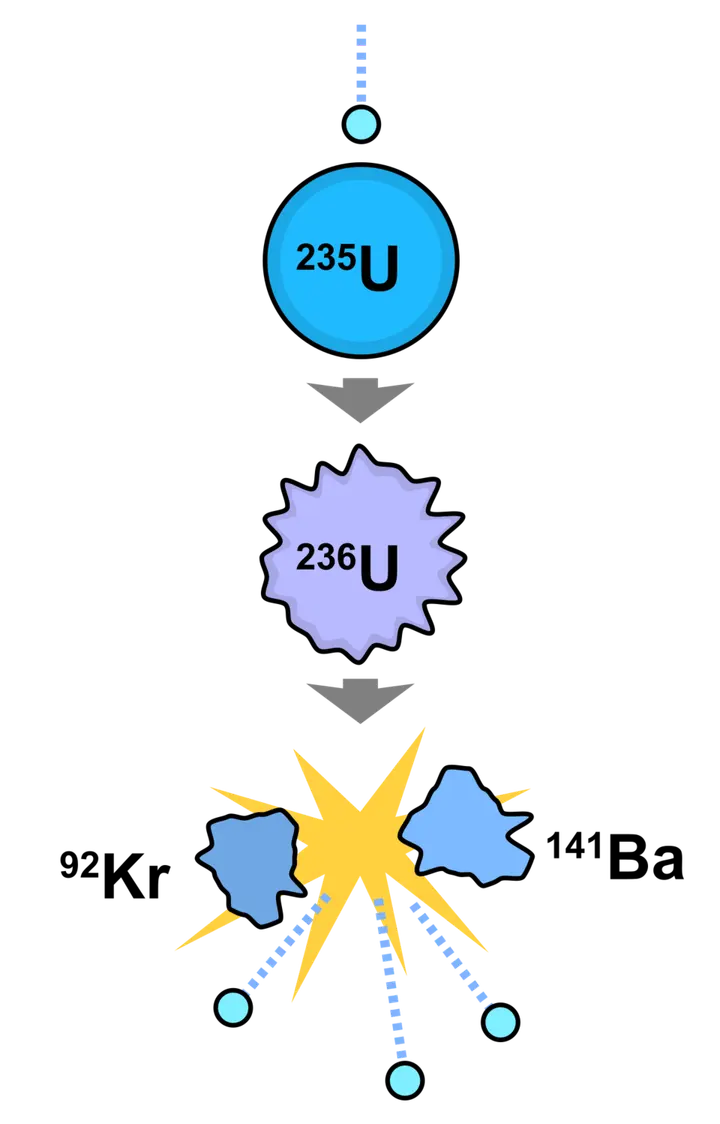
Typically, nuclear fission results in two asymmetric fragments, which is called binary fission. The most well-known example of Uranium-235 is as follows: ²³⁵U + n ⟶ ²³⁶U* ⟶ ⁹⁵Sr + ¹³⁹Xe + 2 n + 180 MeV
Here, uranium breaks down to form Strontium-95 and Xenon-139, releasing two neutrons and 180 MeV of energy. The mass of the fragments produced in this fission is mostly centered around 95±15 and 135±15 Daltons, with a ratio of approximately 3:2. Occasionally, in 2 to 4 cases out of every 1000 fissions, the nucleus splits into three fragments, which is called ternary fission. This third particle is usually an alpha particle (Helium-4), which has a long range and possesses approximately 16 MeV of energy.
Fission can occur in two ways: induced and spontaneous. In 1940, Georgy Flyorov, Konstantin Petrzhak, and Igor Kurchatov discovered that heavy isotopes could break apart automatically without being struck by an external neutron. However, in practical power plants, we use controlled induced fission rather than spontaneous fission.
Fissile Material: The Difference Between U-235 and U-238
Not every uranium atom breaks apart easily. Natural uranium consists mostly of Uranium-238, which can only be fissioned by high-energy, or fast, neutrons. In contrast, Uranium-235 is a 'fissile' material, which is easily fissioned even by slow or thermal neutrons. The probability of neutron absorption is called the fission cross section, and for slow neutrons, the cross section of Uranium-235 is a million times greater than that of Uranium-238.
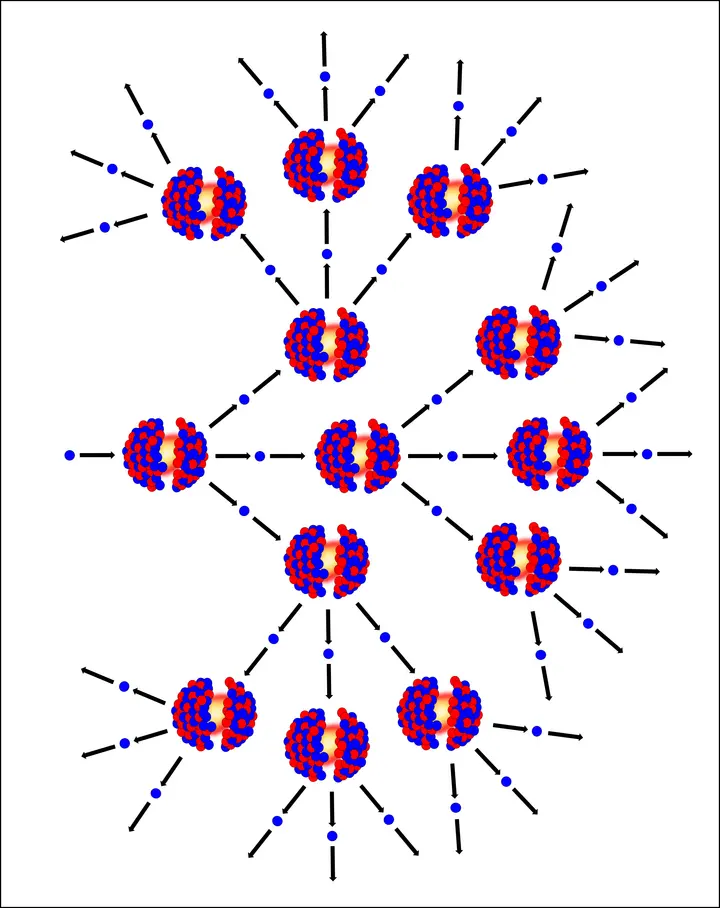
Nuclear power plants use a moderator to slow down the extremely fast neutrons produced after fission, so that they can collide with other U-235 nuclei and maintain a chain reaction. Only three isotopes in the world – U-233, U-235, and Pu-239 – have the capacity to sustain a chain reaction.
The Historical Journey from Laboratory to Power Grid
After scientists understood the energy of fission, the world's first man-made reactor, 'Chicago Pile-1', was successfully started under the leadership of Enrico Fermi at the University of Chicago on December 2, 1942. However, the primary objective of the research at that time was to build an atomic bomb under the Manhattan Project. After the war, the focus shifted toward peaceful energy production.
On December 20, 1951, the EBR-I experimental station in Idaho, USA, generated approximately 100 kilowatts of electricity from nuclear energy for the first time. Subsequently, on June 27, 1954, the Soviet Union's Obninsk power plant became the world's first nuclear power plant to be connected to a grid, providing approximately 5 megawatts of electricity. On August 27, 1956, Calder Hall at Windscale in England became the world's first commercial nuclear power station, which, along with electricity, also produced plutonium-239 for Britain's weapons program.

| Detail | Figure / Capacity | Note |
|---|---|---|
| Operational civilian reactors | 416 | Total installed capacity 376 GW |
| Reactors under construction | 63 | Upcoming capacity 66 GW (mostly in Asia) |
| Planned reactors | 87 | Upcoming capacity 84 GW |
| Global electricity generation (2023) | 2,602 TWh | Approximately 9% of total world electricity generation |
| Average capacity factor | 89% | Highest 92% in USA |
Global Energy Picture and Safety Assessment
In 1960, the global installed nuclear capacity was less than 1 gigawatt (GW), which reached 100 GW by the end of the 1970s and 300 GW by 1990. In the 1980s, on average, a new reactor was started every 17 days. In 2023, nuclear power plants worldwide provided 2,602 terawatt-hours (TWh) of electricity, accounting for approximately 9% of global electricity generation and serving as the world's second-largest low-carbon source after hydroelectricity.
According to data as of November 2025, there are 416 civilian fission reactors in operation worldwide, with a total capacity of 376 GW. In addition, 63 reactors are under construction (66 GW capacity) and 87 new plants are in the planning stage (84 GW capacity). The United States holds the largest fleet, generating approximately 800 TWh of electricity annually with an average capacity factor of 92%, while the global average is 89%.
The greatest asset of nuclear energy is its environmental contribution. According to a scientific study, by preventing air pollution caused by fossil fuel plants, each nuclear plant has saved approximately 800,000 life-years. Compared to coal, mineral oil, natural gas, and hydroelectricity, nuclear energy has the lowest mortality rate per unit of production.
However, this technology is not risk-free. The 1979 Three Mile Island accident, the 1986 Chernobyl disaster (which resulted in 56 direct deaths and a cleanup cost of approximately $68 billion), and the March 11, 2011, Fukushima Daiichi disaster in Japan raised serious questions regarding nuclear safety. Following Fukushima, Germany decided to shut down all its reactors by 2022, while Japan, having tightened safety standards since 2015, undertook the process of restarting 40 reactors, and in 2022, Prime Minister Fumio Kishida announced the reopening of 10 more plants.
Thus, nuclear fission is an achievement of human intellect that has unlocked the power residing in the heart of an invisible atom. If its use continues with strict safety standards and environmental awareness, this energy will remain an indispensable pillar for a carbon-free world of the future.