The Science of Zero Resistance: A Journey Through Superconductivity, Levitating Maglev Trains, and the Quantum Revolution
When metals lose all electrical resistance in biting cold, extraordinary laws of physics emerge—propelling bullet trains above their tracks and unlocking the doors to quantum technology.

Discovery of Zero Resistance: An Unexpected Revolution in Physics
When an electric current passes through any ordinary conducting wire at normal temperature, the free electrons within it constantly collide with the metal atoms. Because of these collisions, energy is lost in the form of heat, which we call electrical resistance. In ordinary metals, resistance gradually decreases as the temperature drops, but it never becomes zero. However, in certain specific materials, as soon as a precise critical temperature is reached, the electrical resistance suddenly vanishes completely and becomes zero. This remarkable phenomenon in physics is called superconductivity.
This historic discovery was made on April 8, 1911, by the Dutch physicist Heike Kamerlingh Onnes. Using newly prepared liquid helium, he was studying how mercury behaves at extremely low temperatures. When the temperature dropped to 4.2 Kelvin, the electrical resistance of mercury suddenly disappeared. Interestingly, during this very experiment, he also observed the superfluid transition of helium at 2.2 Kelvin, although its significance was not recognized at the time. The precise details of Onnes's discovery became fully known only after his notebooks were recovered a century later.
The most exciting characteristic of superconductivity is that if a closed loop is made of superconducting wire and an electric current is passed through it once, it can flow continuously for eternity without any external power source. Subsequently, in 1913, tin was found to become superconducting at 3.8 Kelvin and lead at 7 Kelvin. By the year 1941, niobium nitride was observed to exhibit this property at 16 Kelvin. Superconductivity is not merely an ideal conductor of classical physics, but the entire process can only be understood through quantum mechanics.
Exclusion of Magnetic Field: The Meissner Effect and London Equations
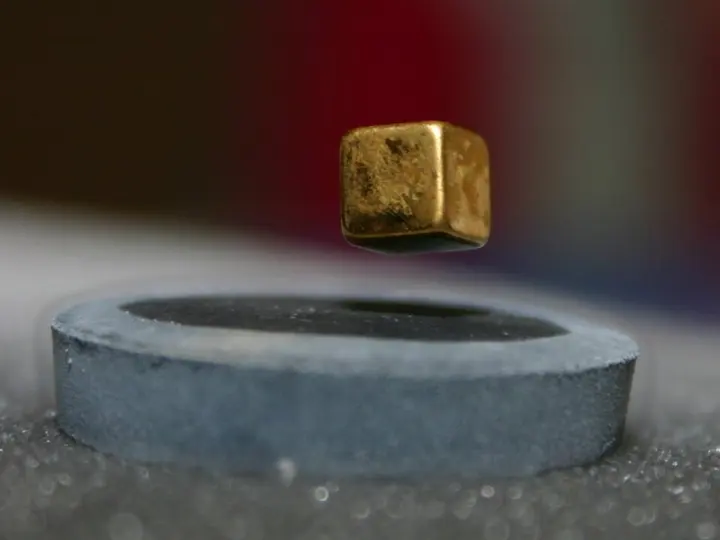
Superconducting materials are not only excellent electrical conductors, but their behavior toward magnetism is even more distinctive. In 1933, Walther Meissner and Robert Ochsenfeld discovered that when a material enters the superconducting state, it completely expels all magnetic fields from within itself. This phenomenon is called the Meissner effect. According to classical physics, a perfect conductor would maintain the magnetic field residing within it, but a superconducting material completely pushes it out, proving that it is a new quantum state.
In 1935, two brothers named Fritz and Heinz London introduced the famous 'London equations' to explain this phenomenon. These equations show that the electromagnetic free energy carried by the supercurrent is minimized, as a result of which the magnetic field drops rapidly to zero as it enters the superconductor from the surface. Due to the Meissner effect, when an ordinary magnet is placed above a superconducting material, the superconductor generates such a diamagnetic current on its surface that the magnet begins to float (levitate) stably in the air.
- Cryogenic reduction in temperatureThe material is extremely cooled below its specific critical temperature (Tc) by liquid helium or liquid nitrogen.
- Formation of Cooper pairsElectrons interact with phonons of the crystal lattice to form pairs, causing the electrical resistance of the material to suddenly drop to exactly zero.
- Meissner effect and magnetic expulsionUpon entering the superconducting state, the material completely expels all external magnetic lines from within itself.
- Stable magnetic levitationDue to the repulsive force of the magnetic field, the magnet or train floats stably in the air above the surface without any friction.
Cooper Pairs and Microscopic Theory
It took scientists decades to understand at what atomic level superconductivity actually operates. In 1950, Landau and Ginzburg proposed the 'Ginzburg-Landau theory', which explained macroscopic properties. Subsequently, Alexey Abrikosov showed that superconductors are of two types: Type-1 and Type-2. For this work, Abrikosov and Ginzburg were awarded the 2003 Nobel Prize. In the same year, 1950, Maxwell and Reynolds noted that the critical temperature depends on the isotopic mass of the isotope, which indicated that crystal lattice vibrations, namely phonons, play a decisive role in this.
Finally, in 1957, John Bardeen, Leon Cooper, and John Schrieffer presented the complete microscopic theory of superconductivity, known as the BCS theory. According to this theory, negatively charged electrons, which normally repel each other, form pairs through interaction with the phonons of the crystal lattice, which are called Cooper pairs. These pairs behave as a boson particle and can flow smoothly through the lattice without any kind of collision or thermal resistance. For this groundbreaking theory, these three scientists were awarded the Nobel Prize in Physics in 1972.
The Revolution of High-Temperature Superconductors: The Era of Liquid Nitrogen
For decades scientists believed that superconductivity is possible only at extremely low temperatures, which required the use of expensive and complex liquid helium. But a revolution occurred in 1986, when superconductivity was observed at temperatures above 35 Kelvin in cuprate-perovskite ceramic materials. Soon after, a researcher named Ching-Wu Chu added yttrium in place of lanthanum to create YBCO (Yttrium Barium Copper Oxide), whose critical temperature directly reached 92 Kelvin (-181 °C).
This discovery was a milestone for the scientific world because cheap and readily available liquid nitrogen boils at 77 Kelvin (-196 °C). Because superconductivity was achieved at temperatures above 77 Kelvin, they were named high-temperature superconductors. This made it possible for laboratories and industrial units to make practical use of superconducting phenomena without extremely expensive cryogenic equipment.
In recent years, surprising superconductivity has also been observed in two-dimensional (2D) materials. In 2018, researchers achieved superconductivity at 1.7 Kelvin by twisting two layers of graphene at a specific angle of 1.1 degrees (twisted bilayer graphene). Subsequently, in 2021, success was achieved in obtaining superconducting characteristics at 2.8 Kelvin in three-layer graphene, and in 2022 at 1 to 2 Kelvin in untwisted trilayers.
| Train / System | Country and Technology | Maximum Speed | Special Note |
|---|---|---|---|
| L0 Series (SCMaglev) | Japan (Superconducting EDS) | ૬૦૩ કિમી/કલાક | World speed record established in 2015 |
| Miyazaki Test Train | Japan (SCMaglev) | ૫૧૭ કિમી/કલાક | Initial experimental record of 1979 |
| Shanghai Maglev | China (Transrapid EMS) | ૪૩૧ કિમી/કલાક | 30.5 km distance in 7 minutes 20 seconds |
| Linimo (HSST) | Japan (Electromagnetic) | ૧૦૦ કિમી/કલાક | Active local transit since 2005 |
| Birmingham Maglev | UK (Linear Induction) | ૪૨ કિમી/કલાક | World's first commercial shuttle (1984-1995) |
Supermagnets, the Josephson Effect, and Quantum Computing
The first practical application of superconductivity was developed in 1954 by Dudley Allen Buck as the 'cryotron' computer switch. Initially, Kamerlingh Onnes attempted to build electromagnets from superconducting wire, but superconductivity would be destroyed even in a normal magnetic field. In 1955, Wijntje made a small magnet of 0.7 Tesla using niobium wire. Then, in 1961, Kunzler and his team observed in the niobium-tin (Nb3Sn) alloy that it could carry an electrical current of over 100,000 amperes per square centimeter even in a colossal magnetic field of 8.8 Tesla at a temperature of 4.2 Kelvin. This material was capable of generating fields up to 20 Tesla.
In 1962, Berlincourt and Hake discovered the more ductile niobium-titanium (NbTi) alloy, which could operate up to 10 Tesla. Due to its ease of manufacturing, Nb-Ti became the primary material for supermagnets worldwide. MRI machines used in hospitals and particle accelerators depend on this material. According to a 2014 estimate by the Conectus organization, economic activity based on superconductivity worldwide amounted to about five billion euros, with the MRI systems alone accounting for an 80% share.
The biggest turning point in the field of quantum technology came in 1962, when Brian Josephson theoretically predicted that even if an extremely thin layer of an insulator is placed between two superconductors, a supercurrent can still flow. This phenomenon is called the Josephson effect, for which he received the 1973 Nobel Prize. Based on this principle, extremely sensitive magnetic meters called SQUIDs (Superconducting Quantum Interference Devices) were created. These very Josephson junctions are today the main pillar for building qubits, the fundamental units of modern superconducting quantum computers.

Maglev Trains Running in Mid-Air Without Tracks
The most magnificent and direct application of superconducting magnets has been in the transportation sector with 'Maglev' (Magnetic Levitation) trains. A Maglev is a train system in which there is no physical friction between wheels or tracks; the train hovers a few centimeters in mid-air above the guideway due to powerful magnetic forces. To propel it forward, linear motor technology is used, the first practical model of which was built in the 1940s by British engineer Eric Laithwaite.
Maglev technology is mainly of two types: Electromagnetic Suspension (EMS) and Electrodynamic Suspension (EDS). The EMS system works on the principle of normal attractive force, which is used in the Shanghai Maglev. On the other hand, the EDS system operates on repulsive force, a concept conceived in 1961 by James Powell and Gordon Danby of Brookhaven National Laboratory after getting stuck in a traffic jam. Japan has developed the SCMaglev (Superconducting Maglev) by incorporating superconducting magnets into this EDS system.
Research on the superconducting maglev in Japan began in 1962. The first successful run was recorded at Japanese National Railways in 1972, and in 1979 this train achieved a speed of 517 km/h on the Miyazaki Test Track. In 2015, Japan's experimental L0 Series superconducting maglev train set a world record on the Yamanashi Test Track by registering a speed of 603 km/h (375 mph). Currently, the 285.6-kilometer-long 'Chūō Shinkansen' line between Tokyo and Nagoya is being built using this technology, construction for which began in 2014 and is now unlikely to open before 2036 due to construction delays.
km/h
Global Reality and Future Challenges
Despite more than a century of research, high construction costs and incompatibility with existing railway infrastructure mean that only six maglev systems are operational worldwide today—four in China, one in Japan, and one in South Korea. The record for the longest-running highest speed in commercial passenger service has been held by China's Shanghai Maglev. Featuring German Transrapid technology, this train covers the 30.5 km distance between Pudong Airport and Central Pudong at a speed of 431 km/h in just 7 minutes and 20 seconds.
In high-speed maglev trains, levitation—that is, lifting the train into the air—consumes a very small fraction of the total energy; the majority of energy is spent overcoming aerodynamic drag. To overcome this limitation, vacuum tube train (Vactrain) technology is now being considered. Today, superconductivity has become the foundation of modern science, ranging from hospital MRI scanners to supercomputing and high-speed railways.