NASA's Swift Telescope's Final Journey: Orbital Decay and the End of a Space Science Odyssey
After studying gamma-ray bursts for 22 years, the Swift telescope is re-entering Earth's atmosphere; learn how solar activity precipitated the downfall of this powerful observatory.

In the history of space science, there are certain observatories that accomplish far beyond their designated limits. NASA's Neil Gehrels Swift Observatory is a symbol of precisely such an extraordinary success. Launched on November 20, 2004, this 1.5-tonne telescope has for the past 22 years been studying the universe's most powerful explosions, known as gamma-ray bursts. However, due to natural physics and the changing activity of the Sun, this mission has now reached its end. According to reports from South Korea's space agency KASA and NASA, this telescope is expected to re-enter Earth's atmosphere and disintegrate on November 3, 2026.
The demise of the Swift telescope is no accident, but the result of a scientific process known as 'orbital decay'. When a satellite is in a low Earth orbit, it comes into contact with an extremely thin atmosphere. Over time, this atmospheric drag slows the satellite's speed, causing its altitude to decrease continuously. In Swift's case, this process accelerated over the past two years. According to Wikipedia data, increased solar activity caused Earth's atmosphere to expand, which increased the drag on the telescope and caused its orbit to decay rapidly.

The Swift Mission: Hunter of the Universe's Secrets
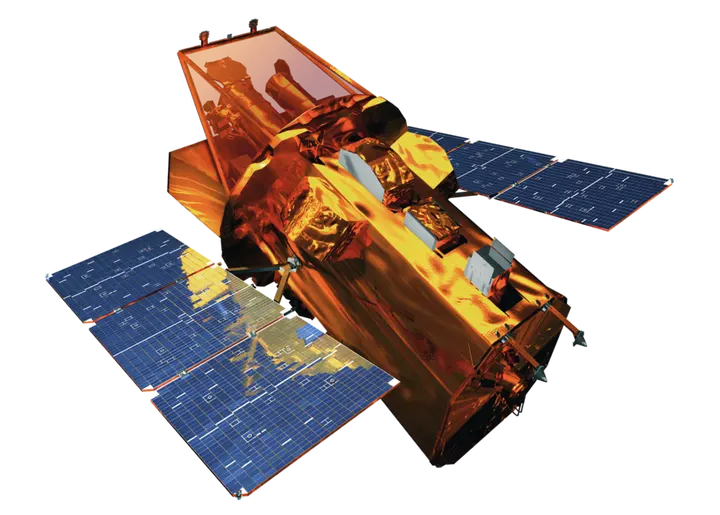
The primary task of the Swift telescope was to detect gamma-ray bursts (GRBs) occurring in the universe and transmit their precise data back to Earth. Gamma-ray bursts are the brightest and most powerful explosions in the universe, lasting anywhere from a fraction of a second to a few minutes. Swift was named for its operational speed. Just as the bird named 'swift' can maneuver swiftly in the air, this telescope could immediately redirect itself the moment an explosion was spotted in the sky. This process is called 'slewing'. The momentum wheels within the telescope enabled it to rotate autonomously within seconds.
Three main instruments operated in this mission: the Burst Alert Telescope (BAT), the X-ray Telescope (XRT), and the Ultraviolet/Optical Telescope (UVOT). The BAT instrument monitored a large expanse of the sky and determined the position of an explosion as soon as it occurred. Subsequently, the XRT and UVOT would swivel toward that direction to study the post-explosion glow, known as the afterglow. According to Wikipedia reports, Swift discovered over 1,000 gamma-ray bursts during its lifetime, with the 1,000th burst discovered on October 27, 2015, known as 'GRB 151027B'.
| Instrument | Main function and feature |
|---|---|
| Burst Alert Telescope (BAT) | Monitoring a large part of the sky and detecting gamma-ray bursts to determine their precise location. |
| X-ray Telescope (XRT) | Studying the afterglow using X-rays and finding the accurate location. |
| Ultraviolet/Optical Telescope (UVOT) | Observing the afterglow in ultraviolet and optical wavebands and obtaining long-term data. |
- Atmospheric dragThin layers of the Earth's upper atmosphere create resistance to the satellite's motion.
- Solar activityIncreased heat during the solar cycle expands the atmosphere, increasing drag.
- Decrease in altitudeAs its speed slows down, the satellite is pulled towards the Earth and its orbit keeps getting lower.
- Re-entryWhen the altitude drops below 300 km, atmospheric density burns up the satellite.
Orbital Decay and the Sun's Influence
Any satellite must maintain the necessary velocity to remain at a specific altitude around the Earth. When Swift was launched, its altitude was approximately 585 to 604 km. However, Earth's atmosphere is not a complete vacuum in space. When the Sun is more active (solar maximum), it heats Earth's upper atmosphere, causing the atmosphere to swell and expand upward. This expanded atmosphere creates drag for satellites like Swift. In 2026, due to such solar activity, Swift's altitude began to decrease.
When a satellite descends below an altitude of 300 km, atmospheric drag becomes so great that bringing it back up becomes nearly impossible. The Swift telescope fell below this 300 km limit on October 9, 2026. This condition is called the 'point of no return'. NASA officially decommissioned Swift on October 23, 2026, because it no longer possessed sufficient stability to make scientific observations.
- Increase in solar activityDue to increased solar activity, the Earth's upper atmosphere heats up, swells, and expands.
- Atmospheric frictionComing into contact with the expanded atmosphere increases the drag force on the satellite, slowing down its speed.
- Altitude reduction and emergencyThe telescope's orbit continuously decreased and dropped below the 300 km limit.
- Official end of the missionWhen the telescope lacked sufficient stability, its operations were officially shut down by NASA on October 23, 2026.
| Instrument Name | Function | Accuracy |
|---|---|---|
| BAT (Burst Alert Telescope) | Detecting and localizing gamma-ray bursts | 1 to 4 arcminutes |
| XRT (X-ray Telescope) | Studying the post-burst X-ray glow | 4 arcseconds |
| UVOT (UV/Optical Telescope) | Observing in ultraviolet and visible light | Less than 1 arcsecond |
The Last Rescue Attempt: Failure of the LINK Mission
NASA had devised an ambitious plan to save Swift. In September 2025, NASA awarded a 30 million dollar contract to Arizona-based private company Katalyst Space Technologies. This mission was named 'LINK'. This was a robotic servicing spacecraft whose purpose was to capture the Swift telescope and boost it back into a higher orbit. Northrop Grumman's Pegasus XL rocket, which is launched from an aircraft, was used for this mission.
The LINK spacecraft was launched on July 3, 2026. However, LINK failed to maintain the precision required in space to dock with Swift. On August 19, 2026, Katalyst announced that 'attitude control' or directional control issues had arisen in the LINK spacecraft, due to which it would not be able to interface with Swift. With this failure, the demise of the Swift telescope became certain. According to a report by the Yonhap news agency, following this failure, the telescope slowly began to fall toward Earth.
Re-entry into the Atmosphere and Safety
When a 1.5-tonne telescope like Swift enters the Earth's atmosphere, it travels at an extremely high speed (thousands of kilometers per hour). The heat generated due to friction with the atmosphere is so intense that a major part of the telescope burns to ashes. However, some heavy metal parts within the telescope, such as mirrors or structural components, do not burn completely and can reach the Earth's surface.
The Korea AeroSpace Administration (KASA) has clarified that the possibility of these telescope fragments falling on the Korean Peninsula is negligible. Generally, NASA and other agencies monitor such reentries in such a way that the debris falls into the ocean. In Swift's case too, most of the remnants are expected to fall into the ocean. In this type of 'uncontrolled reentry', it is difficult to determine the exact time and location, but given Swift's size, it does not pose a major threat to human life.
Swift's Legacy and Future
Even though the Swift telescope is being destroyed, the data it has provided to the scientific world will remain useful for decades. It studied not only gamma-ray bursts, but also supernovae, black holes, and asteroids. In 2011, it photographed the near-Earth asteroid 2005 YU55, and in 2017, it also captured ultraviolet emissions associated with the gravitational waves event.
Swift's demise reminds us that every object sent into space has an end. Orbital decay is a natural process that also helps clear space debris around the Earth. However, losing precious observatories like Swift is a loss for science. Now scientists' eyes are set on the James Webb Space Telescope and other future missions that will carry forward Swift's unfinished work. Swift's 22-year mission proves that if technology is robust, an instrument built for 2 years can also unlock the universe's secrets for 2 decades.