Falling 'Marine Snow' in the Ocean: The Greatest Hidden Mystery of Earth's Carbon Cycle Solved
The density and stickiness of 'marine snow' falling in the dark depths of the ocean can block bacterial attacks and preserve more than 6 times the carbon in the depths for thousands of years. New study published in the journal Science.

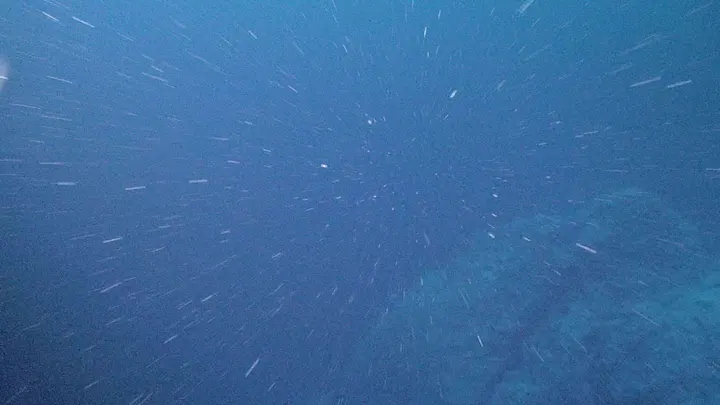
We all know about the white snowflakes falling from the sky during winter on Earth, but have you ever heard of the continuous snowfall happening in the pitch-dark depths of the ocean? Thousands of meters below the surface in Earth's oceans, a unique and never-ending snowfall takes place. In the language of science, it is called 'marine snow'. However, these are not ice crystals like the ones falling on land, but rather an accumulation of extremely tiny particles of marine organism waste, dead phytoplankton, mucus, sediment, and organic-inorganic debris, which constantly drifts from the illuminated surface of the sea toward the bottom.
This ordinary-looking sticky debris plays the role of an invisible warrior in saving Earth's environment. As these particles move from the sea surface toward the floor, they drag tons of carbon dioxide down into the depths with them. According to scientists' estimates, marine snow transports more than 10 gigatons (1 gigaton equals 1 billion tons) of carbon from Earth's ocean surface to the deep sea every year. But the surprising thing is that out of this 10 gigatons, only 2 gigatons of carbon actually reach the depths of the ocean where it remains securely stored for centuries or thousands of years.

- ૧. Origin at the surfaceMarine snow particles are formed by plankton and organisms in the photic zone.
- ૨. Downward transportDue to gravity and weight, these particles slide down into the depths of the ocean.
- ૩. Bacterial invasionAlong the way, bacteria attempt to break down these particles and remineralize them.
- ૪. Protection by stickinessParticles with higher viscosity (stickiness) survive bacterial attacks.
- ૫. Storage in the deepAs a result, a significant amount of carbon is safely stored at the ocean floor.
Why such a huge difference? Why does the remaining 8 gigatons of carbon get destroyed along the way, and what factors control this process? This question had remained a puzzle for oceanographers for decades. Now, scientists from the Scripps Institution of Oceanography at UC San Diego and the University of Lincoln have found a fascinating solution to this puzzle. According to their research published on October 8 in the prestigious journal Science, the 'viscosity' (stickiness or thickness of a substance) of marine snow determines whether the carbon will reach the ocean floor or disperse along the way.
Years-old dilemma of the scientific world and a new Science study
The 'biological carbon pump' plays an extremely vital role in Earth's climate regulation. Microorganisms living in the sunlit euphotic zone (illuminated marine region) absorb carbon dioxide from the atmosphere through photosynthesis. When these organisms die or their excreted waste accumulates, it begins to settle down in the form of particles into the dark aphotic zone. If this carbon reaches a depth of more than 1,000 meters (3,300 feet), it gets isolated from the atmosphere and remains trapped there for countless years.
However, marine bacteria floating in seawater use these marine snow particles as food. As the particles sink, bacteria break them down and 'remineralise' them. As a result, the carbon contained in the particles dissolves back into the upper waters of the ocean in gaseous form. Researchers had long wanted to know which physical properties could slow down this bacterial attack.
The new study has found that extremely sticky and viscous (high viscosity) marine snow particles have the capacity to transport more than six times more carbon to the ocean depths compared to particles with lower stickiness. For the first time in the history of science, scientists have directly observed the microscopic processes between live bacteria and the physical mucus structure of marine snow.
4 Years of Hard Work: Three-Dimensional Imaging of the 'Mucoscape'
The science began in 2021, when Scripps Institution of Oceanography postdoctoral scholar Bryce Inman and his colleague, microbiologist and professor emeritus Farooq Azam, undertook an ambitious project. Inman calls it the 'mucoscape' (a microscopic terrain of mucus). According to Inman, "It was never previously possible to see how any bacterium interacts with the physical structure of mucus."
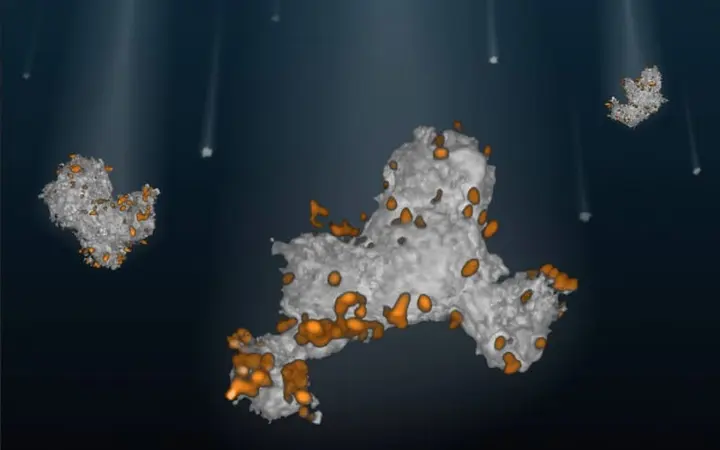
After four continuous years of failures, this team of scientists achieved success in 2025. They prepared a combination of 3D confocal microscopy and special fluorescent molecules. Confocal microscopy uses laser light to capture extremely fine details of different layers of a sample, while fluorescent molecules make the waste particles and bacteria glow in different colors.
Using this technique, researchers were able for the first time to perform 100% three-dimensional mapping of every nook, cranny, cave, and internal structure of marine snow particles. This collaborative research methodology has been published in detail in the journal 'Nature Communications'. Through this method, scientists could see how the particle's stickiness physically hinders the spread of bacteria.
- ૧. Surface formationPlanktons in the illuminated surface of the ocean photosynthesize and convert carbon into biological waste and mucus.
- ૨. Aggregation and motionDead organisms and debris stick together to form particles of marine snow and sink downwards due to gravity.
- ૩. Bacterial invasionMicroscopic bacteria attack the surface of the particle, but cannot easily penetrate the denser, viscous core.
- ૪. Long-term storage in the deep seaDue to slow decomposition, the particles reach depths of over ૧,૦૦૦ meters, where carbon is stored for centuries.
The 'Apple and Worm' Analogy: How Particle Stickiness Works
Like every snowflake falling from the sky, no two marine snow particles are alike. Each particle contains a different liquid mixture of biotic and abiotic substances, causing wide variations in their density and stickiness. Through laboratory experiments and computer simulations, researchers observed that bacteria very easily colonize the outer regions of particles that have low viscosity (low stickiness).
But when the bacteria attempt to move towards the highly viscous, extremely sticky region located in the center of the particle, they get stuck. Inman explains this process with a lovely example: "Think of it like a worm eating into an apple. It is easy for the worm to cut through the soft skin and pulp on the outside of the apple and go inside, but it is extremely difficult to burrow through and come out of the hard core in the middle of the apple."
It takes a very long time for bacteria to break down and decompose the extremely sticky marine snow particles. As a result, these particles rapidly slide down towards the ocean floor without being destroyed along the way. Computer modeling shows that the denser the particle, the deeper it will go into the ocean. This is why higher-viscosity particles successfully transport more than 6 times as much carbon to the deep ocean.
Its widespread impact on Earth's biological carbon pump
This biological carbon pump operating in the oceans serves as an environmental shield for humanity. If this pump stops or slows down, millions of tons of carbon dioxide from the ocean could mix back into the atmosphere, which could drastically increase global warming. According to data published in the journal Science, only 1% to 40% of the total carbon produced at the surface moves beyond the euphotic zone, and only 1% of the detritus settles as mud on the actual ocean floor.
ગિગાટોન કાર્બન / વર્ષ (Gt C/yr)
Fundamentally, the weight of various minerals contained in the particles also increases their sinking rate. This effect is called the 'ballasting effect'. When dust particles or heavy abiotic debris mix with marine snow, it sinks more rapidly, giving bacteria less time to consume it. But now this new study has proven that not only weight, but the internal stickiness of the particle is equally crucial in this equation.
Ocean temperatures are rising due to global warming, which is reducing the stratification of water layers. If ocean temperatures increase, the chemical composition and viscosity of the mucus released by plankton could change. If marine snow loses its stickiness, Earth's capacity to store carbon in the deep ocean could diminish.

Future implications ranging from human health to climate remediation
This discovery is not limited to marine science or the carbon cycle alone. In biology, mucus or viscous substances are found in countless places. The interaction between bacteria and mucus is extremely vital in coral reefs on Earth, kelp forests, plant roots, and the digestive tracts of humans and animals.
Inmanen noted, "Mucus or viscosity, which we used to consider a simple substance, has extremely complex internal structures, caves, and raised parts that are even smaller than the scale of bacteria. This is the first time in the history of science that we are observing this physical habitat in such detail."
Apart from this, to curb human-induced climate change, scientists are considering certain geoengineering schemes, such as iron fertilization in the ocean to enhance the growth of plankton so that more marine snow is formed. However, if these particles do not have the proper viscosity, those efforts could fail. These new studies in Science and Nature Communications have proved that even nature's most delicate and sticky particles drive the Earth's vast climate cycle. Funded by the Simons Foundation and the EPSRC, this research will pave a new path for both environmental and medical sciences in the future.