Green Hydrogen: India's and the World's Ambitious Scientific Journey Toward Zero Emissions
Created from a blend of water and renewable energy, this clean fuel holds the potential to make industries and transportation pollution-free in the future.

Worldwide, unprecedented emphasis is being placed on green energy to reduce dependence on traditional fossil fuels and bring carbon emissions down to net zero. In this direction, green hydrogen has emerged as one of the safest and cleanest alternatives of the future. India, too, is moving forward rapidly with the goal of becoming a global leader in this sector. Currently, major strategies for its technological development and industrial application are being formulated on international platforms.
From a scientific perspective, hydrogen is the lightest and most abundant element in the entire universe. However, on Earth, it is not found in a free state, but exists in compounds such as water and natural gas. To use it, it must be separated from water or gas. The key point is that hydrogen itself has no color, but depending on the method of separation and the source of energy, it has been given various color-coded names.
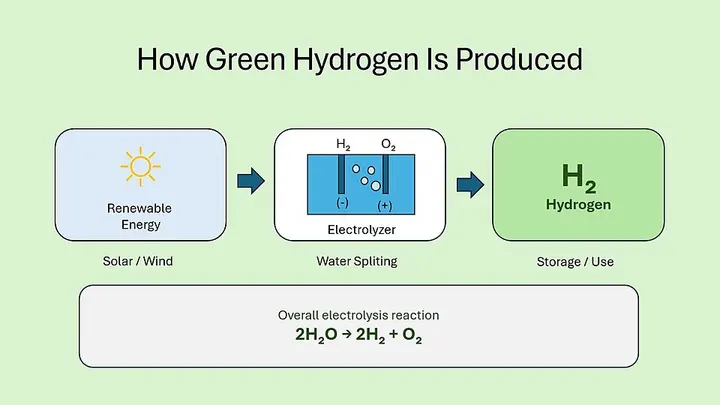
Green hydrogen is primarily produced through the electrolysis process, in which water molecules are split into hydrogen and oxygen using electricity obtained from renewable sources. According to Source 2, this process is up to 80% efficient. Approximately 9 liters of water are required to produce one kilogram of hydrogen. When clean electricity such as sunlight or wind energy is used in this process, it is called 'green' because carbon emissions remain zero.
- Renewable electricityClean electricity is generated from solar or wind energy.
- ElectrolysisWater molecules are split into hydrogen and oxygen using electricity.
- Hydrogen storagePure hydrogen gas is separated and stored for future use.
- Renewable energyCarbon-free electricity is generated by solar panels or wind turbines.
- ElectrolysisThis electricity is sent to an electrolyzer machine where it passes through water (H2O).
- Molecule splittingElectric current breaks water molecules apart into hydrogen and oxygen.
- Storage and useThe released hydrogen gas is collected and stored in tanks or used directly in industries.
History and Science of Electrolysis
Electrolysis is a technique that uses a direct electric current (DC) to drive a chemical reaction that does not occur naturally. According to Source 3, the word 'electrolysis' was introduced in 1834 by Michael Faraday. The name is derived from the Greek words 'electron', meaning amber, and 'lysis', meaning to untie or loosen. However, the discovery of this process had taken place even before Faraday.
In 1785, Dutch scientist Martin van Marum used an electrostatic generator to separate metals from their salts. Subsequently, in 1800, William Nicholson and Anthony Carlisle demonstrated the first successful process of splitting water into hydrogen and oxygen. In 1807 and 1808, Humphry Davy discovered elements such as potassium, sodium, barium, calcium, and magnesium using this same method. This history shows that the technology we are using today for green hydrogen had its foundations laid centuries ago.
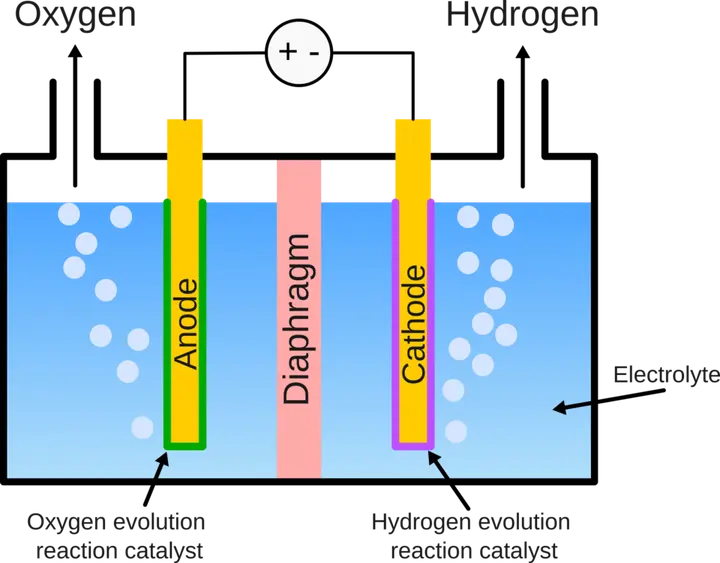
The electrolysis process consists of three main components: an electrolyte, electrodes, and an external power source. The electrolyte is a substance containing free ions that can conduct electricity. When electricity is passed through it, positively charged ions (cations) move toward the negative electrode, or cathode, and negatively charged ions (anions) are attracted to the positive electrode, or anode. Through this process, water molecules break down and release hydrogen in gaseous form.
| Type of technology | Temperature range | Key characteristic |
|---|---|---|
| Alkaline (AE) | 70-90 °C | Mature and low-cost method |
| Proton Exchange (PEM) | 50-80 °C | Fast response, best for solar energy |
| Solid Oxide (SOEC) | 500-1000 °C | Very high efficiency |

Types and Distinctions of Hydrogen
Depending on the method used for its production, hydrogen is given names such as grey, blue, black, and green. According to Source 1, grey hydrogen is produced by heating natural gas, specifically methane, with steam at very high temperatures. This process is called steam-methane reforming. Currently, the majority of the world's hydrogen is produced in this way, but it releases 9 to 11 kilograms of carbon dioxide into the air per kilogram of hydrogen produced.
On the other hand, hydrogen produced using coal is called black or brown hydrogen, which is the most harmful to the environment. When the carbon dioxide released during the production of hydrogen from natural gas is captured and stored underground (carbon capture), it is called blue hydrogen. This method reduces emissions but does not eliminate them entirely. Only green hydrogen is an option that creates no pollution during its production.
The distinctive feature of green hydrogen is that when it is burned as a fuel, the only byproduct emitted is water vapor. Source 2 states that the energy density of hydrogen is 39.6 kWh/kg, which is much higher compared to the 0.15–0.25 kWh/kg of lithium batteries. For this reason, it is considered a better alternative than batteries for heavy industries and long-distance transport.
Types of Electrolyzer Technology
The machine used to produce green hydrogen is called an electrolyzer. According to Source 2, there are currently four main types of electrolyzer technology in existence. The first is Alkaline Electrolyzers (AE), which is the oldest and least expensive technology. It operates at temperatures of 70 to 90 degrees Celsius and is suitable for large-scale production, but it cannot adapt quickly to intermittent sources such as wind or solar energy.
The second type is the Proton Exchange Membrane (PEM). This system operates at 50 to 80 degrees Celsius and can be switched on and off very quickly, making it ideal for solar and wind energy. However, because it uses precious metals like platinum and iridium, its cost is higher. The third type is Solid Oxide Electrolyzers (SOEC), which operate at high temperatures of 500 to 1000 degrees Celsius and are very efficient.
The fourth and emerging type is the Anion Exchange Membrane (AEM). This technology attempts to combine the affordability of alkaline with the flexibility of PEM. Apart from this, scientists are also researching methods such as biological hydrogen production and thermochemical water splitting. According to Source 2, a 2024 study found that by using biochar made from cow dung, the electrolysis process can be made 6 times more efficient.
| Technology | Operating temperature | Key feature |
|---|---|---|
| Alkaline (AE) | 70-90 °C | Oldest and large-scale cheap technology |
| PEM | 50-80 °C | Can be switched on/off quickly, excellent for wind-solar energy |
| SOEC | 500-1000 °C | Highly efficient system operating at high temperatures |
| AEM | Under development | Combination of Alkaline and PEM qualities |
Hydrogen Revolution and Projects in India
The Government of India has taken a major leap in the field of green hydrogen. According to Source 1, on 17 July 2026, Prime Minister Narendra Modi inaugurated India's first indigenous hydrogen-powered train, the 'Namo Green Rail'. In addition, 37 hydrogen-powered buses and trucks are being operated on 10 different geographic routes under a pilot project in the country. Of these vehicles, 15 are based on fuel cell technology and 22 on hydrogen combustion engines.
The use of green hydrogen has also begun in heavy industries. Companies like Tata Steel and JSW are working on hydrogen-based Direct Reduced Iron (H-DRI) plants. Jindal Renewables' green steel project is operational in Angul, Odisha. By February 2026, 19 production projects had become active in the country, with a total annual capacity of over 4,300 tonnes. The Indian Oil Corporation (IOC) is setting up the country's largest plant with a capacity of 10,000 tonnes at the Panipat refinery, which will be completed by December 2027.
The impact of green hydrogen is also visible in the agricultural sector. In March 2026, the Solar Energy Corporation of India (SECI) signed contracts to supply 7.24 lakh tonnes of green ammonia to 13 fertilizer plants. Furthermore, green methanol refueling facilities for ships are being developed by the V.O. Chidambaranar Port Authority. All these efforts show that India wants to become self-reliant not just in using hydrogen, but also in its production.
Economic Challenges and Global Market
The biggest barrier in the path of green hydrogen is its production cost. According to Source 2, in 2024 the production of green hydrogen is 1.5 to 6 times more expensive than hydrogen made from fossil fuels. Experts believe that when its price reaches $2 per kilogram, it will become competitive in the market. In 2022, the global hydrogen market was worth $155 billion, in which the share of green hydrogen was only 2.7%, that is $4.2 billion.
$ અબજ
However, considering the way solar and wind energy prices have decreased between 2009 and 2024, there is hope that green hydrogen will also become cheaper in the future. Between 2010 and 2022, a 60% decrease was recorded in the price of electrolyzers. According to the estimate of the International Energy Agency (IEA), 37 million tonnes of green hydrogen could be produced in the world by 2030. Countries like Australia and Brazil are also making major investments in this sector, although many large projects are still delayed due to economic reasons.
Green hydrogen is not just a fuel, but it is a robust option for energy storage. When wind or solar energy is in high proportion, it can be converted into hydrogen and stored for a long time. This technology is still in the developmental stage and there are many challenges, but it is indispensable for saving the environment. For a growing economy like India, green hydrogen is the key to achieving both energy security and a clean environment.