Technology Extracting Carbon Dioxide Directly from the Atmosphere: How Does Direct Air Capture (DAC) Work?
An in-depth analysis of the scientific processes, costs, and challenges of modern technology designed to remove existing CO2 from Earth's atmosphere, beyond merely reducing carbon emissions.

In the global battle against global warming and climate change, the focus has thus far been primarily on preventing new carbon emissions. However, removing the carbon dioxide (CO2) that has already accumulated in the atmosphere has become equally essential. For this task, Direct Air Capture (DAC) technology has emerged as a critical tool. Direct Air Capture is a chemical or physical process through which carbon dioxide is extracted and separated directly from ambient air. If the CO2 extracted in this manner is safely stored underground for the long term, the entire process is referred to as Direct Air Carbon Capture and Sequestration (DACCS). Such systems are known as Negative Emissions Technologies (NETs) because they reduce carbon in the atmosphere rather than adding to it.
This technology is entirely distinct from conventional Carbon Capture and Storage (CCS). Traditional CCS methods capture CO2 from flue gases emitted by specific sources, such as cement factories or bioenergy plant chimneys, where carbon concentration is very high. In contrast, DAC absorbs CO2 from ambient air, where the carbon concentration is extremely low, at only 400 parts per million (400 ppm). Consequently, high-level chemical processes and energy are required to isolate pure CO2 from atmospheric air. First proposed in 1999, this method is currently undergoing rapid research and the construction of commercial plants worldwide.
- 1. Contacting StageAtmospheric air is drawn into the capture device with the help of large fans.
- 2. Capture StageCO2 in the air binds by intense chemical reaction with a liquid solvent or solid sorbent.
- 3. Separation StagePure CO2 gas is separated from the absorbent medium by applying external heat or energy.
- 4. Storage & RecyclingThe separated CO2 is compressed and stored underground, and the absorbent medium is released for reuse.
Methodology: The three-stage process of separating CO2 from atmospheric air
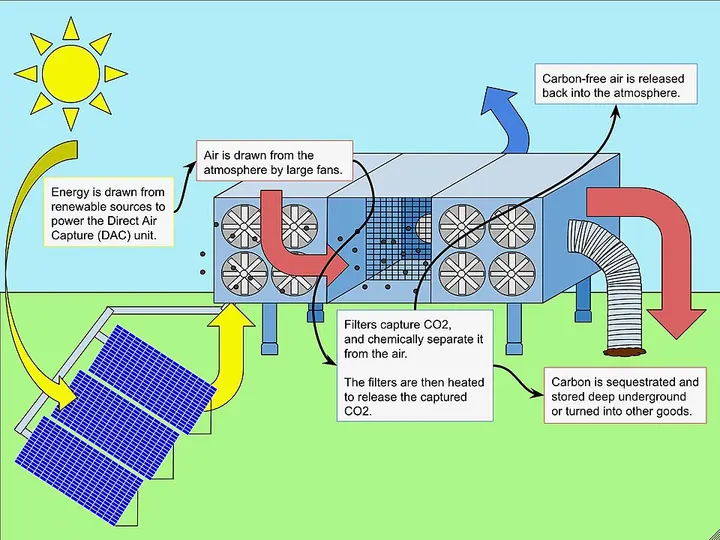
The Direct Air Capture method functions primarily through three integrated stages: the contacting stage, the capture stage, and the separation stage. In the first stage, large fans installed in the DAC system pull ambient air toward specialized equipment. This air passes through a capture reactor or a molecular filter.
In the second stage, the CO2 gas present in the air is captured through a rapid chemical reaction with a liquid solvent (a liquid that dissolves gas) or a solid sorbent (a solid material that binds molecules to its surface). The binding energy of these chemical media is designed in such a way that it captures CO2 molecules even from extremely thin air. Once this process is complete, only the residual components of pure air are released.
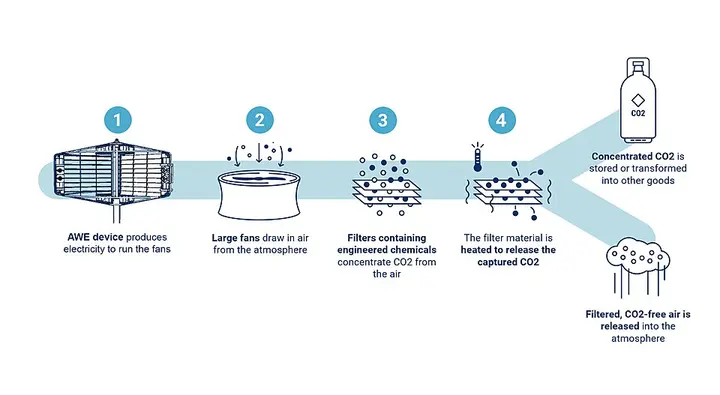
In the third stage, external energy (primarily heat) is applied to release the captured CO2 from the solvent or sorbent. This energy breaks the chemical bonds, releasing a stream of pure CO2 gas. Moisture is removed from this released gas, and it is then compressed. At the same time, the chemical medium is regenerated so that it can be reused in the capture process. The released pure CO2 is then sent for permanent underground storage or put to industrial use.
| Feature | Solid DAC (S-DAC) | Liquid DAC (L-DAC) |
|---|---|---|
| Sorbent Media | Amine-based solid molecular filter | Liquid solvent like sodium hydroxide |
| Process Temperature | Low temperature | High temperature or low temperature |
| Separation Method | Heat & Vacuum | Causticizing and high-temperature heating |
| Energy Requirement | Mainly low-temperature heat | High-temperature heat and electricity |
Key Types of Technology: Liquid (L-DAC) and Solid (S-DAC)
Currently, two main DAC technologies are considered mature for industrial-scale implementation: Solid Sorbent DAC (S-DAC) and Liquid Solvent DAC (L-DAC). Solid DAC typically utilizes low-heat processes. In this method, CO2 adheres to porous solid filters containing amines through chemisorption. Low heat and vacuum are used to release this CO2.
On the other hand, Liquid DAC (L-DAC) typically uses a caustic liquid solvent such as sodium hydroxide. This liquid reacts with CO2 to form sodium carbonate. Pure CO2 gas is obtained by heating the sodium carbonate to high temperatures, and the sodium hydroxide is recovered and reused through a causticizing process. The L-DAC method requires both high-temperature heat and electricity to operate.
ટન CO2 ઉત્સર્જન / ટન CO2 કેપ્ચર
In addition to these two main methods, other innovative technologies are also developing rapidly. Ireland-based company Carbon Collect Limited has developed a passive capture technology called 'MechanicalTree,' which absorbs CO2 from the air without any fans by simply standing in the direction of the wind, significantly reducing energy costs. Moisture-swing adsorption, developed by Professor Klaus Lackner in 2012, uses an anionic exchange polymer resin called Marathon MSA, which absorbs CO2 in a dry environment and releases it in a humid environment.
In addition, Metal-Organic Frameworks (MOFs) are also revolutionizing this field. MOFs are highly porous three-dimensional crystalline structures formed by metal ions and organic molecules. In 2023, the 'OpenDAC' database was released by Meta AI's FAIR teams and the Georgia Institute of Technology. These researchers have accelerated the discovery of suitable MOF materials through 400 million CPU hours of quantum chemistry computational calculations. Furthermore, membrane-based DAC (m-DAC), electro-swing adsorption (ESA), and the use of rock flour ground by glacier ice are also under research, where 1 ton of Greenlandic rock flour can absorb 250 kilograms (550 pounds) of carbon.
Statistics, costs, and energy consumption
The biggest challenge facing direct air capture technology is its exorbitant cost and energy consumption. According to company reports and statistics, the cost of removing 1 ton of CO2 from the atmosphere has remained over $1,000 through 2025. Since this cost is many times higher than current carbon prices, it has not been widely integrated into general emissions trading. However, some experts believe that when plants with an annual capacity of 1 million tons (1 Mtpa) are established, this cost could drop to below $200 per ton, although there is disagreement among experts regarding this estimate.
In terms of environmental impact, the source of electricity used to operate DAC plants is extremely important. If renewable wind energy is used to operate a DAC plant, only 0.01 tons of CO2 are emitted for every 1 ton of CO2 captured. But if grid electricity and natural gas heat are used, 0.65 tons of new CO2 are emitted for every 1 ton of CO2 captured. Therefore, high carbon removal can only be achieved if the grid electricity emission factor is no more than 0.3077 kgCO2/kWh and 50 to 80% of the plant's electricity is obtained from wind energy.
મિલિયન ટન CO2 / વર્ષ
According to the International Energy Agency (IEA) Net Zero Roadmap, to achieve the goals of the Paris Agreement (keeping global temperature rise below 2 degrees Celsius), it will be necessary to capture 85 million tons of CO2 annually by 2030 and 980 million tons (approximately 0.1 gigatons) annually by 2050.
However, DAC is also facing harsh criticism. According to a 2020 scientific analysis, if an attempt is made to capture 30 gigatons of CO2 annually, it would require 16.3 to 27.8 gigatons of ammonia (NH3) and 8.4 to 13.1 terawatt-years of energy (46 to 71% of the global energy supply), which is near impossible. According to another 2021 study, to maintain a carbon removal rate of 73 to 86%, as much electricity and land as required for the global transition from petrol cars to electric vehicles (EVs) would be spent on DAC plants. However, these criticisms were based on a hypothetical level of 30 gigatons, whereas the IEA's actual target is 0.1 gigatons (980 million tons).

Environmental Impacts and Future Direction
Direct Air Capture technology uses common materials such as steel, cement, zeolites, and metallic hydroxides. This is a plus point compared to the rare critical materials used in electric vehicles. Nevertheless, the need for high-temperature heat and land sets a major limit on the widespread use of this technology.
Scientists and environmentalists clearly believe that DAC is not an alternative to reducing carbon emissions but a complementary tool. If industries continue to emit under the assumption that the atmosphere will be cleaned later via DAC, it will prove to be extremely dangerous. In sectors like aviation and space flights, where it is difficult to achieve net-zero emissions, offsetting carbon through DAC before or after the use of jet fuel could be a viable strategy. Future innovations and improvements in energy efficiency will determine how helpful this revolutionary technology will be in saving the Earth from the climate change crisis.