A Festival of Colors in the Sky and Darkness on the Ground: How Solar Storms Can Cripple Power Grids
An in-depth explanation of the complex science behind auroras and the severe consequences of disturbances in Earth's magnetic field.
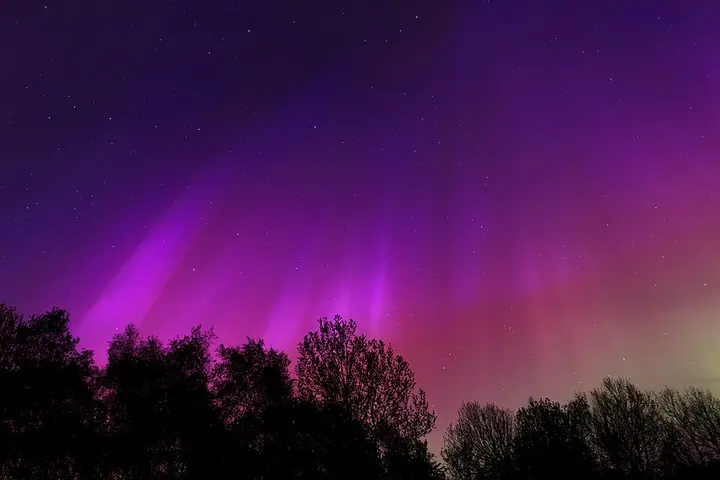
When we see the green and red curtain-like lights waving in the sky of the North Pole, it is not just a beautiful scene of nature, but a sign of a terrifying battle taking place in space. We call this phenomenon 'aurora' or polar lights. While these lights may look distant and vague when viewed from the ground, they are directly connected to the electric currents flowing deep within the Earth. Recent research shows that behind this beauty lies the potential to damage power grids and technology.
To understand this entire process, we must understand the relationship between the Sun and the Earth. The Sun continuously releases a stream of charged particles, which is called 'solar wind'. Sometimes, massive explosions occur on the Sun's surface, known as 'coronal mass ejection' (CME). Through these explosions, billions of tons of charged particles and magnetic fields are thrown into space. When this cloud of particles heads toward Earth, it collides with Earth's protective shield.
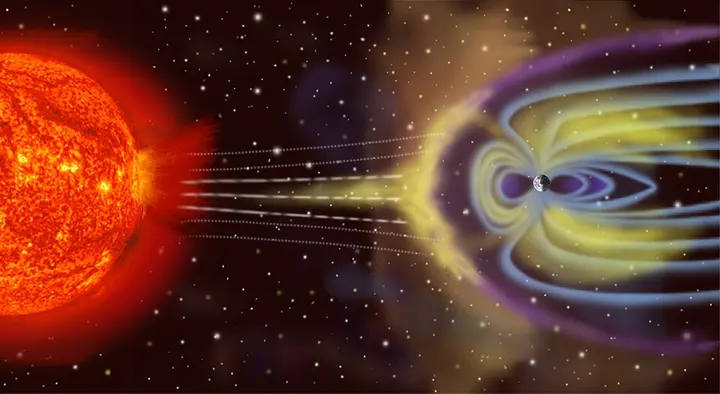
Around the Earth is an invisible magnetic shield called the 'magnetosphere'. This shield is generated by the movement of molten iron in the Earth's interior. Generally, this shield protects us from the Sun's harmful radiation. But when the pressure of the particles coming from the Sun increases, this magnetosphere is compressed. On the side facing the Sun, this shield contracts, and on the rear side, it stretches like a long tail, which is called the 'magnetotail'.
According to scientists, if the direction of the magnetic field coming from the Sun aligns with Earth's magnetic field, the two fields merge. Due to this process, a vast amount of magnetic energy accumulates in the magnetotail behind the Earth. When this energy exceeds a certain limit, it is suddenly released in an explosive manner. This phenomenon is called a 'substorm' or magnetic substorm. This energy is released approximately 45,000 to 65,000 kilometers away from the Earth.
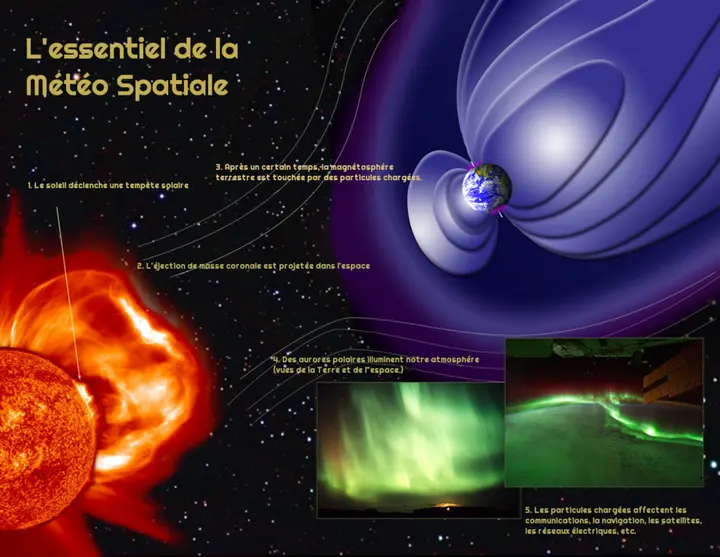
- Solar explosionCharged particles are released from the Sun's surface via Coronal Mass Ejection (CME).
- Magnetic connectionSolar wind hits Earth's magnetosphere and magnetic lines stretch to form a magnetotail.
- Energy releaseTremendous energy is released as magnetic lines reconnect in the magnetotail.
- Atmospheric collisionFast particles collide with gases in Earth's atmosphere to produce auroras and electric currents.
- Ground inductionMagnetic changes induce unwanted electric currents (GIC) in the ground and power lines, damaging the grid.
During this explosion, energetic particles rush toward the Earth at high speed along the Earth's magnetic field lines. When these particles collide with oxygen and nitrogen atoms in the Earth's atmosphere, light is produced. This is the light we see from the ground as an aurora. Typically, this collision occurs at an altitude of 90 to 150 kilometers above the ground. But this is not just a display of light; these particles also generate powerful electric currents in the Earth's upper atmosphere.
According to a report by Business Line, researchers at the University of Michigan have made a significant discovery using data from NASA's THEMIS and NOAA's GOES satellites. They observed that when magnetic field lines reconnect in the magnetotail, a major change in the Earth's surface magnetic field occurs within just 7 minutes. This means that the impact of an event occurring thousands of kilometers away in space can affect technology on Earth within minutes.
nT (નેનો-ટેસ્લા)
When these magnetic changes occur in the sky, they induce electric currents within the ground and power lines. These are known as 'geomagnetically induced currents' (GIC). These currents can be powerful enough to burn out power grid transformers or trip circuit breakers. This can lead to blackouts across entire cities or countries. This occurred in Quebec, Canada, in 1989, where the entire power grid failed in just 9 seconds, leaving 6 million people in the dark for 9 hours.
Scientists use the 'Dst index' (Disturbance-Storm Time index) to measure the intensity of geomagnetic storms. This index measures changes in the magnetic field at the Earth's equator in nano-Teslas (nT). Under normal conditions, this value ranges between +20 and -20 nT. If the value drops below -50 nT, it is considered a magnetic storm. The largest storm in history occurred in 1859 and is known as the 'Carrington Event'. It is estimated that the Dst index reached approximately -1760 nT at that time.
| Scale | Intensity | Effect on power grid |
|---|---|---|
| G1 | Minor | Minor fluctuations may occur in the power grid. |
| G2 | Moderate | Voltage alarms may occur at high latitudes, transformers may be damaged. |
| G3 | Strong | Problems with voltage control and false tripping of protection devices may occur. |
| G4 | Severe | Widespread voltage control problems and grid instability may occur. |
| G5 | Extreme | The grid can collapse completely and transformers can burn out. |
During the Carrington Event, the world did not have power grids like it does today, but there was a telegraph network. The storm generated so much electric current in the telegraph wires that operators received electric shocks and the machines caught fire. If such a storm were to occur today, it could cause severe damage to modern satellites, GPS systems, and internet cables. During the 2003 'Halloween storm', 50,000 people in Sweden lost power, and a Japanese satellite was permanently disabled.
The impact of these storms on Earth is not uniform everywhere. Researchers have noted that even between two stations located only a few kilometers apart, the magnetic changes can differ. This is due to the composition of the ground. If the soil has high moisture content or the rock structure is more conductive, there is a higher probability of damage. Therefore, power grid operators must implement security measures that take local geology into account.
Predicting solar storms is as difficult as weather forecasting. By observing explosions on the Sun, scientists can provide warnings a few hours or days in advance. NOAA uses the 'G-scale', which indicates levels ranging from G1 (minor) to G5 (extreme). A G5-level storm can completely disrupt radio communications on Earth and cause widespread damage to power grids.

This is also a matter of concern for countries like India. Although India is less likely to witness auroras due to its proximity to the equator, changes in the magnetic field during powerful storms can also affect the Indian power grid. There is a particularly high risk of GIC generation in long transmission lines. The storm that occurred in May 2024 was the most powerful in the last two decades, proving that solar activity is now becoming more intense.
In the coming years, the Sun will reach the peak of its 11-year cycle (Solar Maxima), which means the frequency of solar storms will increase. Scientists are now trying to understand the precise impact of these storms using better models and satellite data. Those beautiful auroras visible in the sky remind us that we are part of a vast and dynamic universe, where even a small movement of the Sun can halt our modern lifestyle in an instant.