Amazon Rainforest Shifts from Carbon Sink to Carbon Emitter: Alarm Bell for Earth's Lungs
According to a recent scientific study, the world's largest forest is now releasing more carbon than it absorbs from the atmosphere, signaling a serious threat regarding global warming.

Known as the world's largest tropical rainforest, the Amazon—which we have known for decades as the 'lungs of the Earth'—is now undergoing a terrifying transformation. Until now, the Amazon forest functioned by absorbing anthropogenic carbon dioxide (CO2) present in the atmosphere, known in scientific terms as a carbon sink. A carbon sink is a natural system that absorbs greenhouse gases from the atmosphere. But recent research shows that this vast forest is now releasing more carbon into the atmosphere instead of absorbing it. This means the Amazon has now transformed from a carbon sink into a carbon emitter or carbon source.

This shocking revelation has come to light in a long-term study conducted by scientists, as reported by 'The Hindu'. Researchers used research aircraft between the years 2010 and 2024 to measure carbon dioxide levels at various atmospheric layers across four key locations in the Amazon. The study found that the Amazon region is no longer absorbing enough carbon to offset regional anthropogenic emissions. Anthropogenic emissions refer to activities carried out by humans that generate polluting gases. Deforestation and forest fires are primarily responsible for this shift.
Difference between Carbon Sink and Carbon Pool
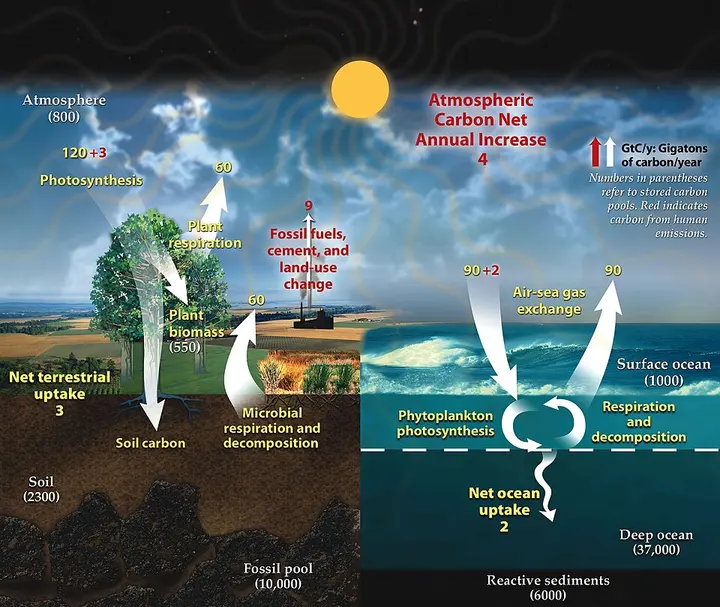
To understand this process, it is necessary to understand the difference between a carbon sink and a carbon pool. According to Wikipedia data, a carbon pool is any reservoir on Earth where carbon can be stored, such as the atmosphere, oceans, land, vegetation, and fossil fuel reserves. When such a pool absorbs more carbon from the atmosphere than it releases, it is called a carbon sink. Land and oceans are the two most important natural carbon sinks on Earth. Trees in forests take in carbon dioxide from the atmosphere through the process of photosynthesis and store it as carbon in wood and leaves.
However, when forests are cut down or burned, this stored carbon is released back into the atmosphere. This exact process is currently happening on a large scale in the Amazon. Soil is also a major medium for carbon storage. In fact, the carbon contained in soil is greater than the combined carbon of all vegetation and the atmosphere on Earth. But due to high temperatures and heavy rainfall in tropical regions, the carbon in the soil undergoes rapid oxidation, meaning the soil there cannot retain carbon for long periods.
The Geographical Extent and Importance of the Amazon
The Amazon rainforest spans the Amazon basin of South America, covering a total area of 7 million square km. Of this, 6 million square km is covered by forests. This vast region spreads across nine countries, with Brazil holding the largest share. According to Wikipedia statistics, 58.4% of the Amazon is in Brazil, 12.8% in Peru, 7.7% in Bolivia, and the remaining share is located in Colombia, Venezuela, Guyana, Suriname, French Guiana, and Ecuador. This forest contains approximately 390 billion trees divided into more than 16,000 species.
- Carbon absorptionTrees absorb CO2 from the atmosphere through photosynthesis and store it in wood and soil.
- Deforestation and firesForests are cleared or burned for agriculture and cattle ranching, releasing stored carbon.
- Disruption of balanceWhen carbon released from fires and destroyed trees exceeds the carbon absorbed by living trees.
- Becoming a carbon sourceEventually the forest starts increasing carbon in the atmosphere instead of reducing it.
The Amazon has been in existence for at least 55 million years. This forest is not merely a collection of trees, but a complex ecosystem that helps regulate the Earth's temperature. The Amazon receives an average annual rainfall of 9 feet. Interestingly, the nutrients required to keep this forest fertile come from the Sahara Desert, located thousands of kilometers away. According to data from NASA's CALIPSO satellite, approximately 182 million tons of dust are blown across the Atlantic Ocean from the Sahara Desert every year, of which 22 million tons of dust fall into the Amazon basin. This dust contains phosphorus, which is extremely essential for the growth of the forest's vegetation.
Causes of Destruction: Fire and Deforestation
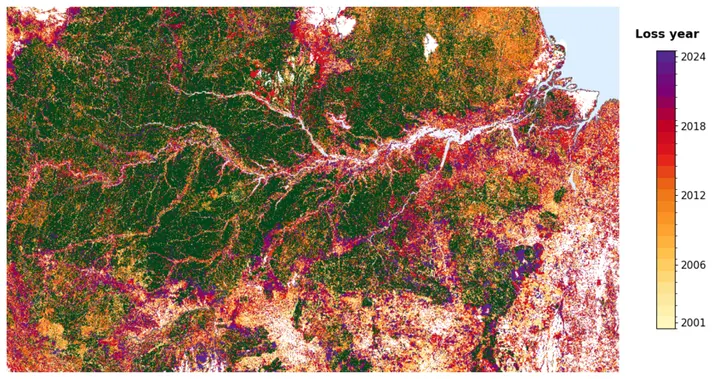
Human intervention is the biggest reason why the Amazon is turning into a carbon emitter. According to a report by 'The Hindu', 38% of the total deforestation in the Amazon in the year 2024 was due to fires in the forest. When large parts of the forest are cleared for agriculture or animal husbandry, it not only loses its capacity to absorb carbon, but also releases the stored carbon into the atmosphere as smoke. Due to this process, the temperature around the forest increases and rainfall decreases, making the forest drier and increasing the incidence of fires.
| Detail | Measurement/Number |
|---|---|
| Total basin area | 70 lakh square km |
| Forest-covered area | 60 lakh square km |
| Estimated number of trees | 390 billion |
| Tree species | 16,000 |
| Annual rainfall | 9 feet |
Scientists warn that if deforestation continues at this pace, the Amazon will reach a 'tipping point'. A tipping point means a turning point from which return is impossible. If a large part of the Amazon is destroyed, the rainforest will transform into a savanna, meaning grasslands. This will have an adverse effect on the weather cycle not only of South America but of the entire world. The economic loss caused by deforestation in Brazil can be seven times higher than the profit generated by its agricultural production. Scientists refer to this situation as 'agro-suicide', because the destruction of forests will reduce rainfall and eventually make agriculture impossible.
Human History and the Amazon
A common belief about the Amazon was that it has always been an untouched natural forest. But archaeological evidence suggests that humans have inhabited this area for at least 11,200 years. According to Wikipedia, around 5 million people lived in the Amazon around 1500 CE. These people created an extremely fertile dark soil named 'Terra preta', which was the result of human-managed land stewardship. This means that a large part of the Amazon remained under human management for centuries and yet stayed thriving.
Today the situation is different. Modern industrialization and large-scale land grabbing activities have put the Amazon at risk. During the rubber trade in the early 20th century, thousands of indigenous people died, and even today forests are being cleared for mining and agriculture. This transformation of the Amazon is proof that even nature's resilience has a limit. If we want to save this most important carbon sink of the Earth, stopping deforestation and restoring the forests is the responsibility not just of South American countries, but of the entire world.
In conclusion, the Amazon becoming a carbon emitter is a major blow in the fight against global warming. Until now we believed that forests would absorb our pollution, but now the forests themselves are becoming a source of pollution. This event reminds us that if we do not take timely action, natural cycles will change in a way that correcting them will no longer be in human hands.