The Solar Energy Revolution in Gujarat: A New Global Horizon for Large-Scale Infrastructure and Technology
An in-depth analysis of how cutting-edge methods for generating electricity from sunlight and the shifting strategies of global companies are shaping India's energy future.

Solar energy is radiant energy derived from the light and heat of the sun, which can be converted into electricity with the help of sophisticated technology. The upper atmosphere of the Earth continuously receives 174 petawatts of solar radiation. Of this, approximately 30% of the energy is reflected back into space, while the remaining 122 petawatts of energy are absorbed by clouds, oceans, and land. This energy is so vast that, according to 2019 figures, the amount of energy reaching the Earth from the sun in just one hour and 25 minutes is greater than the total annual consumption of the entire world. According to a 2011 report by the International Energy Agency, the generation of affordable and inexhaustible solar energy enhances the energy security of countries and helps in reducing pollution.
Solar technology can be primarily divided into two parts: active solar and passive solar. Active solar technologies include photovoltaic systems, concentrated solar power, and solar water heating. These methods capture sunlight and convert it directly into electricity or heat. On the other hand, passive solar technologies involve designing buildings in such a way that they naturally accelerate air circulation or use materials that can store heat. These methods help in reducing energy demand, while active methods increase energy supply. Most of the population on Earth lives in areas where 3.5 to 7.0 kWh/m2 of insolation, or the amount of sunlight, is available daily.
The history of solar energy is quite old and interesting. In 1878, Augustin Mouchot successfully demonstrated a solar steam engine in Paris, but its development stalled at that time due to the availability of cheap coal. Subsequently, in 1897, an American engineer named Frank Shuman built a small demonstration engine that used a chemical called ether, because the boiling point of ether is lower than that of water. Between 1912 and 1913, Shuman built the world's first solar thermal power station in Maadi, Egypt. This plant pumped 22,000 liters of water per minute from the Nile River to irrigate cotton fields. However, due to the First World War and the discovery of cheap oil in the 1930s, the development of this technology slowed down once again.
In modern times, solar thermal technology is used for water heating, space heating or cooling, and industrial processes. Solar water heating systems can meet 60 to 70% of domestic hot water requirements in areas between 40 degrees north and 40 degrees south latitude. By 2015, a total of 436 thermal gigawatts (GWth) of solar water heater capacity had been installed globally, with China leading the world with 309 GWth. In countries like Israel and Cyprus, more than 90% of households use these systems. Among this technology, evacuated tube collectors hold the largest share at 44%.
| Detail | Quantity / Value |
|---|---|
| Total solar radiation reaching Earth | 174 petawatts |
| Energy absorbed by Earth | 122 petawatts |
| Average insolation (daily) | 3.5 to 7.0 kWh/m2 |
| Land required for total world energy | 450,000 square km |
Solar energy is also being widely used for cooking. Solar cookers are mainly divided into three categories: box cookers, panel cookers, and reflector cookers. The simplest box cooker was first created by Horace de Saussure in 1767. These cookers can reach temperatures between 90 and 150 degrees Celsius. Meanwhile, reflector cookers, which use mirrors to concentrate sunlight at a single point, can reach temperatures exceeding 315 degrees Celsius. Additionally, technologies such as parabolic dishes and troughs are used in industries to obtain steam and hot water. The Solar Total Energy Project (STEP) located in Georgia, USA, is an excellent example of this, which provided 50% of the electricity and heat for a textile factory.
The global energy transition is clearly visible in the strategies of major companies like Engie SA. Engie is a French multinational company headquartered in La Défense. Formed by the merger of Gaz de France and Suez in 2008, the company has made a major shift in its strategy since 2014. The company decided to exit coal-based projects and invest heavily in renewable energy. In 2015, Engie acquired a 95% stake in a company named Solairedirect, which increased its photovoltaic production capacity from 125 megawatts to 486 megawatts.
- Collection of sunlightSun rays are concentrated on a collector box using mirrors.
- Conversion of liquid into heatWater or ether in the black pipes inside the collector box gets heated.
- Generation of steamThe heated liquid converts into steam, which creates high pressure.
- Operation of the engineThis steam is used to run a steam engine, which turns a pump or generator.
Engie's new strategy is based on three pillars: decarbonized energy, decentralized energy, and digitized energy. Between 2016 and 2018, the company sold its coal and oil assets and invested 15 billion euros in renewable energy and energy efficiency services. According to 2022 figures, Engie has 96,454 employees worldwide and an annual revenue of 93.86 billion euros. The company has created entities such as 'Engie Digital' and 'Engie Fab' that focus on new technologies like smart grids, the Internet of Things (IoT), and hydrogen.
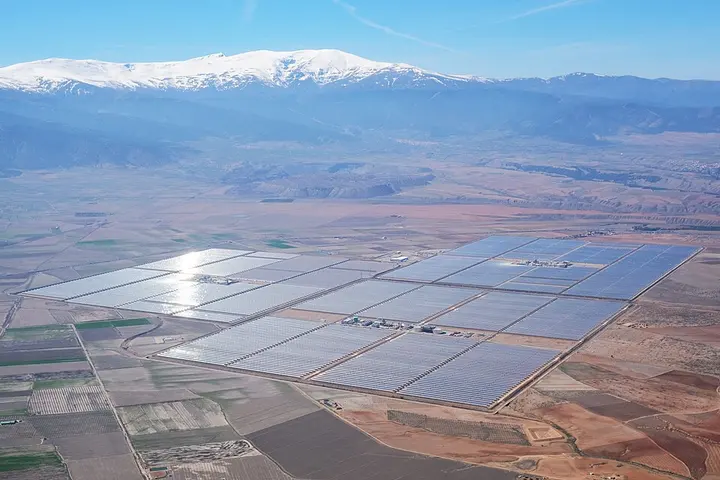
The availability of land is a crucial aspect for large solar energy projects in India, and particularly in Gujarat. According to a 2021 estimate by the Carbon Tracker Initiative, if all of the world's energy needs were to be met solely by solar energy, it would require 450,000 square kilometers of land, which is equivalent to the total area of Morocco or California. This is only 0.3% of the Earth's total land area. In states like Gujarat, where sunlight is abundantly available, such large-scale infrastructure projects can bring self-reliance to the energy sector. According to a United Nations report, the global potential of solar energy is 1,600 to 49,800 exajoules annually, which is many times greater than the needs of humanity.
અબજ યુરો
In passive solar technology, thermal mass is used to maintain temperatures inside buildings. Materials like stone, cement, and water absorb heat during the day and release it at night, keeping the building naturally cool or warm. A solar chimney is also one such passive system, which pulls hot air upward to provide natural ventilation in the building. Additionally, deciduous trees can also act as natural temperature regulators. In summer, their leaves provide shade, while in winter, the shedding of leaves allows sunlight to fall directly on the building. All these methods are proving to be very effective for energy conservation in modern architecture.
In the future, solar energy will not be limited to electricity alone, but will also play an important role in hydrogen production and green mobility. Companies like Engie are now moving forward in the battery storage sector, such as their 2023 acquisition of the Houston-based Broad Reach Power company. As technology becomes cheaper and efficiency increases, solar energy will emerge as a strong alternative to fossil fuels. The proper utilization of this inexhaustible energy source available on Earth is the key to the energy security of tomorrow.