Life-Saving Pharmaceuticals and New Scientific Supplies in Space: NASA's CRS-25 Mission
Northrop Grumman's 25th Cygnus cargo spacecraft will depart from Florida aboard a SpaceX Falcon 9 rocket, bound for the International Space Station.
A New Supply of Science in Space
To ensure that research continues uninterrupted on the International Space Station (ISS), which orbits hundreds of kilometers above the Earth's surface, it is essential to deliver food, scientific equipment, and fuel from Earth at regular intervals. Under a commercial agreement between NASA and the private aerospace company Northrop Grumman, a new resupply mission has been prepared. The official name of this mission is NASA's Northrop Grumman Commercial Resupply Services 25, or CRS-25 for short. As part of this mission, the 25th cargo spacecraft developed by Northrop Grumman will embark on its journey into space.
Preparations for this launch are in full swing at Space Launch Complex 40 at the Cape Canaveral Space Force Station in Florida. According to NASA's official announcement, the launch is scheduled for no earlier than 10:49 a.m. Eastern Standard Time (EST) on Sunday, November 29. A particularly interesting aspect is that Elon Musk's company SpaceX's well-known Falcon 9 rocket is being used to carry Northrop Grumman's own Cygnus XL spacecraft into space, which is an example of the growing collaboration in the commercial space industry.
- Launch from Cape CanaveralAboard a SpaceX Falcon 9 rocket, the Cygnus XL spacecraft will depart for space from Florida's Space Launch Complex 40 at the scheduled time.
- Arrival in orbit and pursuitAfter separating from the rocket, the vehicle will gradually move towards the orbit of the International Space Station using its own engines and approach it.
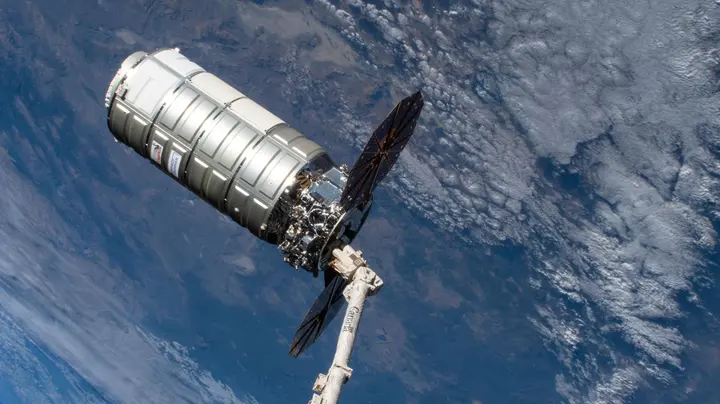
- Capture by Canadarm2Astronauts present at the space station will safely capture the approaching unmanned vehicle with the help of the station's large robotic arm, Canadarm2.
- Docking with the Unity moduleWith the help of the robotic arm, the vehicle will be docked to the Earth-facing port of the Unity module, and cargo and research equipment will be unloaded.
- Waste disposal and separationAfter remaining attached to the station for about six months, the vehicle will detach in May 2027 filled with waste and will burn up and be destroyed in Earth's atmosphere.
Robotic Arm Capture and Orbital Operations
Once the Falcon 9 rocket pierces the Earth's atmosphere and places the Cygnus XL spacecraft into its designated orbit, this unmanned vehicle will gradually approach the space station. Instead of docking it directly, the astronauts living on the International Space Station will capture it using a specialized robotic arm. For this process, the station's massive Canadian robotic arm, Canadarm2, will be used. From the control room, astronauts will use this robotic arm to grab and pull the Cygnus spacecraft, connecting it to the Earth-facing port of the station's Unity module.

After this connection, researchers on the station will open the spacecraft's hatch to unload the cargo and scientific experiments inside. According to NASA, the Cygnus XL spacecraft will remain attached to the space station for approximately six months and will serve in orbit until around May 2027. Previously, on October 9, 2026, the previous Cygnus cargo vehicle was released from the Unity module by Canadarm2 after a successful six-month stay, at which time the station was orbiting 263 miles above the Indian Ocean near Madagascar. This new spacecraft, too, will be destroyed upon re-entry into the atmosphere, carrying the station's waste after completing its six-month mission.
| Subject | Detail |
|---|---|
| Official mission name | NASA's Northrop Grumman CRS-25 (NG-25) |
| Cargo spacecraft | Cygnus XL |
| Launch vehicle | SpaceX Falcon 9 |
| Launch site | Space Launch Complex 40, Cape Canaveral, Florida |
| Launch date and time | No earlier than November 29, 10:49 AM EST |
| Docking location (ISS) | Earth-facing port of the Unity module |
| Duration of stay | Until May 2027 |
| Contract sequence | Northrop Grumman's 25th supply vehicle with NASA |
Research from Cancer to Muscle Atrophy
The CRS-25 mission is not limited to delivering daily necessities; it includes highly advanced biological experiments to fight serious diseases. Under the negligible effect of gravity in space, known as microgravity (the absence or near-absence of Earth's gravitational force), chemical and biological processes behave quite differently than they do on Earth. This mission is carrying specialized hardware to create DNA-inspired nanoparticles. These particles could bring a major revolution in improving drug delivery methods for diseases such as cancer and osteoarthritis (joint wear) in the human body.
In addition, the spacecraft is carrying a scientific study that will help predict whether tumors in cancer patients will spread to other organs. This medical prognosis will guide doctors in selecting the right treatment for the patient in a timely manner. At the same time, human muscle cells and special drugs are being sent to test treatments for the problem of muscle weakening during space travel and aging on Earth. A compact and consistent radiation sensor, intended to ensure the safety of astronauts on future deep-space missions, is also a key part of this mission.
Northrop Grumman's Industrial Foundation
Northrop Grumman, which is carrying out this mission, is the fifth-largest government contractor in the United States. Formed in 1994 through the $2.1 billion merger of Grumman Aerospace and Northrop Corporation, the company ranks 110th on the Fortune 500 list. According to 2024 figures, 87% of the company's annual revenue is derived directly from the U.S. federal government, and 12% is obtained from international sources. The company receives more than 2% of all U.S. government contractor spending.
Northrop Grumman's business structure is divided into four major sectors. In 2024 revenue, Aeronautics Systems accounted for 29%, Space Systems for 27%, Mission Systems for 25%, and Defense Systems for 19%. In 2018, the company acquired the well-known rocket manufacturer Orbital ATK for $9.2 billion ($7.8 billion in cash and $1.4 billion in debt), which originally developed the Cygnus spacecraft. This division was later reorganized to form the Space Systems sector, which today handles critical responsibilities ranging from NASA's James Webb Space Telescope to the boosters for the Space Launch System (SLS) and the HALO module for the lunar-orbiting Lunar Gateway.
A Bridge to Global Science and Future Missions
Humanity has been continuously inhabiting the International Space Station for the last 26 years, conducting unprecedented experiments that are impossible on Earth. This cargo supply, facilitated by American private capacity, not only keeps the current space station operational but also serves as preparatory work for humanity's long-duration space journeys ahead. NASA is handing over low-Earth orbit economic and cargo logistics to private companies, allowing it to focus its resources and attention on lunar missions like the Artemis program and a Moon Base, as well as future Mars missions.

DNA-based particles and muscle regeneration drugs developed in space may bring new hope in the near future for cancer patients and ordinary citizens suffering from age-related ailments. Every new spacecraft arriving at this human laboratory established in Earth's orbit is proof that space exploration is no longer just a matter of scientific curiosity, but has become directly linked to medical treatment and human welfare on Earth.