A New Revolution in Astronomy: The Extremely Large Telescope to Uncover New Planets and Signs of Life from the Depths of the Universe
Taking shape in Chile's Atacama Desert, the world's largest optical telescope will use a remarkable five-mirror design and adaptive optics to unprecedentedly expand humanity's observational capabilities.
The Event and Its Significance: A New Vision for Observing the Universe
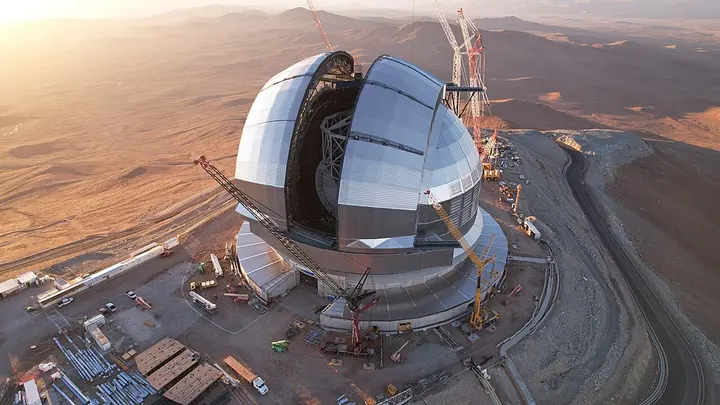
Whenever humanity has looked toward the sky, the curiosity to understand the unknown universe has grown. In the northern Atacama Desert of the South American country of Chile, an extraordinary optical telescope—a telescope that collects visible light to clearly display distant objects—called the Extremely Large Telescope (ELT) is being constructed. Being built under the aegis of the European Southern Observatory (ESO), this telescope will become the world's largest optical and mid-infrared extremely large telescope upon completion.
This telescope possesses the remarkable ability to collect 100 million times more light than the human eye. By the year 2025, the ELT will be able to gather approximately 10 times more light compared to the world's largest existing optical telescopes. Its light-collecting surface area is 250 times greater than that of the Hubble Space Telescope, and it has the capacity to provide images that are 15 times sharper and clearer than those of Hubble.

The primary objective of this telescope is to conduct an in-depth study of the atmospheres of exoplanets orbiting other stars. Furthermore, it aims to investigate the first galaxies formed in the universe, supermassive black holes, the mysteries of the universe's invisible dark matter and dark energy, and the detection of water and organic molecules from protoplanetary disks surrounding newly forming stars.
History of the Astronomical Telescope: From Galileo to Space Telescopes
The history of visible-light astronomy is as old as human civilization itself. Visible light has a wavelength of 380 to 750 nanometers. Before the invention of the telescope, astronomy was limited to observations made with the naked eye. The German-Dutch spectacle maker Hans Lippershey is credited with the invention of the first optical telescope, as he was the first to apply for a patent.
Building on this success, the physicist Galileo Galilei constructed a 3x magnification telescope in the year 1609 and later developed improved 30x versions. On August 25, 1609, Galileo demonstrated his telescope to Venetian lawmakers and, in March 1610, published his first astronomical observations in a book titled Sidereus Nuncius.
In the modern era, astronomical telescopes are divided into three main types: refracting telescopes (which use lenses and exhibit chromatic aberration, i.e., color defects), reflecting telescopes (which use mirrors and are the most widely used in scientific research), and catadioptric telescopes (which use a combination of both lenses and mirrors). To avoid atmospheric distortions and light pollution, NASA launched the Hubble Space Telescope into low Earth orbit in 1990. Currently, the largest ground-based telescopes with composite glass mirrors are the Keck Telescopes, the Gran Telescopio Canarias, and the Southern African Large Telescope, which have mirror diameters of around 10 meters.
ELT Site and Architecture: Construction on the Peak of the Atacama Desert
On April 26, 2010, the Council of the European Southern Observatory (ESO) selected Cerro Armazones, a mountain located 23 kilometers away from the Paranal Observatory in the Atacama Desert of northern Chile, for the construction of the ELT. Before selecting this site, locations such as Cerro Macon in Argentina, the Roque de los Muchachos Observatory in the Canary Islands, and sites in North Africa, Morocco, and Antarctica were considered.
Initially, this massive project was named the European Extremely Large Telescope (E-ELT), but in June 2017, the name was shortened to ELT. Due to the stability of the atmosphere and the arid climate on Earth, the Atacama Desert is considered the best place in the world for stargazing.
Initially, the Overwhelmingly Large Telescope (OWL), with a 42-meter diameter and 1,300 square meters of surface area, was considered with a 100-meter design, but this idea was abandoned due to an estimated cost of 1.5 billion euros and extreme complexity. Subsequently, the original 42-meter plan was reduced by 13% in 2011 and approved with a 39.3-meter diameter and 978 square meters of surface area.
Optical Design: The Science of 5-Mirror Technology
The greatest technical achievement of the ELT is its innovative 5-mirror anastigmat design. While most traditional telescopes use two mirrors, the ELT creates extremely sharp and clear images across a wide field of view of 10 arcminutes (one-third the width of the full moon) through a complex combination of five mirrors.
- Primary mirror (M1)The 39.3-meter mirror collects light from the sky and reflects it towards the secondary mirror.
- Secondary and tertiary mirrors (M2 and M3)The 4.25-meter M2 and 4.0-meter M3 mirrors direct light rays towards a clear and adapted point.
- Fourth mirror (M4 - Adaptive Optics)The 2.4-meter thin mirror changes shape 1,000 times per second with the help of 5,000 actuators to remove atmospheric distortion.
- Fifth mirror (M5) and Nasmyth focusThe M5 mirror stabilizes the image and sends light to the scientific instruments located on the side of the telescope.
The first three mirrors in the system (M1, M2, M3) are curved, collecting the light coming from the sky and focusing it at a specific point. The fourth mirror (M4) and the fifth mirror (M5) are flat. M4 actively corrects distortions caused by atmospheric turbulence, while M5 provides image stabilization by keeping the image free from movement. These mirrors direct the light toward two Nasmyth focal stations located on the side, where multiple large astronomical instruments can be mounted simultaneously.
| Mirror | Diameter (meters) | Type / Function | Specialty |
|---|---|---|---|
| M1 (Primary) | 39.3 | Main reflecting mirror | Made of 798 hexagonal segments |
| M2 (Secondary) | 4.25 | Convex | World's largest secondary mirror (3.5 tons) |
| M3 (Tertiary) | 4.0 | Concave | Creates aberration-free images for a wide field of view |
| M4 (Fourth) | 2.4 | Deformable | 1,000 changes per second with 5,000 actuators |
| M5 (Fifth) | Flat | Tip-tilt stabilization | Steadily directs light towards instruments |
Primary Mirror (M1): A Remarkable Combination of 798 Glass Segments
Manufacturing and transporting any single piece of glass with a diameter greater than 8 meters is impossible with current technology. Therefore, the ELT's 39.3-meter diameter primary mirror (M1) is being constructed by joining 798 small hexagonal segments. Each segment is 1.45 meters wide and 50 millimeters thick.
The contract for manufacturing these segments was awarded to the German company Schott AG, which has prepared the blanks from a glass-ceramic material called Zerodur that does not expand even slightly in response to temperature changes. Schott AG has produced a total of 798 main segments and an additional 133 maintenance segments. During working hours, 2 segments will be removed daily for re-coating and replacement, ensuring the telescope's surface remains clean and maximally reflective at all times.

The French company Safran Reosc received the contract to polish these mirrors, precisely polishing one segment per day to a surface irregularity of less than 7.5 nanometers root mean square. The 4,608 edge sensors were manufactured by the FAMES consortium, consisting of Fogale (France) and Micro-Epsilon (Germany), which measure the position of the segments with an accuracy of one-millionth of a millimeter. The 2,394 position actuators, built by CESA (Spain) and VDL (Netherlands), maintain the shape of the mirror against changes caused by wind, gravity, and temperature.
Adaptive Optics: The Art of Correcting Atmospheric Aberrations
When observing the sky from the ground, the Earth's atmosphere bends light rays, blurring the image. The ELT solves this problem through adaptive optics: an active glass correction system that removes atmospheric distortions.
The telescope is equipped with a fourth mirror (M4) that has a diameter of 2.4 meters and is only 2 millimeters thick. Behind M4 are approximately 5,000 small mechanical actuators, which make subtle changes to the shape of the mirror's surface 1,000 times per second in response to atmospheric turbulence.
In addition, the secondary mirror (M2) is the world's largest convex mirror, with a diameter of 4.25 meters and a weight of 3.5 tons, which was manufactured by Schott AG and polished to an accuracy of 15 nanometers by Safran Reosc. Supported by cells manufactured by the company SENER, both the M2 and the 4.0-meter diameter concave M3 mirror are held steady at 32 points. Combined with six laser guide star units, this system is capable of completely eliminating atmospheric blurring to provide images sharper than those of the Hubble Space Telescope.

Statistics, Cost, and Construction Timeline: Statistical Comparison
The entire ELT project is an extraordinary financial and engineering undertaking. In 2011, when the diameter of the glass was reduced from 42 meters to 39 meters, the estimated cost of the project decreased from 1.275 billion euros to 1.055 billion euros. According to 2017 estimates, the total cost of the telescope including first-generation instruments was 1.15 billion euros.
In December 2014, the ESO Council approved the first phase of construction after securing more than 90% of the funding. On May 26, 2017, the foundation stone for the observatory's main dome was laid. By July 2023, more than 50% of the telescope's construction work was completed. According to the latest schedule, the telescope's Technical First Light will occur in March 2029, and first scientific observations will begin in December 2030.
What does this revolution mean for India and the common man?
The Extremely Large Telescope is not just a laboratory for scientists, but a solution to questions linked to the existence of all mankind. The ELT may provide an answer to the centuries-old question, "Are we alone in the universe?" By detecting the presence of oxygen, water, or organic molecules in the atmospheres of Earth-like planets orbiting other stars, it will verify the possibility of life beyond Earth.
For astronomers and young researchers in India and other developing countries, this global project will create vast opportunities in the fields of data processing, adaptive optics, and advanced sensor technology. In the future, this technology will also be used in satellite communication, medical optical imaging, and atmospheric studies.