The Nuclear Powerhouse of Deep Space Missions: Engineering and Functionality of RTGs
How do spacecraft operating billions of kilometers from sunlight maintain a continuous power supply for decades? An in-depth analysis of the physics, history, and future technology of Radioisotope Thermoelectric Generators (RTGs).
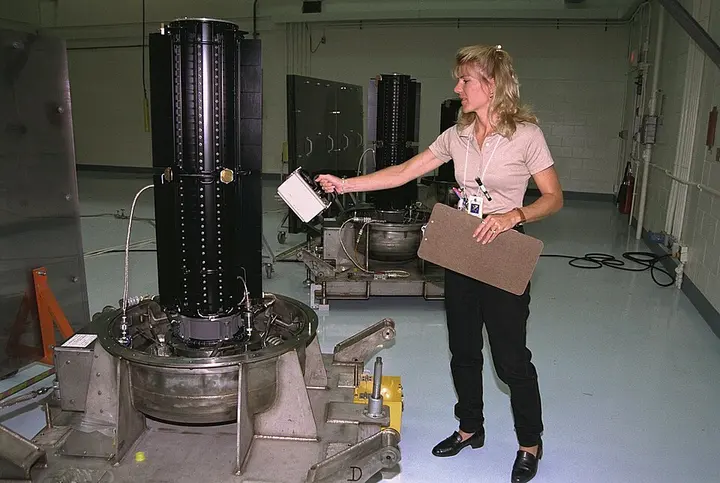
In space science, when a spacecraft travels toward the extreme outer reaches of the solar system, sunlight becomes so faint that even massive solar panels fail. In such harsh and dark environments, the task of keeping man-made instruments alive for decades is performed by the 'Radioisotope Thermoelectric Generator' (RTG), which is known in simpler terms as a 'nuclear battery' or Radioisotope Power System (RPS). This is a remarkable device that contains no moving parts, meaning there is no risk of its components wearing out or breaking down.
The fundamental principle of an RTG combines two highly complex scientific fields: the intense heat generated by radioactive decay and the 'Seebeck effect' of electrical engineering. Where conventional fuel cells, chemical batteries, or mechanical generators fail or become too heavy, this device provides hundreds of watts of electrical energy continuously for decades. For working without maintenance for years on the ground and in space, this system has proven to be a boon for space agencies worldwide.
The foundation of this technology was laid in 1954 by scientists Kenneth C. Jordan and John Birden at Mound Laboratories. For this invention, they were inducted into the 'National Inventors Hall of Fame' in 2013. Starting January 1, 1957, under a contract with the United States Army Signal Corps, intensive research began on generating electricity directly using thermocouples by utilizing polonium-210 as a heat source. Under an agreement with the U.S. Atomic Energy Commission and led by Dr. Bertram C. Blanke, the first practical RTG was developed in Miamisburg, Ohio.
- 1. Radioactive decayContinuous excessive heat is generated by natural alpha decay of radioactive fuel (such as Plutonium-238).
- 2. Temperature differenceA large temperature difference is created between the inner hot junction (fuel container) and the cold junction connected to the outer cooling grid.
- 3. Electric current via Seebeck effectUnder the Seebeck effect, electrons flow due to the temperature difference through the semiconductor roof of the thermocouple and electricity is generated.
- 4. Power distribution to instrumentsThe voltage generated by serially connected thermocouples is supplied to the spacecraft's cameras and instruments.
The first journey in the space sector took place in 1961, when the first RTG, named SNAP 3B, was launched on the U.S. Navy's Transit 4A satellite, using 96 grams of plutonium-238 metal. Following this, the Navy used RTGs on the ground at the desolate Fairway Rock in Alaska from 1966 to 1995. On the other hand, by the end of the 1980s, the Soviet Union had installed as many as 1,007 large RTGs (primarily of the Beta-M series) to power unmanned lighthouses and navigation beacons in the Arctic Circle region. After the dissolution of the Soviet Union in 1991, many generators were left abandoned, but through Russian and international efforts, all these units were safely decommissioned by 2021.
The United States Air Force also deployed between 100 and 150 ground-based and seafloor RTG units powered by strontium-90 for the 'Top-ROCC' and 'SEEK IGLOO' radar systems in Alaska during the 1970s and 1980s. At one time, an experiment to use small plutonium micro-batteries in cardiac pacemakers was also initiated in the medical field by Mound Lab on June 1, 1966. However, due to concerns regarding whether the nuclear fuel would remain safe during human cremation, this program was discontinued in 1972; by 2004, 90 such pacemakers remained in use, and by the end of 2007, only 9 were left.
In the space sector, the use of RTGs has been unparalleled. NASA's famous missions such as Pioneer 10 and 11, Voyager 1 and 2, Galileo, Ulysses, Cassini, and New Horizons, which traveled toward Pluto, were entirely dependent on RTG power. In the future, the Dragonfly mission to Saturn's moon Titan will also use an RTG. During the moon landings, RTGs named SNAP 27 were placed on all missions from Apollo 12 to Apollo 17 to operate equipment. However, when the Apollo 13 mission was aborted, its RTG sank into the depths of the Tonga Trench in the South Pacific Ocean. To operate rovers on Mars, RTGs were chosen instead of solar panels for Curiosity (which contains 4.8 kilograms of plutonium-238 dioxide) and the Perseverance rover, so that operations could continue for years even amidst dust storms.

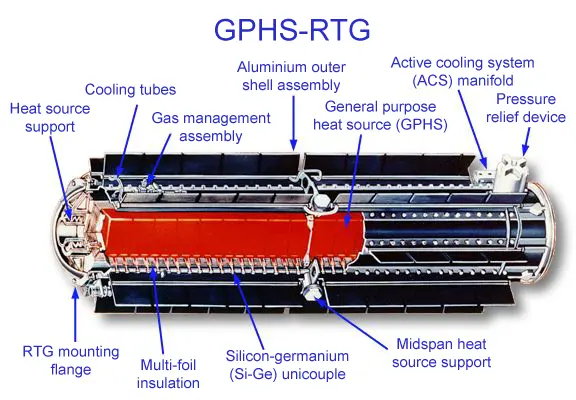
The construction of an RTG is very simple yet extremely robust according to nuclear technology standards. At its center is a strong container in which radioactive fuel is kept. Thermocouples are embedded in the walls of this container. The inner end of the thermocouple is connected to the hot fuel, and the outer end is connected to the external environment or radiator fins (heat sink). A thermocouple is a device made of semiconductor or metal that works on the physics principle known as the 'Seebeck effect.' When a large temperature difference is created between two metal junctions connected in a closed circuit, an electric current automatically begins to flow in the circuit. To obtain the desired voltage, hundreds of such thermocouples are connected in series.
It is crucial to understand here that an RTG is not a nuclear reactor. Nuclear power plants or reactors used in space (such as the Soviet Union's BES-5 Buk or America's SNAP-10A) operate on nuclear fission, that is, a chain reaction of atomic splitting. These can be controlled using neutron-absorbing control rods; their power output can be increased or decreased, or they can be shut down entirely. In contrast, no chain reaction occurs in an RTG. Heat is generated solely through the spontaneous decay of the fuel's atoms. The rate of this heat depends on the half-life of the fuel and cannot be increased, decreased, or stopped. Therefore, auxiliary rechargeable batteries must be used for additional power requirements, and the generator must be continuously cooled during launch. A meltdown or nuclear explosion is not possible in an RTG, but there is certainly a risk of radioactive contamination if a rocket explodes.
Great care must be taken when selecting fuel. The fuel's half-life (the time taken for the amount of substance to reduce by half) must be long enough to provide heat at a steady rate for decades. Space missions require fuel that provides high power density with low weight and volume. Additionally, the radiation emitted by the fuel should primarily be of the alpha decay type. If there is beta or gamma radiation, heavy shielding (layers of lead or heavy metals) must be constructed to block it, which increases the weight of the spacecraft. Plutonium-238 meets all these criteria.

Currently, due to a severe global shortage of Plutonium-238, scientists are working on RTGs with novel subcritical reactions. In this system, proposed in NASA's 2012 NSPIRE competition and studied by the Idaho National Laboratory's Center for Space Nuclear Research (CSNR) in 2013, a neutron source is created by reacting alpha particles emitted from plutonium with beryllium. By keeping the control factor Keff < 1, normal fission is generated through a subcritical process. Since the fission process releases 30 times more energy (200 MeV) compared to alpha decay (6 MeV), this system increases fuel efficiency by 10%, thereby reducing plutonium consumption.
In addition, for interstellar missions to extremely distant galaxies, such as the 'Innovative Interstellar Explorer' proposal that has been ongoing since 2003, Americium-241 (241Am) fuel was proposed in 2002. Because the decay rate of Americium is very slow, it can provide energy to a spacecraft for 1,000 years. In a 1999 proposal, the concept of powering an ion engine via 'Radioisotope Electric Propulsion' (REP) with the help of an Advanced Radioisotope Power Source (ARPS) was presented. These new horizons of technology show that when humanity sets out to navigate the dark latitudes beyond the solar system, it will be this nuclear heart that keeps its science and communication systems alive.