Humanity's Strong Arm in Space: Canadarm Technology and Its Remarkable Operation
An in-depth analysis of the design, engineering, and space operations of Canadarm2, operating on the International Space Station, and its predecessor, Canadarm1.

Whenever complex engineering is discussed in the history of space science, the name of the Canadarm is mentioned with pride. This is not merely a robotic arm, but a revolutionary enhancement in mankind's capability to work in space. From the construction of the International Space Station (ISS) to the repair of satellites, this Canadian technology has played a foundational role in every critical operation. According to Wikipedia reports, the genesis of this system began in 1969 when NASA invited Canada to participate in the space shuttle program.
The Canadian company DSMA ATCON had previously built a robot for refueling nuclear reactors, which caught NASA's attention. In 1975, an agreement was signed between NASA and the National Research Council (NRC) of Canada to develop this robotic arm. The main work of this project was entrusted to Spar Aerospace (currently MDA). The official name of the Canadarm was the 'Shuttle Remote Manipulator System' (SRMS), but during an event on February 11, 1981, it was officially named the 'Canadarm'. The Canadian flag and name were inscribed on this arm, which became Canada's identity in space.
The original Canadarm1 was structured much like a human arm, featuring parts like a shoulder, elbow, and wrist. Its length was 15.2 meters (50 feet) and its diameter was 38 centimeters (15 inches). This robotic arm weighed 410 kilograms on Earth, but in space it could handle payloads—equipment or satellites carried into space—weighing up to 29,000 kilograms. In the 1990s, its control system was upgraded, increasing its capacity to 266,000 kilograms. Interestingly, even though this arm could lift such massive weight in space, on Earth it cannot support its own weight.
The most important feature of the Canadarm is its joints. It had a total of six joints which provided it with 'six degrees of freedom'—six directions of movement. There were two joints near the shoulder (yaw and pitch), one joint at the elbow (pitch), and three joints at the wrist (pitch, yaw, and roll). Because of these joints, it could move with extreme precision in space. At the end of this arm was a special tool called the 'end effector', which performed the function of gripping objects.
| Detail | Canadaarm1 (SRMS) | Canadaarm2 (SSRMS) |
|---|---|---|
| Length | 15.2 meters | 17.6 meters |
| Weight (on Earth) | 410 kilograms | 1,800 kilograms |
| Joints | 6 | 7 |
| Main Material | Graphite Composite | Titanium |
| Diameter | 38 centimeters | 35 centimeters |
There is an interesting story behind the design of the end effector. Engineer Anthony Zubrzycki conceived this concept by wrapping rubber bands around his fingers. This design used three wires that would firmly grip the grapple fixture—a special point for holding—located on the payload. This design proved to be much more successful than other claw-like mechanisms. It was because of this end effector that the Space Shuttle was able to catch and repair delicate instruments like the Hubble Space Telescope.
- Engage gripOne end of the arm (LEE) connects to a Power Data Grapple Fixture (PDGF) on the station.
- Release other endOnce power is supplied, the other end releases from its previous connection.
- Move forwardThe free end swings through the air and moves toward the next PDGF on the station.
- New connectionThe other end grasps the new PDGF and the process starts again.
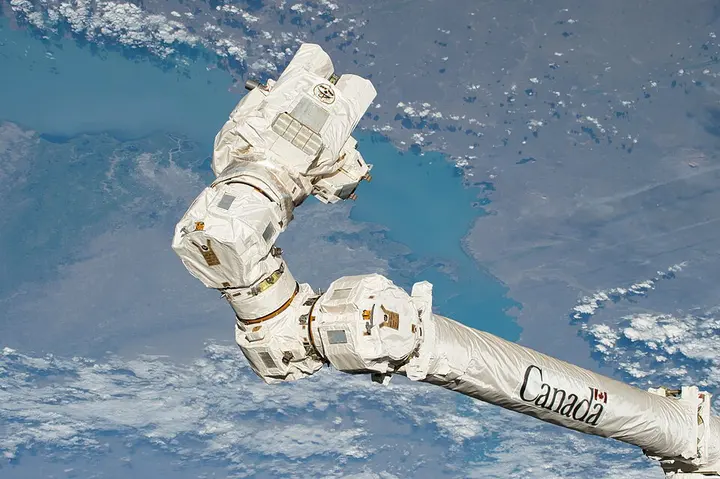
Following the success of Canadarm1, a more advanced 'Canadarm2' was developed for the International Space Station, officially known as the 'Space Station Remote Manipulator System' (SSRMS). Launched in April 2001, this arm is 17.6 meters (58 feet) long and weighs 1,800 kilograms. It is made of titanium metal. Canadarm2 is very different from its predecessor because it can move around the station from one place to another in an 'inchworm' fashion.
Latching End Effectors (LEEs) are located on both sides of Canadarm2. This means it can grab the Power Data Grapple Fixture (PDGF) on the station to receive its power and data. While one end is connected to the station, the other end can remain free to work. If it needs to move to another location, it connects the free end to another PDGF and releases the first end. In this way, it can reach anywhere across the entire space station. There is also a special rail system on the station for this movement, called the Mobile Base System (MBS).

The capacity of Canadarm2 is remarkable. It can handle payloads of up to 116,000 kilograms. It works by catching uncrewed cargo vessels like the SpaceX Dragon and Cygnus in space and attaching them to the space station. This process is called 'berthing'. When the robotic arms of both the Space Shuttle and the space station worked together, it was referred to in the media as the 'Canadian Handshake'.
The third important part of this robotic system is 'Dextre', which is also called the 'Special Purpose Dextrous Manipulator' (SPDM). Dextre is a small, two-armed robot that attaches to the end of Canadarm2. Its work is extremely delicate and precise, something previously only astronauts could do. It performs the task of replacing and maintaining exterior parts of the space station, which reduces the need for astronauts to undertake dangerous 'spacewalks'—walking outside the craft in space.
The Canadarm is operated from inside the space station via a 'Robotic Work Station' (RWS). There are two types of hand controllers here: one rotational and the other translational (for linear motion). Astronauts control this arm by viewing camera feeds on three LCD screens. However, most operations are now performed remotely from Earth by NASA's Mission Control Center or the Canadian Space Agency's John H. Chapman Space Centre. Astronauts take direct control of it only for time-sensitive tasks.

There are multiple systems in place for the safety of Canadarm2. If for any reason the arm were to get stuck and the space shuttle doors could not be closed, Canadarm1 featured an explosive-based mechanism to detach the arm from the vehicle. Canadarm2 is also fitted with thermal blankets to protect it from the extreme temperatures of space. In May 2021, a small piece of orbital debris collided with Canadarm2, damaging its thermal blanket and a boom (the long section of the arm), but its operation was not affected.
Five models of Canadarm1 were built, one of which was lost in the Challenger disaster. The remaining models are now on display in various museums. Canadarm2 is still operational and will also help connect modules of the Axiom Space Station in the future. Canada is now working on 'Canadarm3', which was to be prepared for the 'Lunar Gateway' to be built around the Moon, though according to recent reports, there is uncertainty regarding the future of this project.

The Canadarm is not just a machine, but a symbol of international cooperation. It has proven that with the help of robotics and artificial intelligence, humans can perform complex tasks even in the harsh environment of space. An image of Canadarm2 is also depicted on the Canadian five-dollar banknote, showing how much of a source of pride this technology is for the country. As we plan to venture to Mars and beyond, robotic systems like the Canadarm will become increasingly autonomous and powerful.