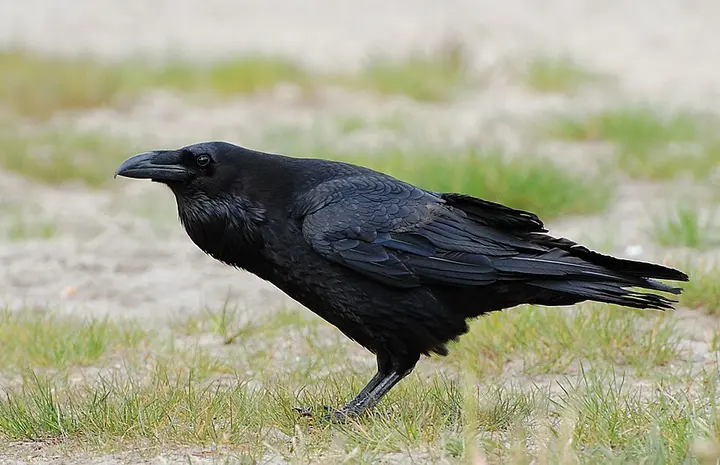
The Remarkable Intelligence of Crows: Ability to Make Decisions Twice as Fast as Humans and Monkeys
Researchers at the University of Tübingen in Germany have discovered that crows can process complex visual information and make decisions in just 235 milliseconds, demonstrating their extraordinary cognitive capacity.

We have all witnessed the agility of crows flying in the sky. Changing direction abruptly, sensing a potential threat, or swiftly snatching food fallen on the ground is a routine matter for them. However, new research by German scientists has proven that these birds are far ahead of humans and apes not only in flight, but also in their capacity for vision and decision-making. This discovery sheds light on the remarkable capabilities of avian brains and demonstrates that having a human-like brain is not a prerequisite for high intelligence.
This study, conducted by researchers at the University of Tübingen in Germany, was recently published in the prestigious journal 'Science'. According to this research, crows make decisions upon seeing a visual stimulus in just 235 milliseconds, which is approximately a quarter of a second. This speed is roughly double that of humans and apes. This means that by the time we see an object and begin thinking about it, a crow has already processed that information and responded.
For this research, scientists conducted experiments on two carrion crows (Corvus corone). A touchscreen was placed before the crows in a laboratory, displaying numerous moving dots. These dots were moving either to the left or to the right. The crows had to identify the correct direction of these dots and peck at a mark corresponding to that direction. This experiment was divided into two levels: easy and difficult.
In some patterns, the direction of the dots was completely clear, while in others it was very difficult to discern. Even so, the performance of the crows was stellar. When the direction was clear, their accuracy reached nearly 100 percent. Most importantly, even in difficult conditions, their responses were not mere guesses, but meticulously considered decisions. This demonstrates how sharp and precise the visual acuity of crows is.
The most startling aspect of the study is the speed at which their brains operate. Researchers recorded the activity of neurons in the crows' brains. They focused particularly on a region of the brain known as the 'Nidopallium caudolaterale' (NCL). This part of the avian brain plays a crucial role in processing information and making decisions. Interestingly, the function of this region is analogous to the 'prefrontal cortex' found in the human brain.
- Visual stimulusDots moving on the touchscreen appear in front of the crow's eyes.
- Neuron activationIn just 70 milliseconds, neurons in the NCL part of the brain begin to identify the direction.
- Information processingNeuronal activity in the brain increases and a decision about the direction is made.
- Physical responseIn a total of 235 milliseconds, the crow announces its decision by pecking in the correct direction.
Neuron recordings revealed that just 70 milliseconds after the moving dots appeared on the screen, the crow's brain begins to distinguish the difference between their directions. Following this, neural activity gradually increases, reaching a specific threshold to signal a decision. In other words, as soon as visual information is received, the brain activates immediately and arrives at a conclusion very rapidly. This process is so swift that it even outpaces the functioning of the mammalian brain.
Another aspect of this discovery is that bird brains do not possess a folded 'cerebral cortex' like humans and apes. Nevertheless, crows use the same foundational principles for processing information and making decisions that are found in mammals. This means that a human-like brain structure is not essential for complex thinking and rapid decision-making. Nature has provided birds with a different type of brain architecture, yet it enables them to perform extremely complex tasks very quickly.
Scientists believe that this remarkable speed in crows is linked to their lifestyle. During flight, they must avoid airborne obstacles, change direction suddenly, and keep track of every movement around them. While searching for food on the ground, they also need to recognize objects quickly and peck in the right spot. Even a fraction of a second's delay can pose a threat to their life or result in losing food. Due to these demands, their visual and decision-making capabilities evolved extensively during the course of evolution.
| Species Name | Maximum Weight (grams) | Maximum Length (cm) |
|---|---|---|
| Common Raven | 1400 | 65 |
| Dwarf Jay | 41 | 21.5 |
| American Crow | --- | --- |
Crows are members of the 'Corvidae' family, which includes birds such as ravens, rooks, magpies, and jays. This family comprises a total of 135 species, of which about 47 species belong to the 'Corvus' genus. These birds possess exceptionally large brains relative to their size. Their brain-to-body mass ratio is comparable to that of non-human great apes and whales, which is only slightly less than that of humans.
According to a Wikipedia report, crows are not only fast, but they are also extremely intelligent. They can make and use tools. They can recognize human faces and remember them for a long time. Not only that, if there is a threat from a specific person, they share that information with other crows as well. Crows live in social groups and communicate with each other through various types of sounds. This social structure also plays a major role in the development of their intelligence.

Birds of the Corvidae family are found in almost all parts of the world. The largest bird of this family is the 'Common Raven' (Corvus corax), which can weigh more than 1,400 grams and has a length of up to 65 centimeters. On the other hand, the 'Dwarf Jay' (Cyanolyca nanus) is the smallest bird of this family, weighing only 41 grams and measuring 21.5 centimeters in length. A major reason for the success of crows is their omnivorous diet. They easily subsist on insects, fruits, seeds, and meat as well as human food.
| Bird Name | Weight and Length |
|---|---|
| Common Raven | Weight over 1,400 grams, length 65 cm |
| Dwarf Jay | Weight 41 grams, length 21.5 cm |
However, scientists do not yet fully understand how a crow's brain processes information so much faster than humans. This study was based on only one specific type of visual test, so it would be premature to say that crows are faster than humans in every type of decision. But this research illustrates a bigger point: intelligence can take many forms. Even an ordinary crow flying in the sky can explain to science how wondrous and diverse the brain machinery created by nature can be.
In the future, similar research will be conducted on other birds to provide a clearer picture of avian brain efficiency. For now, this research has proven that 'crows are clever' is not just a story, but a scientific truth. Their high speed and accuracy give us a new perspective to understand the diversity of the brain and the wonders of evolution.