Successful Landing of Rafale-M on INS Vikrant: A New Era for Indian Naval Power
The first successful test flight of the French Rafale-M fighter jet on India's first indigenous aircraft carrier, INS Vikrant, has elevated India's defense capabilities to a new global benchmark.

The 29th of October has been recorded as a landmark event in the history of the Indian Navy. On this day, a French-made Rafale-M (Marine) fighter jet successfully landed on India's pride, the indigenous aircraft carrier INS Vikrant. This landing was not merely a procedure, but the beginning of an extremely powerful alliance for the security of India's maritime borders. This complex operation was carried out under the leadership of Captain Ashok Rao, the Commanding Officer of INS Vikrant. With this success, the Indian Navy is now ready to establish its dominance at sea through the synergy of cutting-edge French technology and Indian engineering.
According to a Livemint report, the Rafale-M made a safe landing on the deck of INS Vikrant on its very first attempt. This test is significant because landing on an aircraft carrier is many times more difficult than landing on a land-based runway. A ship constantly moving on ocean waves and a runway of limited length put the pilot's skill and the aircraft's technology to a rigorous test. This successful landing proves that the Rafale-M and INS Vikrant are perfectly capable of operating together. The video released by the Navy captures this historic moment, which is a symbol of the growing strength of the Indian defense sector.
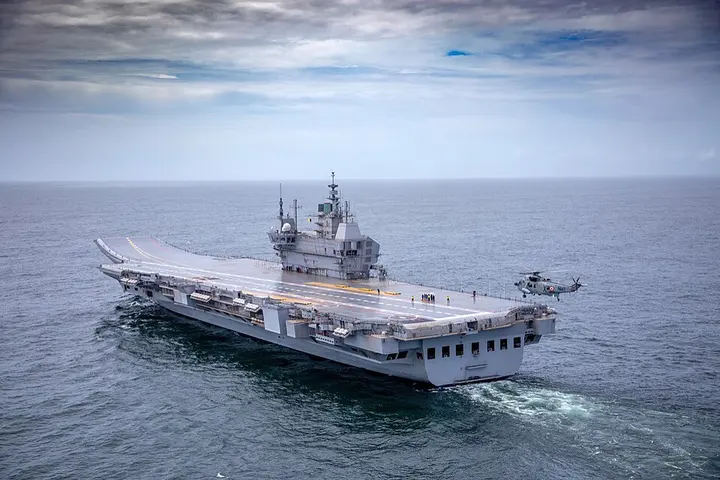
Examining the background of this entire project, INS Vikrant is India's fourth aircraft carrier and the first to be built entirely within the country. According to Wikipedia data, this ship was constructed by Cochin Shipyard Limited (CSL). The name 'Vikrant' is derived from a Sanskrit word meaning 'courageous'. The ship's motto is 'Jayema Sam Yudhisprudhah', which means 'I defeat those who dare to challenge me'. The design work for this ship began in 1999, and its keel laying commenced in 2009. It was commissioned into the Navy in 2022, and since then, it has remained the focal point of India's maritime power.
| Detail | Criteria / Figure |
|---|---|
| Length | 262 meters |
| Maximum speed | 28 knots (52 km/h) |
| Endurance | 7,500 nautical miles |
| Crew (number of sailors) | 1,700 |
| Total compartments | 2,300 |
| Power plant | 4 GE LM2500 gas turbines |
The Rafale-M, or Rafale Marine, is the naval version of the Rafale fighter jet manufactured by the French aerospace company Dassault Aviation. In April 2025, the Government of India signed a defense deal worth approximately ₹63,000 crore with France to purchase 26 Rafale-M jets. This package includes 22 single-seat fighter aircraft and 4 twin-seat trainer aircraft. The contract encompasses not only the aircraft but also pilot training, flight simulators, state-of-the-art weaponry, and long-term maintenance support. Delivery of these aircraft is expected to begin in late 2028 or early 2029.
- ApproachThe pilot brings the aircraft towards the deck at a precise angle according to the ship's speed and wind direction.
- Hook DeploymentA strong steel hook at the rear of the aircraft is deployed downwards.
- Arrestor Wire CatchDuring landing, the aircraft's hook catches one of the three-four strong wires laid on the deck.
- Rapid DecelerationDue to the tension of the wire, the aircraft comes to a halt extremely quickly (in seconds).
Technically speaking, the Rafale-M has been specifically designed to operate from aircraft carriers. Compared to standard land-based fighter jets, carrier-based aircraft must withstand the heavy shocks encountered during landing. The STOBAR (Short Take-Off But Arrested Recovery) method is used for landing on the INS Vikrant. In this method, the aircraft takes off from a short runway, and during landing, the aircraft's hook catches onto strong wires on the ship's deck, bringing it to a halt in seconds. Trials of the Rafale-M are being conducted to verify the precision of this process, ensuring there is no room for error in combat-like situations.
વિમાનોની સંખ્યા
The scale of the INS Vikrant can be gauged from its statistics. The ship is 262 meters long and has a top speed of 28 knots (approximately 52 km/h). Once refueled, it can travel up to 7,500 nautical miles (approximately 13,900 km). The ship contains about 2,300 compartments and can accommodate 1,700 crew members. Furthermore, it features a modern hospital complex and separate cabins for female officers. Four General Electric LM2500 gas turbines are used to power the ship, providing it with immense strength at sea.
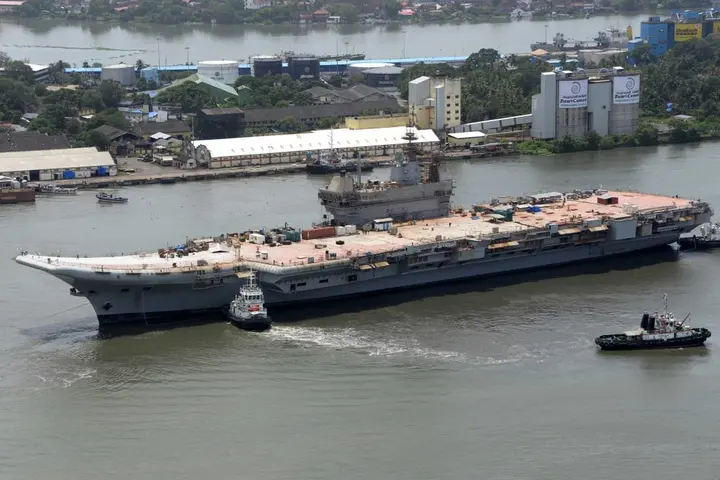
The arrival of the Rafale-M will multiply the Indian Navy's multirole capabilities. This aircraft is capable of not only air defense but also maritime strike, reconnaissance, and attacking ground targets. These aircraft will serve as a protective shield for the naval fleet. India currently has two active aircraft carriers: INS Vikrant and INS Vikramaditya. The Rafale-M will be able to operate from both these ships, which will extend India's strategic reach across the Indian Ocean and beyond.
Under India's 'Atmanirbhar Bharat' initiative, this agreement also includes provisions for technology transfer. This means that in the future, it will be easier to integrate Indian-made weapons with the Rafale-M. This will reduce India's foreign dependency in the defense sector and provide a boost to domestic industries. According to a PIB report, the total cost of this project has been approximately ₹23,000 crore (construction cost), which is a testament to India's engineering capability. Following the successful testing of the Rafale-M, the Navy will now move forward with the process of making these aircraft fully operational.
Ultimately, this union of the Rafale-M and INS Vikrant is not just a combination of two machines, but a demonstration of India's growing military strength and its ability to adopt modern technology. When the full fleet of these aircraft arrives in India in 2028-29, the Indian Navy will emerge as one of the most powerful navies in the world. To maintain peace on the seas and provide a befitting reply to enemies, this pair will remain a guardian of India for decades to come. This success is the result of the hard work of India's defense scientists, engineers, and naval personnel, which lays the foundation for a secure India of tomorrow.