A Colossal Instrument Listening to the Universe's Invisible Sounds: The Operational Mechanics of the Very Large Array (VLA) Radio Telescope
A detailed explanation of how 27 massive antennas located in the New Mexico desert unite to unlock the deep mysteries of space.

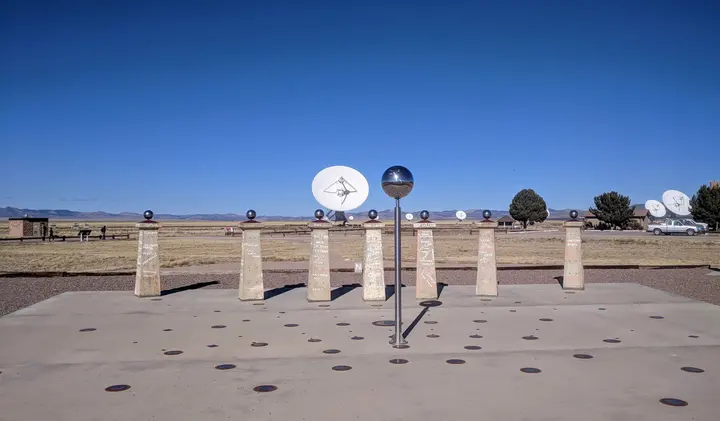
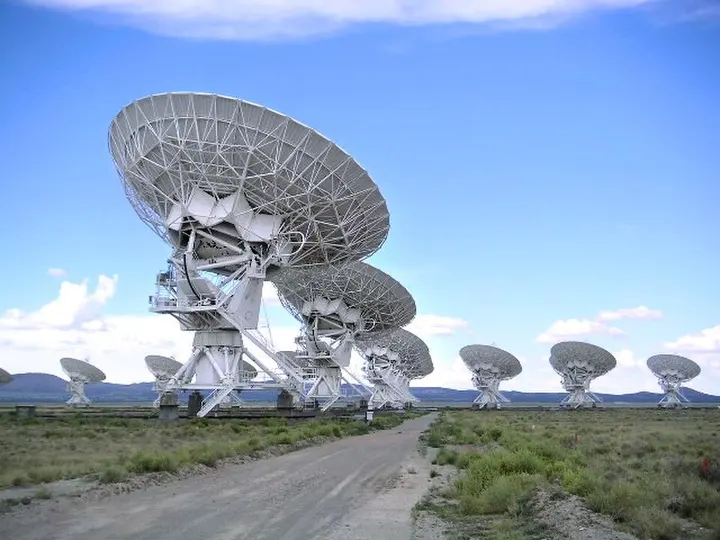
On the vast plains of San Agustin in New Mexico, 27 giant white dishes can be seen arranged in a precise pattern. These are no ordinary antennas, but the most powerful radio telescope in human history, known as the Karl G. Jansky Very Large Array (VLA). Built in the 1970s, this observatory is still considered the world's most important instrument in the field of radio astronomy. Instead of light waves, it captures radio waves emanating from celestial objects, which our eyes cannot see.
Radio astronomy began accidentally in 1933 by Karl Jansky, an engineer at Bell Telephone Laboratories. He was tasked with investigating noises that were disrupting transatlantic voice transmissions. Jansky observed that a specific type of hiss repeated every 23 hours and 56 minutes. This period was exactly one 'sidereal day,' which is the time it takes for the Earth to complete one rotation relative to the stars. This proved that the noise was not coming from the Sun, but from the center of our Milky Way galaxy. In honor of this discovery, the unit for measuring the intensity of radio waves has been named the 'Jansky' (Jy).
Radio telescopes work differently than standard optical telescopes. Light waves are very short, while radio waves can range from centimeters to meters in length. To capture these long waves, the size of the telescope must also be very large. If we want a clear image of a star, the radio telescope's dish would need to be kilometers long, which is impossible to build. The solution to this problem lies in a method called interferometry, which the VLA utilizes.
- Signal ReceptionRadio waves coming from celestial objects are captured by 27 dishes.
- Data TransmissionThese waves are sent to a central supercomputer via optical fiber.
- CorrelationA machine called a 'correlator' compares and mixes the signals from all antennas.
- Image SynthesisThrough mathematical processes, this data is converted into a high-resolution image.
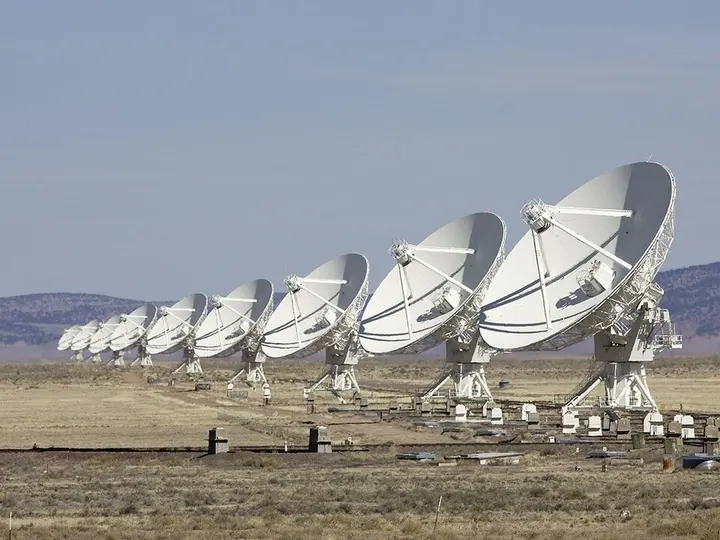
The VLA uses 27 independent antenna dishes, each 25 meters in diameter, arranged in the shape of the English letter 'Y.' Each of these dishes weighs 209 metric tons. With the help of interferometry, all these antennas work together as a single massive telescope. When two separate antennas capture waves coming from the same celestial object, their signals are combined. This process is called aperture synthesis. This increases the resolution of the telescope—that is, the clarity of the image—as if it were a single dish as large as the distance between the antennas.

The most significant feature of the VLA is its railway tracks. Each antenna is mounted on double parallel railway tracks, which allows them to be moved as needed. Using a special locomotive called 'Hein's Trein', these antennas are shifted into four main configurations, known as A, B, C, and D configurations. In the A configuration, the antennas are spread out over 21-kilometer-long arms, which are used to observe extremely fine details. Conversely, in the D configuration, all antennas are densely packed within 600 meters of the center, which is useful for observing large portions of the sky. The VLA cycles through all these stages every 16 months.
| Detail | Current VLA | Future ngVLA |
|---|---|---|
| Number of antennas | 27 (operational) | Over 260 |
| Dish diameter | 25 meters | 18 meters (main array) |
| Frequency range | 74 MHz to 50 GHz | 1.2 to 116 GHz |
| Estimated cost | $78.5 million (1980) | $2 billion (construction) |
From a scientific perspective, the VLA has achieved many milestones. It has observed the rotation of gases around black holes and the protoplanetary disks forming around new stars. In 1989, when the Voyager 2 spacecraft passed by the planet Neptune, the VLA was used to capture its weak radio signals. Furthermore, through the 'VLA Sky Survey' (VLASS), which began in 2017, 80% of the sky is being scanned, with the expectation of discovering 10 million new celestial objects.
સાપેક્ષ સ્કેલ
With the development of technology, the VLA has also been upgraded. In a project that ran from 2001 to 2012, its old electronic systems were replaced with state-of-the-art equipment, increasing its capacity by 8,000 times. Now, scientists are planning to go even further by building the Next Generation Very Large Array (ngVLA). According to an announcement in June 2023, this new project will feature more than 260 antennas spread across North America. This new telescope will be 10 times more sensitive than the current VLA and will be able to operate at frequencies from 1.2 to 116 GHz.
Construction of the ngVLA is expected to begin in late 2028, with initial scientific operations starting by 2031. The project will cost approximately $2 billion. Germany is also contributing to this, with the University of Würzburg building the Wetterstein Millimeter Telescope (WMT), which will become part of the ngVLA. With such immense sensitivity, scientists will be able to search for the universe's oldest stars and perhaps even signals from extraterrestrial civilizations.
| Configuration | Description | Maximum Distance |
|---|---|---|
| A | Largest and most spread out form | 21 km (each arm) |
| D | Densest and smallest form | 600 meters (from center) |
| Hybrid | For specific celestial objects | Various |
The VLA is a center of attraction not only for scientists but also for tourists. Located 80 km from the city of Socorro in New Mexico, this site is open to visitors, featuring a small museum and a self-guided walking tour facility. However, due to the desert environment, the weather here remains highly variable. Completed in 1980 at a cost of $78.5 million, this complex remains a symbol of human curiosity today, revealing to us secrets of the universe that could never have been known with the help of light.